

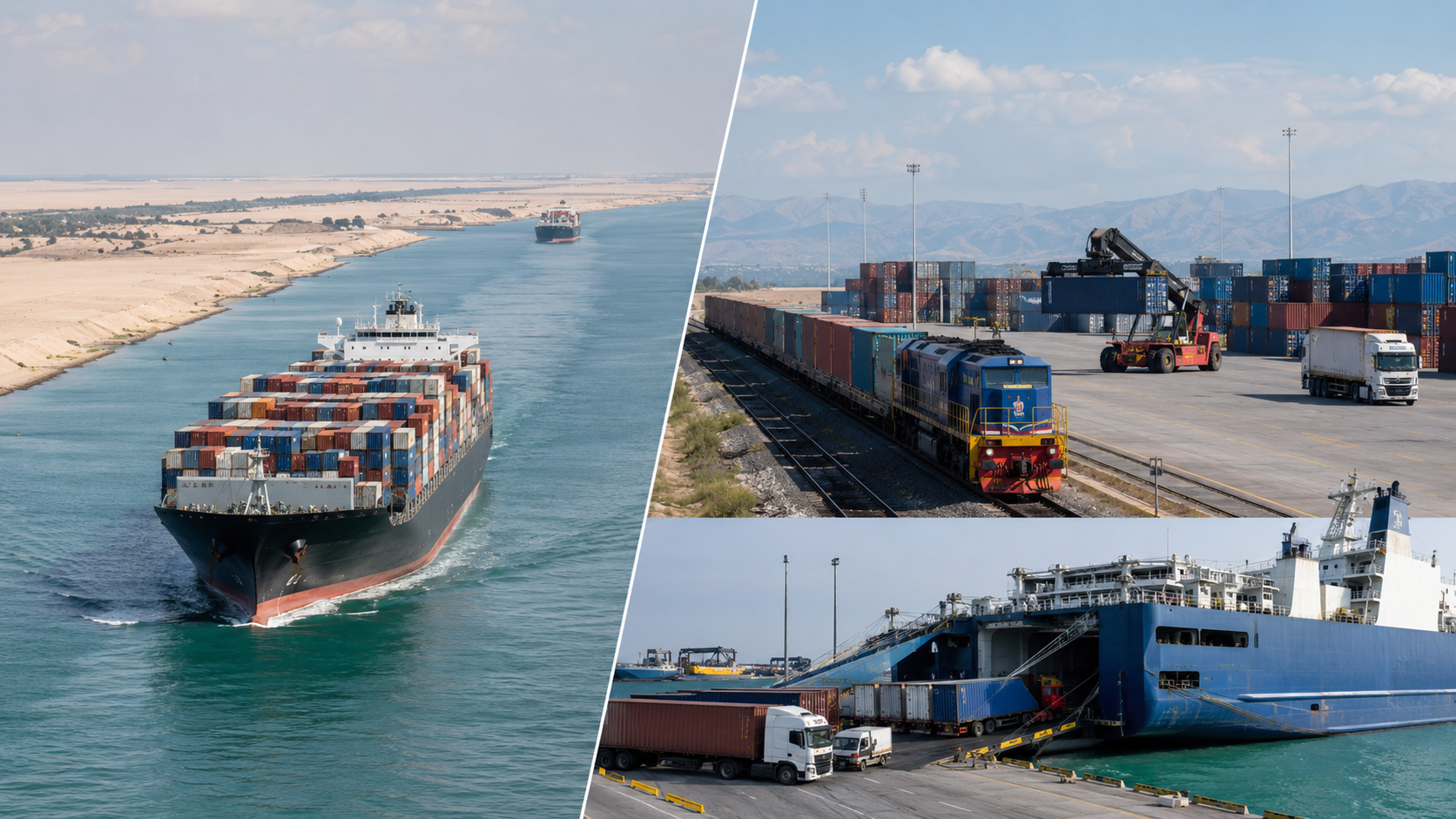
Сan the Middle Corridor truly compete with the Suez Canal and the traditional northern rail route through Russia?
The answer depends not only on geopolitics but also on economics, infrastructure, and operational reliability.
As K2Cargo News recently reported in “Can the Middle Corridor Become Eurasia’s Main Alternative?”, Kazakhstan, Azerbaijan, Georgia and Türkiye continue investing heavily in ports, railways and digital logistics systems. However, infrastructure alone does not automatically make a transport corridor competitive.
Speed Is the Corridor’s Main Advantage—In Theory
Compared with maritime transport through the Suez Canal, the Middle Corridor promises significantly shorter transit times.
Most logistics operators advertise delivery times between China and Europe of approximately 20 to 30 days, making the route attractive for cargo that cannot justify expensive air freight but requires faster delivery than traditional ocean shipping.
Electronics, automotive components, consumer goods, industrial equipment and time-sensitive cargo are among the products that could benefit most from shorter transit.
However, advertised transit times do not always reflect operational reality.
Several logistics companies report that deliveries may occasionally require 50–70 days due to congestion, weather conditions, ferry delays or customs procedures. Unlike traditional rail routes through Russia, the Middle Corridor combines rail, maritime transport and multiple border crossings, making coordination considerably more complex.
Every Additional Border Means Additional Risk
The route crosses several independent customs territories.
Cargo leaving China enters Kazakhstan before crossing the Caspian Sea to Azerbaijan. It then continues through Georgia and Türkiye before reaching European markets.
Each border introduces potential delays caused by customs inspections, documentation requirements, railway coordination or administrative procedures.
Although participating countries continue harmonizing digital customs systems, documentation and scheduling, complete integration has not yet been achieved.
As a result, transport reliability often depends as much on administrative efficiency as on infrastructure itself.
The Caspian Sea Remains the Biggest Bottleneck
The maritime crossing between Kazakhstan and Azerbaijan continues to represent the most vulnerable part of the entire corridor.
Unlike continuous railway transport, the Caspian crossing depends on ferry schedules, weather conditions, vessel availability and port capacity.
Strong winds or storms may delay departures for several days.
When ferries are delayed, containers accumulate in ports, affecting railway schedules on both sides of the sea.
Although Kazakhstan and Azerbaijan continue expanding ferry capacity and port infrastructure, demand has increased almost as quickly as investment.
This makes the Caspian crossing one of the main operational challenges for logistics companies planning regular services.
Why the Northern Route Is Still Faster
Before geopolitical tensions fundamentally changed Eurasian logistics, containers could travel from central China to Poland through Kazakhstan, Russia and Belarus in approximately two weeks.
The northern corridor offered a continuous railway connection with relatively few interruptions.
The Middle Corridor cannot currently match this level of operational simplicity.
Two maritime crossings, multiple railway operators, changing gauge systems, customs procedures and multimodal handling inevitably increase transit complexity.
This does not mean the corridor is ineffective.
Instead, it serves a different purpose: diversification rather than replacement.
Can the Middle Corridor Compete with Suez on Price?
Cost remains another important challenge.
Industry estimates indicate that transporting a forty-foot container via the Middle Corridor may still cost almost twice as much as shipping the same container from Asia to Europe through the Suez Canal during periods of stable maritime freight rates.
Ocean shipping benefits from enormous economies of scale.
Ultra-large container vessels transport more than 20,000 TEU on a single voyage, while multimodal corridors require repeated handling, rail transfers and ferry operations.
Every additional handling operation increases cost.
For low-value bulk cargo such as raw materials, agricultural products or basic industrial goods, maritime shipping therefore remains significantly more economical.
Which Cargo Benefits Most?
The Middle Corridor is best suited for cargo where time has measurable commercial value.
Consumer electronics, machinery, automotive components, pharmaceuticals, fashion products and higher-value industrial goods can justify higher transport costs if faster delivery improves inventory management or reduces production downtime.
Companies serving Central Asia, the South Caucasus or Türkiye also benefit because the corridor directly connects these growing markets.
By contrast, oversized cargo, heavy industrial equipment and low-margin commodities usually remain better suited for maritime transport.
Frequent transshipment increases both handling costs and operational risk.
Geopolitics Has Changed Supply Chain Thinking
The Middle Corridor exists today not because it is always cheaper or faster, but because global supply chains have changed.
Companies increasingly evaluate logistics through the lens of resilience rather than pure transport cost.
Disruptions in the Red Sea, uncertainty surrounding the Strait of Hormuz, sanctions affecting Russian transit and broader geopolitical tensions have encouraged many multinational companies to diversify transport routes.
As K2Cargo News recently explained in its analysis of maritime security in the Strait of Hormuz, route diversification has become an essential component of modern supply-chain risk management.
For many international manufacturers, paying slightly more for transportation is increasingly viewed as insurance against future disruption.
The Future Depends on Reliability, Not Headlines
The Middle Corridor has already proven that it is more than a geopolitical concept.
Cargo volumes continue growing.
Governments continue investing.
Private logistics operators continue expanding services.
Yet long-term success will depend less on political declarations than on operational performance.
If participating countries can reduce border delays, increase ferry capacity, harmonize customs procedures and digitalize cargo documentation, the corridor will become increasingly attractive.
If these challenges remain unresolved, the route will continue serving mainly niche cargo and regional trade flows.
The future of Eurasian logistics is unlikely to depend on a single corridor.
Instead, global supply chains are moving toward a network of complementary routes.
Within that network, the Middle Corridor is becoming an increasingly important strategic option—not because it replaces every alternative, but because it gives shippers one more reliable choice.
Read also: Can the Middle Corridor Become Eurasia’s Main Alternative?