

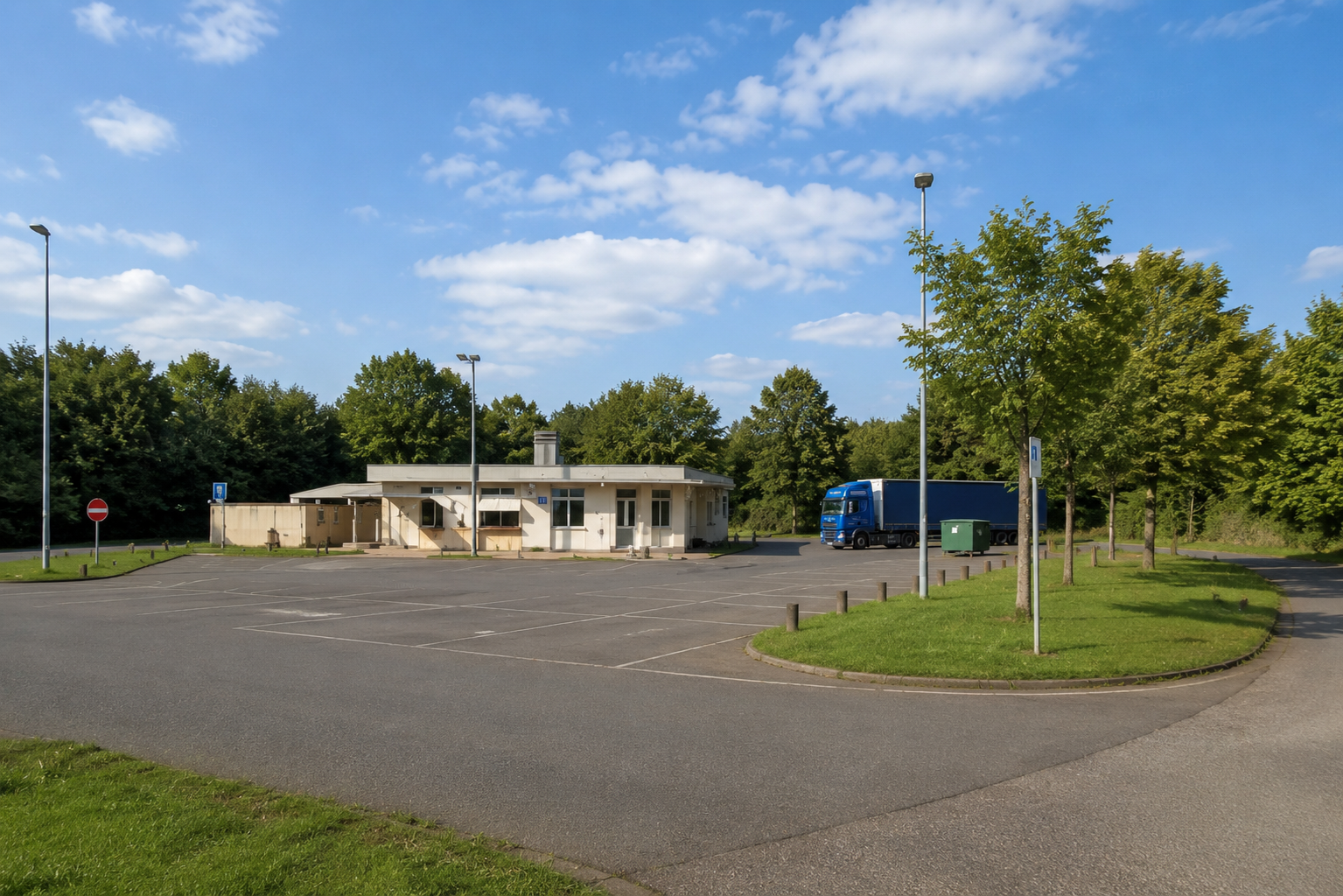
France has closed the Chevries rest area on the D962 road between Laval and Mayenne, creating concern among local businesses and professional drivers who rely on parking capacity along one of the department’s busy freight routes.
The region in question is the Mayenne department in western France, in the Pays de la Loire region. The affected road section connects Laval and Mayenne, and local authorities estimate that around 3,000 trucks use this route every day.
The closure came into effect on July 1, 2026. According to local officials cited by the French road transport publication Routiers.com, the decision was linked to maintenance costs, poor sanitary conditions and repeated concerns about antisocial behavior and potentially illegal activity in the area.
For transport operators, the closure may look like a small local infrastructure decision. In practice, however, it touches on a much larger problem across Europe: the shortage of safe, accessible and properly maintained rest areas for truck drivers.
As K2Cargo News previously reported in “Nearly Half of Trucks Inspected in France Violated Driver Rest Rules”, rest-time compliance remains a major enforcement issue in France. The closure of roadside parking areas makes that challenge even more complicated.
A Local Decision With Regional Consequences
The Chevries rest area was located on the D962 in the Laval–Mayenne direction. While not one of France’s largest motorway service areas, it played an important role for drivers moving through the department.
According to the local authority, maintaining the site cost almost €10,000 per year. Officials also pointed to the poor condition of the toilets, which were reportedly built in the 1980s or 1990s and would require substantial investment to renovate.
The department argued that such investment was not justified given its medium-term infrastructure plans. As a result, the rest area was closed rather than upgraded.
From a budget perspective, the decision may appear rational. Maintaining old facilities with limited resources can be expensive, especially when sanitary blocks, waste management and security problems require constant attention.
But for truck drivers, a closed rest area does not eliminate the need to stop. It simply shifts that need somewhere else.
Around 3,000 Trucks Use the Route Every Day
The D962 between Laval and Mayenne is not a minor local road from a freight perspective.
With around 3,000 trucks reportedly passing through each day, the route plays a significant role in regional goods movement. Even if only a small share of drivers need to stop, the availability of rest space matters.
Truck drivers operate under strict driving and rest time rules. They cannot simply continue driving indefinitely because a parking facility has closed. If drivers cannot find a legal or suitable place to stop, they may face a difficult choice: continue driving while tired, park in an unsuitable location or risk violating rest-time requirements.
This is why rest areas are not only a comfort issue. They are part of road safety infrastructure.
A parking space with toilets, lighting and safe access can reduce fatigue, stress and illegal stopping. Removing such infrastructure can create pressure elsewhere on the network.
Local Restaurant Fears Parking Overflow
One of the immediate concerns comes from the owners of La Marmite, a restaurant located near the D862 about seven kilometers from the closed Chevries rest area.
The restaurant has a private parking area, and its owners fear that truck drivers who previously used Chevries may now try to stop there instead. This could create overcrowding and operational problems for a business that was not designed to absorb displaced parking demand from a public rest area.
The situation is made more difficult by the fact that, according to local reports, there is no other truck parking area between the restaurant and the town of Mayenne.
This is a familiar pattern in many European regions. When public or roadside parking capacity is reduced, pressure often shifts to private facilities, fuel stations, restaurants, industrial zones or road shoulders.
For private businesses, this can create conflicts. They may benefit from truck driver customers, but they may also face congestion, sanitation issues, parking management problems and complaints from other users.
Safe Parking Is a Road Safety Issue
The closure of Chevries comes at a time when driver fatigue and safe parking shortages are receiving more attention across Europe.
DEKRA’s 2026 Road Safety Report, focused on “Working in Road Traffic,” highlights the risks faced by people whose workplace is the road, including professional truck drivers. The report points to time pressure, irregular working hours, monotonous driving environments, lack of rest time and high performance demands as factors that contribute to stress and fatigue.
A DEKRA survey of professional drivers also found that a large share of respondents regularly parked in hazardous places in order to comply with rest-period rules. Many drivers reported driving additional distances in search of parking.
This creates a paradox for the transport sector. Regulations require drivers to rest, but infrastructure does not always provide enough safe places to do so.
If rest areas close without replacement capacity, the gap between legal requirements and practical conditions becomes wider.
The Cost Question Is More Complex Than Maintenance
The department’s maintenance-cost argument is understandable. Public authorities have limited budgets, and old facilities can be expensive to repair.
However, the true cost of rest-area closure is not limited to the €10,000 annual maintenance figure.
If drivers are forced to stop in unsafe locations, the risk may shift to road shoulders, village entrances, private parking lots or industrial estates. This can create new costs for police, municipalities, businesses and road users.
If fatigue increases, the potential consequences are much more serious. Accidents involving heavy goods vehicles can lead to road closures, injuries, cargo losses, insurance claims and major disruption.
From a logistics perspective, safe parking should be treated as part of freight infrastructure, not as an optional roadside service.
What This Means for Carriers
For transport companies using the Laval–Mayenne corridor, the immediate consequence is the need to review route planning.
Dispatchers and drivers should know that the Chevries rest area is no longer available and identify alternative stopping points before reaching the route. This is especially important for drivers approaching the end of their legal driving time.
Fleet operators may also need to update internal instructions and navigation systems. If drivers continue to rely on outdated parking information, they may arrive at a closed site with limited remaining driving time.
For carriers, such situations create compliance risk. A single closed rest area may not seem critical, but repeated parking uncertainty across routes can make rest-time planning more difficult.
As K2Cargo News noted in its coverage of French inspections, enforcement authorities are paying close attention to driver rest rules. That makes access to suitable parking even more important.
Europe Needs a Better Parking Strategy
The Chevries closure is a local story, but it reflects a Europe-wide problem.
Road freight depends on drivers being able to stop safely, legally and predictably. Yet parking infrastructure often receives less attention than roads, toll systems and traffic restrictions.
This imbalance matters. A transport corridor is only as reliable as its weakest operational point. If drivers cannot find rest areas, the efficiency of the whole route suffers.
Authorities may have legitimate reasons to close outdated facilities, especially where sanitation, security or public-order problems exist. But closures need to be matched with broader planning. Otherwise, the problem is displaced rather than solved.
For France and other European countries, the future of truck parking will require more than isolated local decisions. It will require coordination between departments, road operators, municipalities, private businesses and the transport industry.
The closure of the Chevries rest area shows how even a small roadside facility can become part of a much larger debate about safety, working conditions and the resilience of freight transport.
Read also: Nearly Half of Trucks Inspected in France Violated Driver Rest Rules