

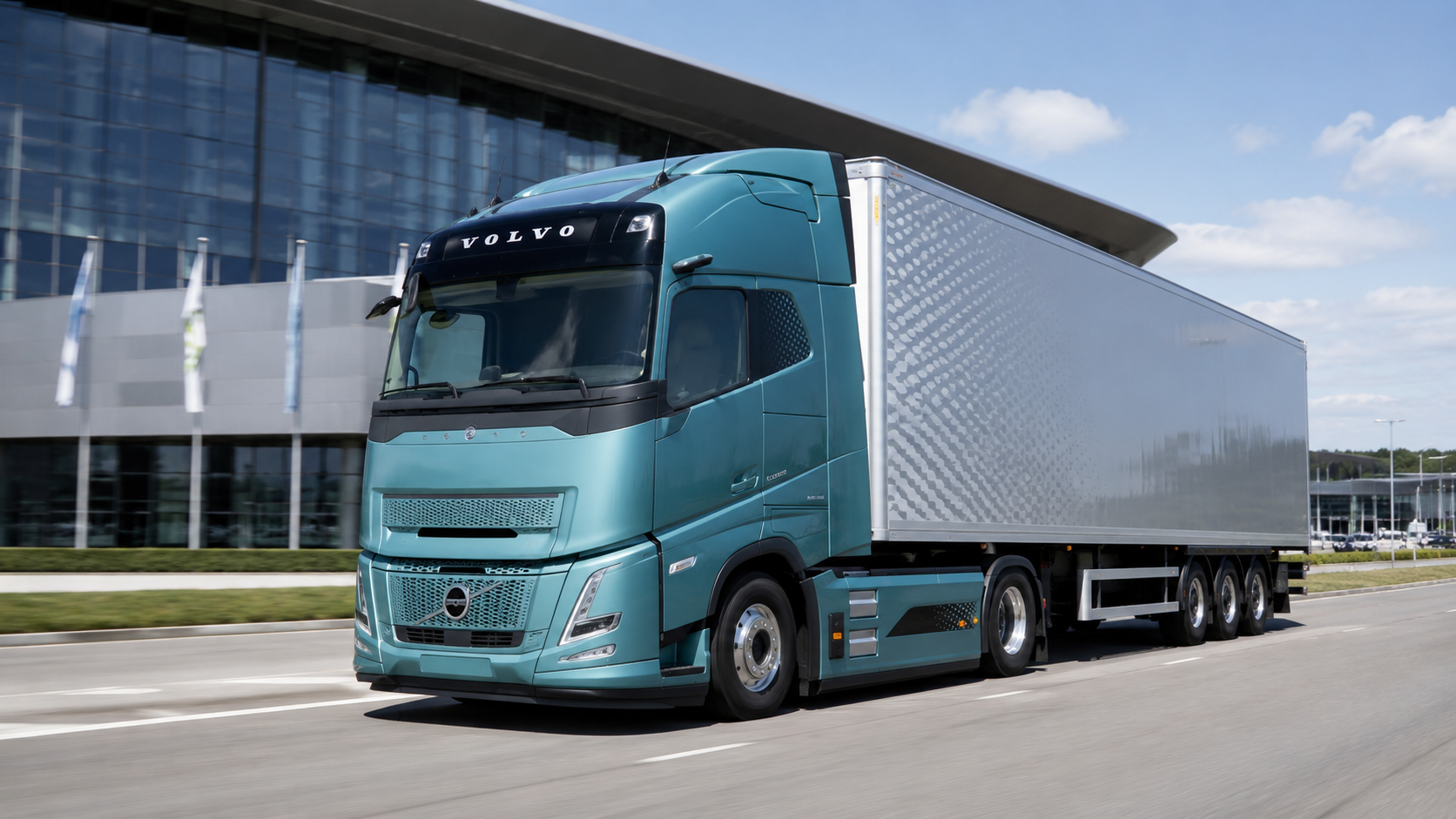
Volvo Trucks is preparing one of its most important technology presentations of 2026. At IAA Transportation in Hanover, the company will show a broad range of trucks, drivelines and services designed to help transport companies reduce emissions, improve uptime and manage mixed fleets more efficiently.
The exhibition program will focus on three major areas: electric long-haul transport, more efficient combustion engines and future hydrogen technology. Volvo will display eight trucks at its stand and make seven more vehicles available for test drives.
The main attraction will be the Volvo FH Aero Electric with extended range. The model is designed for long-haul and intercity operations and can travel up to 700 km on one charge. Visitors will be able to test the vehicle on a track near Volvo’s stand.
For logistics companies, this is a strategically important launch. Electric trucks are gradually moving from urban delivery and regional routes toward longer-distance operations. A range of up to 700 km means that battery-electric heavy transport can become realistic for more hub-to-hub routes, two-shift operations and scheduled distribution networks.
As K2Cargo News previously reported in AI Is Transforming Europe’s Logistics Industry, the future of transport efficiency will depend not only on vehicles, but also on data, automation and integrated digital services. Volvo’s IAA 2026 program fits directly into that transition.
Electric Range Becomes a Competitive Factor
The Volvo FH Aero Electric with extended range is one of the most important models in Volvo’s 2026 portfolio.
The truck uses a compact e-axle that integrates electric motors and transmission elements, freeing up chassis space for more battery capacity. This allows the vehicle to reach up to 700 km on a single charge, depending on operating conditions, weight, weather and driving style.
Volvo also highlights fast charging as a key part of the model’s productivity. The truck is prepared for megawatt charging, allowing the battery to be charged from 20% to 80% in about 50 minutes when using MCS infrastructure.
This is important because charging time is one of the biggest concerns for freight operators. If a heavy electric truck can recharge during a legally required driver rest period, it becomes easier to integrate into normal transport schedules.
The truck’s potential payload of up to 28 tonnes also matters. For long-haul electric transport to be commercially viable, range cannot come at the cost of unacceptable payload losses.
New D13 Engine Keeps Diesel Relevant
Volvo is not presenting electrification as the only solution.
At IAA 2026, visitors will also be able to test the Volvo FH Aero with the new D13 engine. The updated 13-liter combustion engine platform is designed to improve fuel efficiency while remaining compatible with renewable fuels.
This reflects the reality of the transport market. Many carriers are not ready to electrify all operations immediately. Long distances, heavy loads, limited charging infrastructure, high vehicle cost and route complexity mean that combustion engines will remain important for years.
The new D13 engine is therefore positioned as a bridge technology. It can reduce fuel consumption and emissions in fleets that still depend on diesel or renewable diesel. For operators running international routes or heavy-duty applications, that can be as important as buying electric trucks.
Volvo’s broader engine strategy also includes gas and future hydrogen applications. This gives customers more options depending on route length, available infrastructure and fuel prices.
Hydrogen Truck Shows the Next Step
Another important exhibit will be Volvo’s hydrogen-powered combustion engine test truck.
The company plans to launch hydrogen combustion trucks commercially before 2030. These vehicles are expected to be especially relevant for long-distance transport and regions where charging infrastructure is limited or where battery-electric trucks may face operational constraints.
Hydrogen combustion is different from hydrogen fuel-cell technology. Instead of producing electricity on board, the truck uses a combustion engine adapted to run on hydrogen. Volvo says this approach can offer diesel-like drivability while sharply reducing CO2 emissions when green hydrogen and renewable ignition fuel are used.
For fleet operators, the attraction is clear: hydrogen combustion may feel closer to today’s diesel operations than a fully electric truck. Refueling can be faster than battery charging, and the technology builds on existing engine knowledge.
However, the main challenge remains infrastructure. Without sufficient green hydrogen production, distribution and refueling networks, the technology cannot scale quickly. That is why Volvo presents hydrogen as part of a multi-path strategy rather than a single universal answer.
Volvo Promotes a Three-Path Strategy
Volvo’s IAA program shows that the company is not betting on one drivetrain only.
Its approach combines battery-electric trucks, hydrogen fuel-cell electric trucks and combustion engines that can run on renewable fuels such as biogas, HVO, biodiesel and green hydrogen. This gives transport companies flexibility at a time when regulations, infrastructure and customer demands are changing at different speeds across markets.
For urban and regional logistics, battery-electric trucks are becoming increasingly practical. For long-distance routes with reliable charging infrastructure, extended-range electric trucks may become more attractive. For routes where charging is limited, renewable-fuel combustion engines or hydrogen options may remain relevant.
This mixed approach is important for large fleets. Many logistics companies operate different types of routes at the same time: city distribution, regional transport, construction, refrigerated transport, international linehaul and special applications. One technology rarely fits all of them.
Eight Trucks on Display, Seven for Test Drives
Volvo’s stand will include a broad model lineup.
The trucks on display will include the Volvo FH Aero Electric with extended range, Volvo FH Aero, Volvo FH Aero gas-powered, Volvo FH16 Aero, Volvo FH Electric, Volvo FM Electric, Volvo FL Electric and Volvo VNL for North America.
The test-drive fleet will include a Volvo FH Aero hydrogen-powered combustion engine test truck, two Volvo FH Aero Electric models with extended range, a Volvo FH Aero with the new D13 engine, a Volvo FH Aero gas-powered, a Volvo FM Electric and a Volvo FL 4×4 crew cab.
This lineup shows the full range of Volvo’s positioning. The company wants to address European long-haul transport, regional logistics, urban distribution, North American operations, gas-powered transport and future hydrogen use.
Digital Services Become Part of the Truck Offer
Volvo’s IAA 2026 program will not be limited to hardware.
The company will also present service contracts, digital uptime tools, financing solutions, fleet management services and guidance for customers moving toward alternative fuels. It will also discuss charging and refueling infrastructure, which is becoming one of the most important conditions for decarbonizing transport.
For carriers, this may be as important as the trucks themselves. Buying an electric or alternative-fuel truck is only one part of the transition. Companies also need route analysis, charging planning, driver training, maintenance support and financial models that make the investment viable.
Digital services can help operators manage energy use, vehicle health, driver behavior and uptime. In mixed fleets, where diesel, gas and electric trucks operate together, such tools become even more important.
Volvo Builds on Strong Market Position
Volvo Trucks enters IAA 2026 from a strong position.
The company says it was the European market leader in heavy trucks above 16 tonnes in both 2024 and 2025. It also reports that more than 70,000 Volvo FH Aero trucks have been sold, while its battery-electric trucks have collectively covered more than 450 million km.
Safety is another part of Volvo’s message. All seven Volvo truck models tested by Euro NCAP have received the maximum five-star rating. For customers, this supports the brand’s positioning around safety, efficiency and environmental care.
What It Means for Transport Companies
Volvo’s IAA 2026 presentation is not only about new models. It shows where the European truck market is heading.
Transport companies are being pushed to reduce emissions, improve fuel efficiency, protect driver safety and manage rising operating costs. At the same time, they need vehicles that work reliably in real business conditions.
Volvo’s answer is a broad technology portfolio: electric trucks for routes where charging works, efficient diesel and gas engines for today’s operations, hydrogen for future long-haul needs and digital services to manage the transition.
For carriers, the key question will be practical economics. Range, payload, fuel or energy cost, charging time, service availability and financing will determine whether new technology can move from demonstration fleets to everyday transport.
IAA 2026 will therefore be more than a showcase. It will be a test of how ready the industry is to turn future truck technology into profitable logistics operations.
Read also: AI Is Transforming Europe’s Logistics Industry