

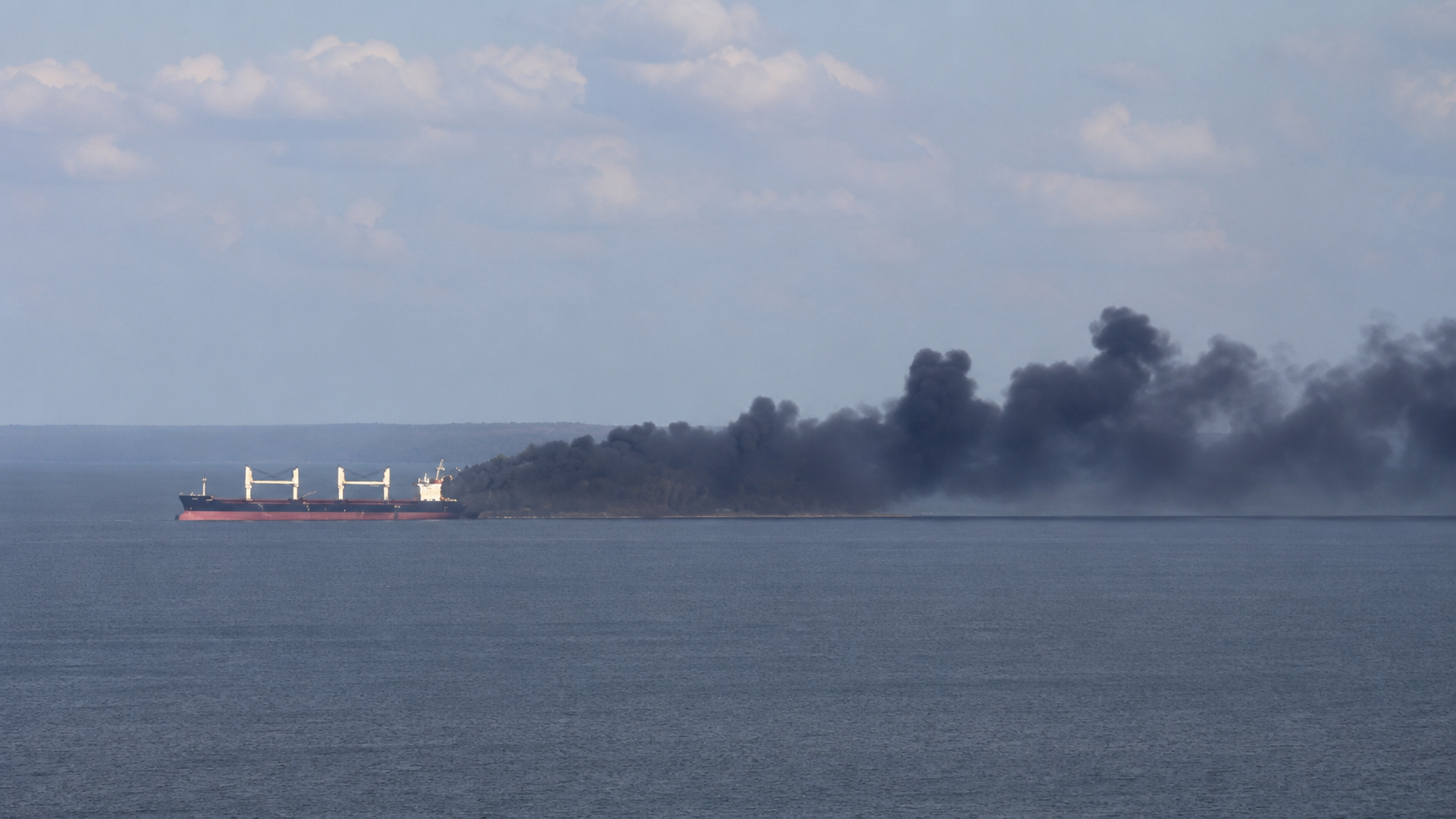
Another Vessel Incident Was Reported at Around 18:00
Eyewitness reports emerged on the evening of July 28 of another incident involving a merchant vessel off the coast of Odesa.
Images circulating from the area show a cargo ship offshore with a large plume of dark smoke. Preliminary eyewitness accounts say the vessel was hit at around 18:00.
At the time of publication, Ukrainian authorities, port agencies and the vessel operator had not officially disclosed its name, flag, cargo, extent of damage or information about possible casualties.
The cause of the fire and circumstances of the incident therefore remain unconfirmed.
This should not be confused with the vessel incident announced earlier on July 28 by Ferrexpo.
Ferrexpo Announced a Separate Damaged Vessel
Ferrexpo said on the morning of July 28 that Russian drones had struck and damaged a vessel carrying the mining group’s product while it was sailing in Ukrainian waters of the Black Sea.
The ship was carrying approximately 55,000 tonnes of high-quality DR-grade iron ore pellets.
It remains afloat, although its structural condition and the status of the cargo remain unknown. The crew was rescued, but one seafarer was killed.
Ferrexpo did not disclose the ship’s name, flag, exact location or, importantly for the current count, the date on which the attack took place.
It is therefore more accurate to say that Ferrexpo announced the incident on July 28 rather than that the vessel was necessarily struck on July 28.
The incident reported by eyewitnesses off Odesa at around 18:00 appears to be separate, but official confirmation is still pending.
At Least 36 Vessels Are in the Confirmed Count
The exact total continues to change, while government agencies use different reporting periods.
On July 23, Ukrainian Foreign Minister Andrii Sybiha said 31 merchant vessels had been attacked since the beginning of July.
Additional confirmed incidents followed.
On July 25, the merchant vessel MV AGN Ragnar was struck at the Port of Odesa. Four Indian nationals were aboard; two were confirmed safe while two remained unaccounted for.
Attacks on July 26 and 27 subsequently damaged four civilian vessels in Mykolaiv Oblast. The ships had been blocked in Ukrainian ports since the beginning of the full-scale invasion and were not operating commercial voyages. One person was killed and others were injured.
Adding only dated incidents confirmed after the Foreign Ministry’s July 23 figure produces a minimum of at least 36 affected vessels since the beginning of July.
If the evening July 28 incident off Odesa is officially confirmed as a separate new strike, that minimum would rise to at least 37.
The Ferrexpo vessel cannot yet safely be added separately because the company did not disclose the date of the attack, creating a risk of double counting.
The Confirmed Death Toll Is at Least 22
The casualty count also depends heavily on the reporting period.
Reports citing Odesa regional prosecutors said 28 civilian vessels had been attacked between June 20 and July 20, killing 21 people and injuring another 34.
At least one additional person was subsequently killed in the attacks on civilian vessels in Mykolaiv Oblast.
That produces a conservative minimum of 22 confirmed deaths in non-overlapping dated incidents.
Ferrexpo has reported another crew fatality. If its vessel was struck after July 20 and that death is not included in the earlier statistics, the minimum would rise to 23.
Two seafarers from MV AGN Ragnar remain missing and should not be counted as fatalities without official confirmation.
There is currently no casualty information from the vessel incident reported off Odesa at around 18:00 on July 28.
UN Reports 44 Crew Members Killed or Injured
At the UN Security Council on July 27, Kayoko Gotoh, Director for Europe and Central Asia within the UN political and peacebuilding departments, highlighted the rapid deterioration in maritime security.
She said the ports of Odesa, Chornomorsk, Pivdennyi, Izmail and Mykolaiv had come under renewed systematic Russian attacks.
More than half a dozen attacks on civilian vessels were reported in Odesa Oblast during July, reportedly killing or injuring 44 crew members.
That figure combines fatalities and injuries among crew members in the incidents referenced by the UN and is not an overall death toll for all vessel attacks.
Ten People Were Killed on a Grain Vessel
One of the deadliest incidents involved a Guinea-Bissau-flagged ship near Odesa.
According to the UN, the vessel was carrying grain and its crew included Indian and Syrian nationals.
Ten people were killed.
The badly damaged Golden Leo later sank off the Odesa coast, prompting increased monitoring of the area because of possible environmental and navigational risks.
Five More Were Killed on a Togo-Flagged Ship
The UN also highlighted a July 13 attack on a Togo-flagged vessel unloading mineral fertilisers at the Port of Odesa.
Five people were killed, including three crew members, while ten others were injured.
The repeated incidents have significantly changed risk calculations for international shipowners.
K2Cargo.News previously reported that shipowners suspended new calls at Ukrainian ports.
The ports themselves were not administratively closed. The disruption has largely resulted from commercial decisions by shipowners and insurers assessing threats to vessels, cargoes and crews.
Ferrexpo Effectively Loses Its Black Sea Export Route
The Ferrexpo case shows that the disruption now extends beyond grain.
The company had been exporting iron ore pellets through the Black Sea to customers in the Middle East.
Following attacks around ports and on loaded vessels, Ferrexpo said it does not expect to be able to load additional ships through this route for the foreseeable future.
Shipowners have already given advance notice of cancellations.
Ferrexpo has approximately 189,000 tonnes of pellets designated for shipment, including 55,000 tonnes aboard the damaged vessel and substantial volumes in storage.
The production and delivery cost of the affected inventory is approximately $20 million.
The maritime security crisis is therefore beginning to reshape not only Ukrainian grain exports but also shipments of industrial raw materials.
Wheat Prices Have Risen 20%
The global food market is one of the UN’s main concerns.
Gotoh told the Security Council that, according to UNCTAD data, world wheat prices had risen by around 20% since the beginning of July.
They reached their highest level since March 2024.
The UN placed this rise in the context of escalating attacks on Black Sea ports, merchant ships, grain terminals, agricultural infrastructure and crops.
It is more precise to describe the attacks as an important source of market pressure rather than the sole cause of the full 20% increase.
Four of the 13 major grain terminals at Odesa-region ports have reportedly suspended grain purchases because of the continuing security threat.
Maritime Escalation Is Moving in Both Directions
The UN also pointed to expanding Ukrainian operations against Russian and Russia-linked maritime logistics.
More than 100 vessels were reportedly struck in the Sea of Azov during July, prompting restrictions on navigation.
The wider picture is therefore one of escalating maritime operations across both the Black Sea and the Sea of Azov.
Russian strikes are affecting Ukrainian ports and foreign-flagged civilian vessels, while Ukraine has expanded attacks on Russian maritime logistics, including tankers and cargo ships.
The UN has warned that further escalation could increase risks to civilian navigation and international trade routes.
Black Sea Shipping Is Losing Predictability
For shipowners, the most serious problem is no longer a single damaged vessel but the increasing difficulty of predicting whether an entire voyage can be completed safely.
A route may appear available when a contract is signed but become too dangerous before the ship reaches Ukrainian waters.
Physical damage risk is compounded by war-risk insurance costs, crew safety concerns, cargo exposure and uncertainty over whether a vessel will be able to leave a port after loading.
Container services have already been affected. Maersk suspended its container service through Chornomorsk.
The Danube and overland corridors through Ukraine’s western borders remain alternatives for agricultural exports, but they cannot fully replace deep-water Black Sea capacity.
The new incident reported by eyewitnesses off Odesa on the evening of July 28 illustrates how quickly the operating environment continues to change.
The dated confirmed minimum currently stands at 36 affected vessels since the beginning of July. If the evening incident is confirmed as a separate attack, that number would rise to at least 37, while the final figure could increase further once the date of the Ferrexpo vessel incident is clarified.
Read also: Shipowners Suspend Calls at Ukrainian Ports