

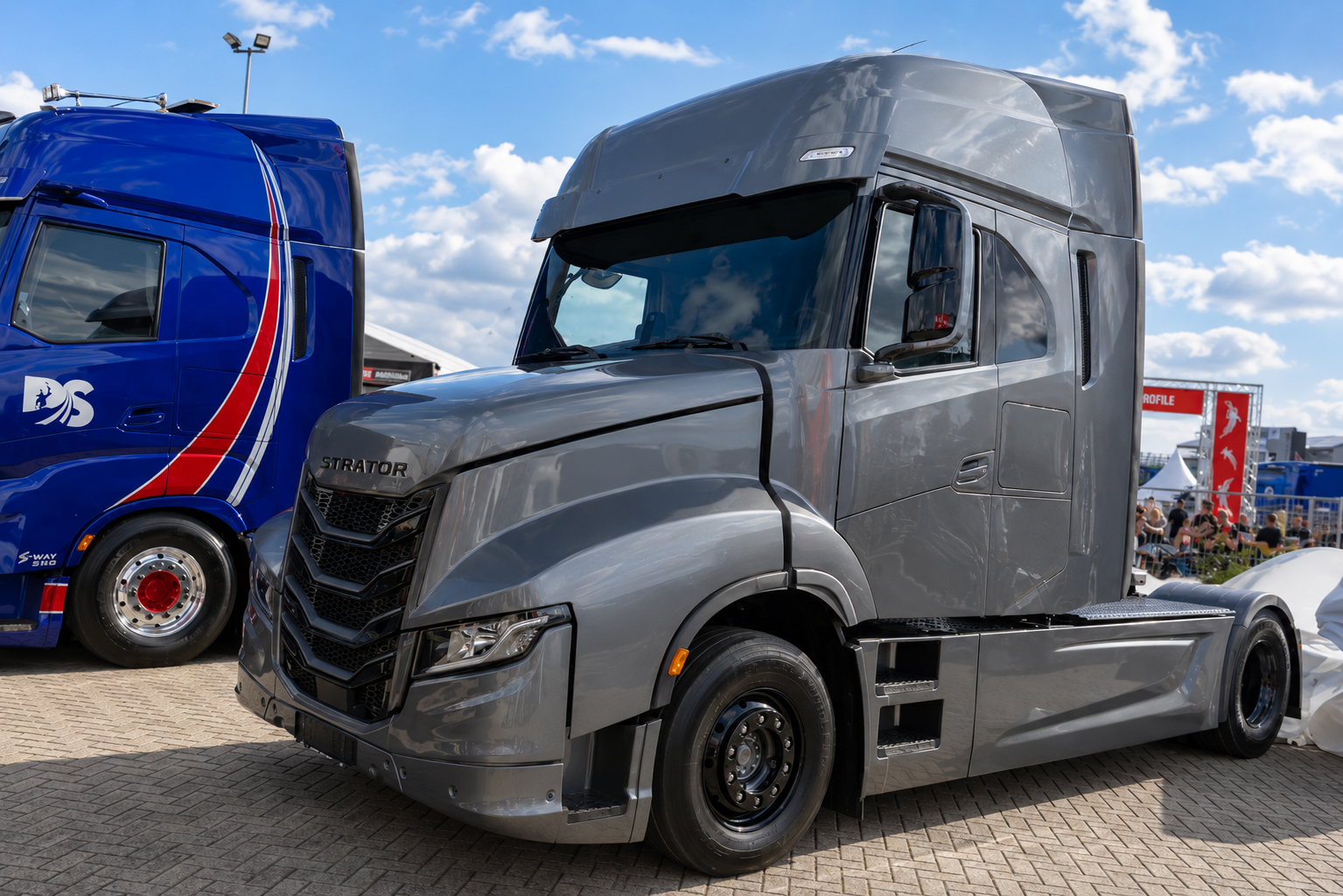
Strator Is Back as a Production Truck
The Iveco Strator has returned to the European market following several years without new production vehicles.
The new generation of the unusual bonneted tractor was officially unveiled in the Netherlands at Truckstar Festival 2026.
It is now based on the latest Iveco S-Way, replacing the Stralis platform used for the previous generation.
The most important distinction is that this is not simply a one-off show truck.
The new Strator is offered through Iveco Schouten, assembled in Born in the Netherlands and supported as a commercial product.
Europe therefore once again has one of its few modern bonneted trucks designed to perform real transport work rather than simply appear at exhibitions.
K2Cargo.News previously reported on the preparations for the new Iveco Strator’s July debut. The project has now moved from announcement to an orderable production vehicle.
The Strator Story Began 20 Years Ago
The concept originated in the Netherlands in 2006 at Charles Feijts Bedrijfswagens.
Engineers started with the European Iveco Stralis but fundamentally changed its layout.
The cab was moved rearwards, placing the engine in front of it, while design and component inspiration came from Australia’s Iveco PowerStar.
The first Strator entered a European market in which almost every mainstream long-haul truck had already adopted a cab-over-engine configuration.
That made it immediately distinctive.
Mechanically it remained an Iveco, but visually the truck had much more in common with American and Australian long-haul tractors.
Other specialist workshops subsequently began developing similar vehicles based on Scania and Volvo trucks.
Strator was among the projects that helped turn the bonneted European truck from a one-off conversion into a small commercial category of its own.
Around 50 First-Generation Trucks Were Built
The Strator was never a high-volume model.
Approximately 50 examples of the first generation were produced over more than a decade.
Each was effectively built for an individual customer.
The range included conventional long-haul tractors as well as highly specialised heavy-haulage vehicles.
One of the final examples went to British operator G&B Finch.
The right-hand-drive 6×4 was developed for heavy transport using a Stralis X-Way as its donor vehicle.
Once the Stralis left production, the earlier Strator lost the platform on which it had been based.
Continuing to manufacture the same conversion was therefore no longer practical, and the programme went into a multi-year pause.
S-Way Gave the Strator a Second Life
The arrival of the Iveco S-Way eventually created an opportunity to revive the concept on a modern platform.
Work on a successor started well before the 2026 unveiling, but the vehicle could not simply reproduce the old conversion.
Heavy trucks now face substantially more demanding requirements involving safety systems, emissions, electronic driver assistance, aerodynamics and type approval.
The original mix of European Stralis and Australian PowerStar components was no longer available either.
The most recognisable part of the truck — its bonnet — therefore had to be redesigned from the ground up.
The Bonnet Is No Longer Borrowed From Australia
The new Strator maintains the basic philosophy of the original but now has its own front-end design.
Development involved Jacco Hoogendoorn, an engineer associated with Spyker Cars, together with Belgium-based Arens Vehicle Design.
Instead of reproducing the old PowerStar look, the new truck has a much more individual shape.
The upper bonnet is relatively narrow, with pronounced separate wheel arches creating proportions reminiscent of classic bonneted trucks from the first half of the twentieth century.
At the same time, designers retained a visual connection with the current S-Way.
The headlights, lower grille treatment and other elements make the truck’s Iveco origins immediately recognisable.
Its most dramatic visual feature is simply the amount of truck in front of the windscreen.
The distance between the front bumper and cab makes the Strator appear considerably longer than a conventional S-Way even though both are based on the same modern vehicle architecture.
The S-Way Cab Has Been Moved Rearwards
Creating the bonneted layout means the cab no longer sits directly above the front of the powertrain.
It has been moved rearwards, placing the engine underneath the long bonnet.
That change required substantial revisions around the sides of the vehicle.
Access steps have been repositioned behind the front axle.
New lower door panels and infill sections complete the area between the cab and chassis.
The unusual geometry also makes the cab appear considerably taller than on a standard S-Way.
Inside, however, Iveco Schouten has retained the architecture of the modern production vehicle.
This is important operationally because customers receive the distinctive driving position and appearance without requiring an entirely unique interior and electrical system.
The Interior Remains Modern S-Way MY2024
The new Strator uses the current Iveco S-Way MY2024 as its technical base.
The cab therefore retains its digital instrument display, modern infotainment system, revised steering wheel and latest driver-focused dashboard layout.
Unlike a purpose-built American conventional truck, the interior has not been redesigned exclusively for the Strator.
A small engine tunnel also remains.
Removing it completely would have required a much more radical modification to the production cab structure.
For the driver, the result is an unusual combination.
The dashboard and controls feel like a modern S-Way, but the seating position is now behind the front axle with a long bonnet stretching out ahead.
That driving environment is one of the fundamental differences between the Strator and a conventional European tractor.
xCursor 13 Delivers Up to 580 hp
Under the new bonnet sits Iveco’s current xCursor 13 diesel engine.
Strator customers can specify outputs of 460, 500 or 580 hp.
The flagship version delivers up to 580 hp and is suitable for more demanding transport applications.
The engines are paired with the latest generation of the automated ZF TraXon transmission.
The unusual appearance therefore does not mean outdated mechanical technology.
In powertrain terms, the new Strator remains closely related to the current S-Way and benefits from the latest Iveco heavy-truck architecture.
The 580 hp specification may be particularly attractive because bonneted trucks are often purchased for international long-haul work or specialised heavy transport.
4×2, 6×2 and 6×4 Versions Are Available
Iveco Schouten has developed several chassis configurations from the start.
The entry version is a 4×2 tractor.
Three-axle customers can select a 6×2 with a liftable steered pusher axle.
Another 6×2 configuration uses a twin-tyre tag axle.
A full 6×4 tractor is available for heavy-duty applications.
The Strator is therefore not limited to a single promotional specification.
Depending on the customer, it can serve as a distinctive international tractor or as the basis for much more specialised heavy transport work.
Production will nevertheless remain highly individual, meaning the Strator is unlikely ever to compete with the normal S-Way on volume.
Why Would a European Carrier Want a Long Bonnet?
From a purely practical perspective, a bonneted layout creates a clear disadvantage in Europe.
European combination-length limits make every metre valuable.
A longer tractor can reduce the available space elsewhere in a vehicle combination or make certain operating arrangements more complicated.
That is one of the main reasons nearly all mainstream European heavy trucks use cab-over-engine layouts.
Strator buyers, however, are rarely making the decision on operating cost alone.
The truck can function both as a working vehicle and as a branding asset.
For a family-owned carrier, abnormal-load specialist or smaller premium fleet, a highly distinctive tractor can become part of the company’s identity.
A Strator is difficult to confuse with hundreds of conventional white tractors travelling along the same motorway.
Bonneted Trucks Have Created a Small European Niche
The market did not disappear during the Strator’s absence.
Specialist manufacturers continued to convert modern European trucks into bonneted models.
Dutch company Vlastuin Truckopbouw has developed conversions based on Scania and Volvo products.
Similar Scania-based projects are available from specialist operators in Norway.
The segment remains tiny compared with the mainstream tractor market, but the presence of multiple builders indicates a persistent customer base.
The returning Strator therefore enters a more established niche than the original model did two decades ago.
Customers no longer need to be convinced that a European bonneted tractor can exist.
Iveco Schouten instead needs to convince them that the Strator is the one they should choose.
Strator Could Attract Buyers Beyond the Netherlands
Although the project has Dutch roots, first-generation Strators operated in several European countries.
Heavy-haulage, exhibition logistics and specialist transport companies are particularly obvious potential customers.
For these businesses, the visual identity of a truck can carry more value than it does in a large commodity fleet.
Poland may also offer a small potential market as heavy-truck demand has recovered significantly in 2026.
K2Cargo.News recently reported that Polish registrations of tractors above 16 tonnes rose by more than 30%.
Iveco remains a relatively small player in Poland’s long-haul tractor segment compared with Volvo, Scania, DAF, Mercedes-Benz and MAN.
Strator will not materially change Iveco’s registration totals, but it could increase the brand’s visibility among specialist operators.
Dealer Support May Be One of Its Biggest Advantages
For such a niche conversion, styling is only one part of the equation.
An operator buying an expensive individual truck also needs confidence that it will remain serviceable years later.
That makes Iveco Schouten’s involvement particularly important.
The Strator is built around current Iveco production technology, while its engine, transmission, electrical systems and cab retain standard origins.
Most of the unique components relate to the bonneted layout and exterior bodywork.
That approach should make long-term operation easier than running a completely bespoke truck with little connection to an established dealer network.
Strator Returns as More Than an Experiment
The first Strator was an ambitious experiment by a Dutch Iveco dealer.
The new generation looks like a much more mature product.
It combines the current S-Way platform with its own front-end design, the latest xCursor 13 engine, multiple chassis configurations and an established sales channel.
Iveco Schouten is not trying to turn it into a mass-market tractor.
Strator remains a specialised truck for operators that want commercial capability and a vehicle that stands out immediately on the road.
Its closest rivals are therefore not ordinary S-Way tractors.
They are custom bonneted Scanias and Volvos — and the desire among a small group of European transport companies to own something unlike the rest of the fleet.
After several years away, the Strator is returning to almost exactly the niche that it helped create two decades ago.
Read also: Iveco Strator Returns: New Generation to Debut in July
