

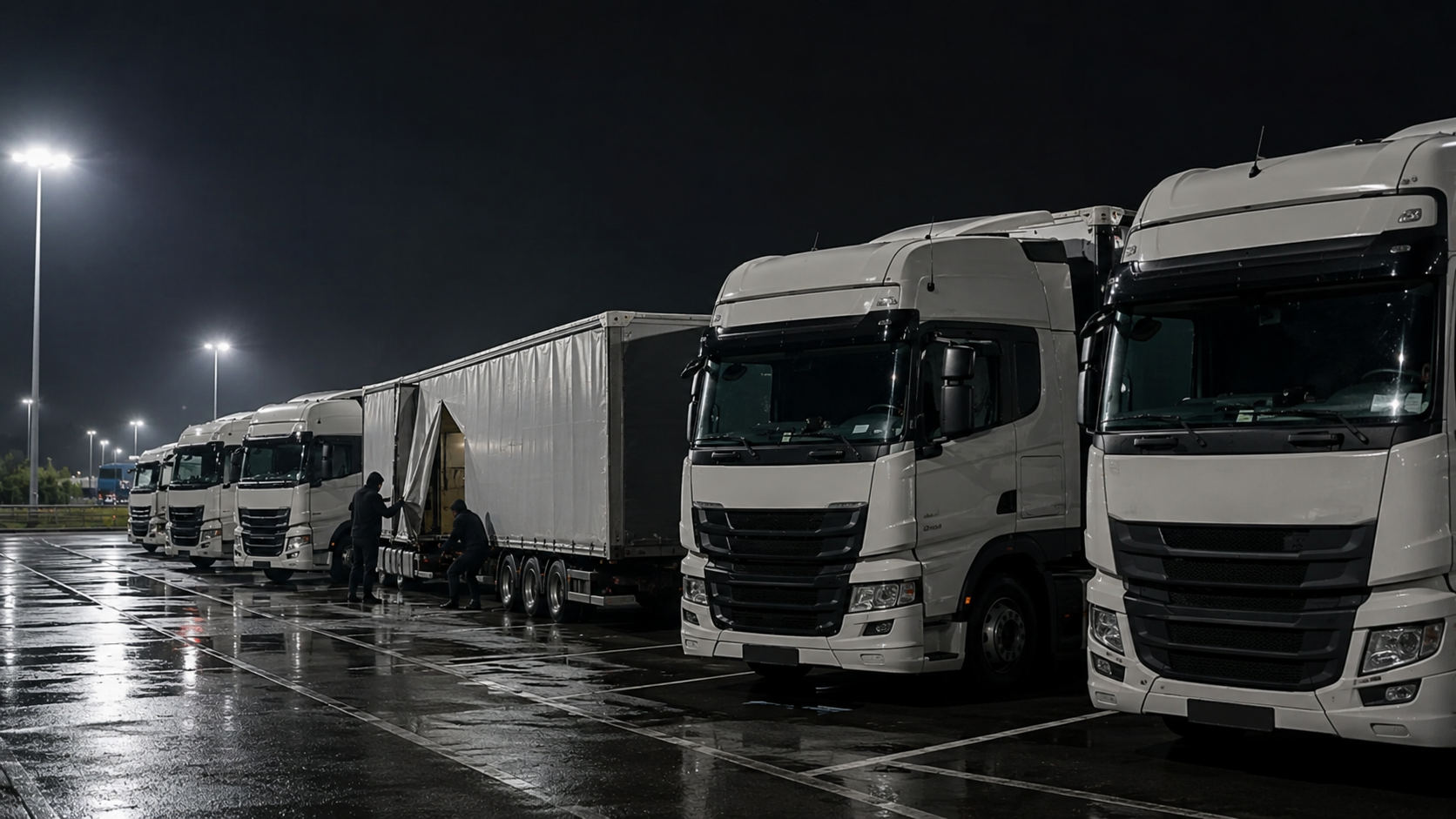
Trucks Remain the Main Target
Cargo theft is becoming one of the most serious security risks facing European road freight.
Criminal groups are no longer limited to opportunistic attacks on parked trucks. They increasingly study routes, use forged documents, impersonate carriers and drivers, and combine physical theft with digital fraud.
The latest BSI Consulting and TT Club Cargo Theft Report covering 2025 shows that trucks remain the dominant target, accounting for roughly 70% of recorded incidents globally.
Insider cooperation was identified in around 22% of cases.
For transport operators, this changes the meaning of cargo security. Companies now need to protect not only the vehicle and trailer but also information about the load, route, stopping points, driver and subcontractors.
Germany Accounts for 27% of Recorded European Incidents
Germany recorded the largest proportion of cargo theft incidents reported in Europe during 2025, accounting for 27% of the regional total covered by the report.
Italy followed with 13%, the United Kingdom with 9%, while France and Spain each accounted for 6%.
Germany’s position partly reflects the enormous volume of road freight moving through the country.
Its motorway network links Benelux, France, Poland, Central Europe and Italy, making major corridors particularly attractive to organised criminal groups.
The report identifies highways including Germany’s A2 and A4, Spain’s AP-1 and AP-7, and Britain’s M1 and A1 as recurring areas of exposure.
For a carrier, this means the risk associated with an individual truck stop or motorway section can matter more than a country’s overall crime rate.
Warehouses Account for One-Third of Theft Locations
Another significant development is the growing importance of fixed logistics facilities.
Warehouses accounted for approximately 33% of recorded theft locations in Europe. Parking areas represented around 15%, rest areas another 11%, and production facilities approximately 8%.
This does not contradict the finding that trucks remain the dominant target.
A vehicle may be attacked while parked at a warehouse, logistics centre, roadside facility or rest area.
At the same time, criminals are increasingly targeting the storage locations themselves, with particularly strong growth in facility theft reported in Italy, Germany, Romania and Bulgaria.
Cargo is therefore not automatically safe once a truck passes through a warehouse gate.
Access control, identity verification and facility security have become part of the same risk-management system as vehicle protection.
Theft Increasingly Begins Before Anyone Cuts a Trailer Curtain
Traditional slash-and-grab attacks remain common in Europe.
Curtain-sided trailers parked at unsecured locations and rest areas continue to be targeted, particularly overnight.
But organised cargo crime is becoming more sophisticated.
One of the fastest-growing methods is the fictitious pickup.
Criminals obtain or forge information relating to a genuine shipment, pose as an authorised driver or transport company and collect the cargo from a warehouse without raising immediate suspicion.
Fraudsters use forged documents, cloned vehicle plates, fictitious transport firms, compromised credentials and stolen digital identities.
In some cases, criminals know not only what a truck is carrying but also where it is expected to stop for mandatory driver rest.
Route information itself has therefore become a security-sensitive asset.
Criminals Prefer Goods That Can Be Resold Quickly
Cargo that can be divided into smaller quantities and sold rapidly remains particularly attractive.
Food and beverages, electronics, pharmaceuticals and automotive parts are repeatedly identified among commonly targeted commodities.
In the European section of the 2025 report, electronics represented around 15% of stolen commodity categories, followed by food and beverages at 11% and apparel at 8%.
Thieves do not need to target only expensive smartphones or computers.
Food, alcohol, household products and automotive components can be attractive because they are easy to resell and difficult to identify once a shipment has been divided.
As a result, cargo theft is now a relevant risk for almost every international road carrier.
UK Cargo Losses Reached Around $149 Million
The problem is particularly serious in the United Kingdom.
BSI Consulting and TT Club estimate cargo theft losses there at around $149 million in 2024, equivalent to more than £110 million depending on the exchange rate used.
Other UK industry and police datasets can show somewhat different figures because freight crime is not yet recorded under one fully standardised methodology.
The broader conclusion remains the same: cargo theft has become a major supply-chain cost rather than an isolated loss suffered by individual hauliers.
Operators may also face trailer damage, vehicle downtime, insurance deductibles, investigations and contract penalties following a theft.
Repeated incidents can eventually affect insurance costs as well.
Britain Is Short Around 11,000 Secure HGV Spaces
The lack of secure infrastructure increases exposure.
The Road Haulage Association estimates that the UK needs approximately 11,000 additional safe and secure HGV parking spaces.
This is particularly important because of mandatory driving and rest rules.
A driver cannot simply continue driving indefinitely until a secure site becomes available.
Once the legal driving period expires, the truck has to stop.
If secure parking is full or unavailable along the route, drivers may be pushed into lay-bys, industrial estates or other poorly protected locations.
Those areas provide organised criminals with exactly the opportunity they need.
The parking shortage is therefore no longer just a driver-welfare problem. It has become a supply-chain security issue.
Secure Stops Need to Be Planned Before Departure
Digital freight platform SNAP is urging carriers to include secure stopping locations directly in route planning.
A route can no longer be designed solely around distance, tolls and scheduled arrival time.
Operators also need to determine where the driver will take mandatory breaks and whether those locations provide an appropriate level of protection.
For theft-attractive or high-value cargo, the safest route may be slightly longer if it provides access to certified parking.
That changes the economics of transport.
An additional parking charge or modest detour can be far cheaper than losing a load worth hundreds of thousands of euros.
Digital platforms are making this easier. K2Cargo.News recently reported that Trimble CoPilot added booking for 750 truck parks across 26 countries, allowing parking to become part of the navigation process itself.
Certified Parking Means More Than CCTV
Europe is gradually standardising the security levels available at truck parking facilities.
TAPA EMEA operates its Parking Security Requirements system, with Level 1 representing the highest formal protection level.
The official EU Safe and Secure Truck Parking Area standard uses a separate structure: Bronze, Silver, Gold and Platinum.
ESPORG supports parking operators in implementing the EU standard.
Higher security involves far more than installing a camera near the entrance.
Certification considers controlled access, perimeter protection, lighting, CCTV, operating procedures, personnel and the site’s ability to respond to incidents.
Driver welfare facilities are also part of the broader parking-quality framework.
SNAP argues that recognised standards are therefore an important mechanism for improving security across European road freight.
Parking Requirements Are Becoming Part of the Transport Contract
For high-value cargo, the choice of stopping location is increasingly moving beyond the driver’s personal decision.
Shippers, insurers and customers may specify what type of parking facility must be used.
This is particularly relevant to electronics, pharmaceuticals and other theft-targeted products.
Secure stopping points may eventually become as normal a part of a transport order as the loading address, temperature requirement or prescribed route.
Technology already allows operators to combine route planning with databases of certified parking sites and information about known theft hotspots.
TAPA, for example, uses cargo-crime intelligence and secure-parking data to help logistics companies assess route exposure.
Secure Parking Cannot Prevent Digital Fraud
Carriers also need to recognise the limits of parking security.
If criminals have obtained a transport order through stolen credentials or convinced a warehouse to release a load to a fictitious carrier, a fenced parking area will not solve the problem.
Physical and digital security therefore need to work together.
Companies increasingly need stronger subcontractor verification, protected email systems, limited access to sensitive load information and procedures for confirming unexpected changes in destination or routing.
Particular caution is required when a driver is suddenly instructed to deliver somewhere else or when an unfamiliar subcontractor appears shortly before collection.
Modern cargo criminals exploit whichever point in the supply chain is weakest, whether it is a trailer curtain, a truck park or a dispatcher’s email account.
What Carriers Should Change
Cargo security is becoming part of routine transport planning.
Before departure, operators should identify not only the shortest route but also mandatory rest points, certified parking availability and an alternative stop if the preferred location is full.
Key measures include:
- booking secure overnight parking in advance;
- restricting information about cargo and routes to those who genuinely need it;
- verifying subcontractors and unexpected account changes;
- using GPS monitoring and alerts for unplanned deviations;
- avoiding unsecured parking for theft-attractive loads simply to save a parking fee;
- giving drivers a defined procedure for suspected surveillance or attempted theft.
Large fleets are increasingly turning these measures into central security policies rather than leaving decisions entirely to individual drivers.
England Is Continuing to Fund Parking Improvements
Growing freight crime is also pushing governments to treat truck parking as transport-security infrastructure.
National Highways operates a scheme worth up to £20 million to support improvements to HGV parking facilities in England.
Eligible projects can include lighting, CCTV, secure fencing, additional parking capacity and improved driver facilities.
The current National Highways scheme remains open until March 31, 2031 and provides match funding for qualifying improvements at existing sites close to the strategic road network.
This should not be confused with the separate Department for Transport HGV Parking and Driver Welfare Grant Scheme.
Previous DfT funding rounds also supported parking improvements, but that scheme is currently closed to new applications.
It is therefore more accurate to say that the National Highways programme is available through 2031 rather than describing all UK truck-parking funding as a single extended scheme.
Europe Is Building More Secure Facilities
Investment is also growing across continental Europe.
New parking projects increasingly combine controlled entry, continuous surveillance, perimeter protection, booking systems and full driver facilities.
One of the most notable examples is being developed in Spain, where a covered secure facility will accommodate almost 400 trucks.
Such developments are considerably more expensive than a basic asphalt parking area, but they address several problems simultaneously.
They protect cargo, provide suitable conditions for mandatory driver rest and allow operators to reserve space before arrival.
The problem is that new capacity is still being added more slowly than the market requires.
Security Is Becoming Part of the Freight Rate
Secure parking creates an additional cost for a road carrier.
But saving money on parking is becoming increasingly risky.
The price of one night at a protected facility is minor compared with the cost of stolen cargo, trailer damage or several days of vehicle downtime.
Freight crime is also beginning to influence insurance requirements.
The higher the risk associated with a particular cargo or route, the more relevant GPS tracking, certified parking and documented security procedures become.
Secure parking is therefore no longer simply a service drivers use if a space happens to be available.
It is becoming a normal component of the transport chain.
In modern European logistics, carriers increasingly need to plan not only how the cargo moves, but also where it stops.
Read also: Spain Builds Covered Truck Parking for 383 Trucks