

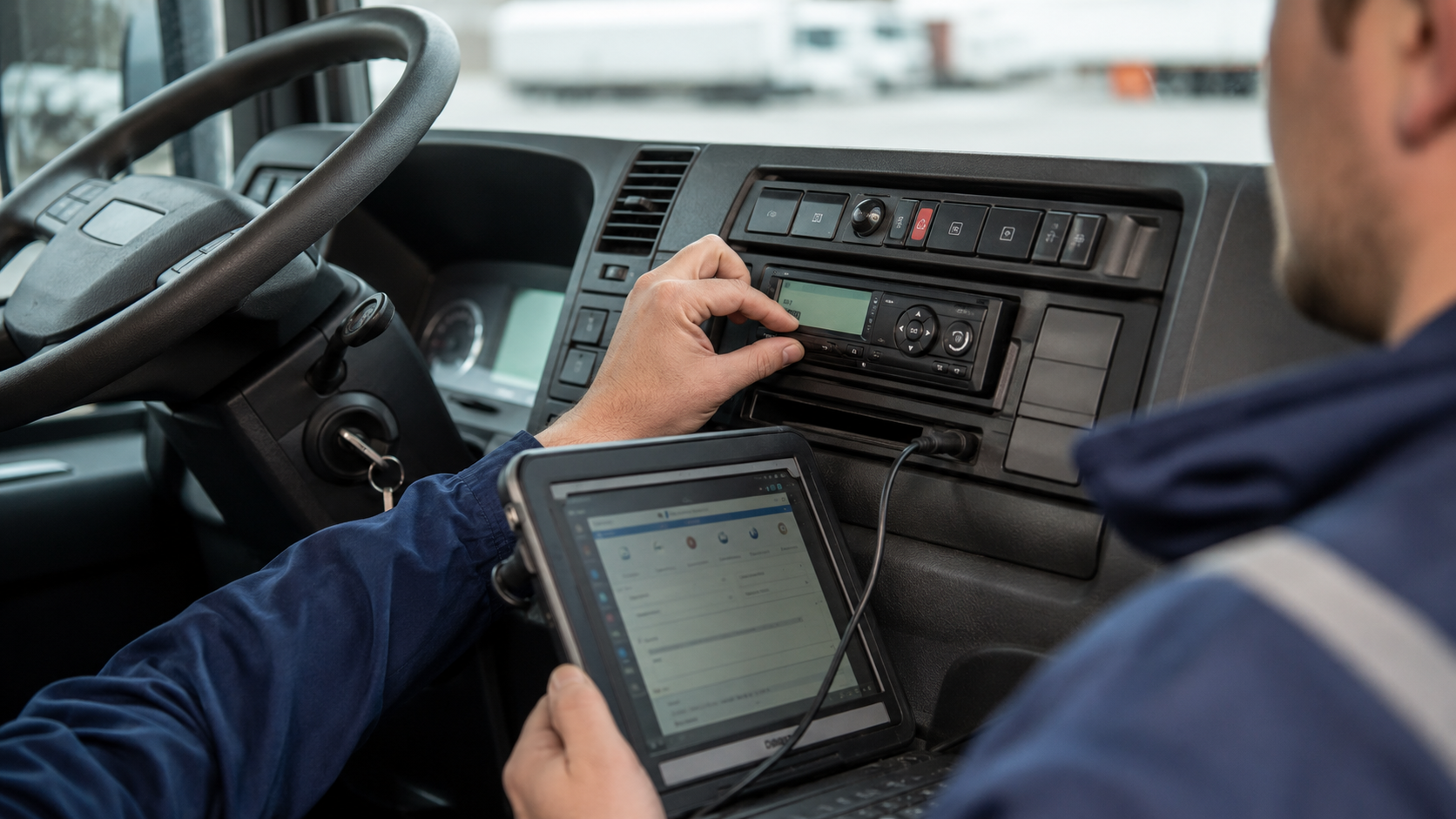
JRC Publishes Official List of Vulnerable Tachographs
The European Commission’s Joint Research Centre has officially added specific second-generation smart tachographs to its list of recording equipment requiring mandatory software security updates.
The measure affects two widely used product families: Continental/VDO DTCO 1381 version 4.1 and Stoneridge SE5000-8.1 revisions B, C, D and E.
JRC states that this mechanism operates under Article 20(4) of Regulation (EU) No 165/2014. Where type-approval authorities determine that measures are required to address security vulnerabilities in vehicle units, motion sensors or tachograph cards, the Commission is informed and the affected equipment can be subjected to a mandatory update.
This makes the measure different from an ordinary manufacturer recommendation. The affected software is now covered by a formal security-related update requirement.
VDO DTCO 4.1 Must Move to Version 4.1b
For Continental/VDO, the requirement applies to DTCO 1381 version 4.1 under type approval e1-84-08 and software release 04.01.26.
On the technical-data printout, this software is shown as V 4126.
It must be upgraded to software 04.01.41, shown as V 4141 on the technical printout. The updated unit becomes DTCO 4.1b under type approval e1-84-10.
The mandatory update measure has applied since July 15, 2026.
This does not mean that every truck still displaying V 4126 had to stop operating immediately on July 15.
JRC sets a specific deadline: an already installed unit must be updated no later than its next periodic inspection, while equipment not yet installed must be updated at first installation.
Fleet operators should therefore identify DTCO 4.1 units running V 4126 now and ensure they do not pass through their next scheduled inspection without moving to V 4141.
Stoneridge Requirement Starts on September 1
For the Stoneridge SE5000-8.1, the mandatory security-update measure takes effect on September 1, 2026.
It applies to revisions B, C, D and E running software 1214 or 1619.
According to the current JRC table, the update path is:
- Revision B with SW 1214 to SW 2424;
- Revision C with SW 1214 to SW 2525;
- Revision D with SW 1619 to SW 2424 or 2525;
- Revision E with SW 1619 to SW 2626.
The units then move to newer revisions F, G, H and I respectively.
There is an important correction to information circulating in some industry reports. The current JRC table, last updated on July 17, lists 2424, 2525 and 2626 among the required software releases. It does not list version 2425.
As with VDO, an installed unit must be updated no later than its next periodic inspection, while equipment awaiting installation must be updated when first installed.
Fleets Do Not Need to Replace Every Tachograph
The requirement does not mean that otherwise serviceable Smart Tacho 2 units have to be removed and replaced across entire fleets.
VDO states that an existing DTCO 4.1 can receive the software functionality of DTCO 4.1b. The manufacturer recommends carrying out available updates in connection with the periodic tachograph inspection.
Stoneridge has likewise provided an upgrade route for existing SE5000 Smart 2 units, with newer configurations available through software updates.
This can substantially reduce compliance costs compared with replacing the complete vehicle unit.
Updates, however, need to follow manufacturer service procedures and be performed with the appropriate workshop equipment. EU Member States maintain networks of authorised tachograph workshops responsible for inspection, calibration and repair of digital tachographs.
Why the Update Has Become Mandatory
The JRC classification describes these measures specifically as mandatory security software updates.
EU rules require manufacturers to detect vulnerabilities throughout the life cycle of tachograph equipment and prevent or mitigate their possible exploitation.
VDO also explains that update capability is a fundamental feature of Smart Tacho 2. Software updates are used to maintain compliance with security requirements, evolving legislation, card changes and technical standards.
The public JRC table does not provide a detailed technical description of the individual vulnerabilities behind the current mandatory action.
It would therefore be inaccurate to attribute the entire measure to one specific GNSS, card or remote-control fault without additional technical documentation.
Smart Tacho 2 Is Central to EU Road Transport Enforcement
The second-generation smart tachograph is one of the key tools introduced under Mobility Package 1.
Its function extends beyond recording driving and rest periods.
Smart Tacho 2 automatically records border crossings, stores loading and unloading operations, provides improved software-update capability and offers stronger protection against manipulation. The European Commission links the technology to driver rights, fair competition and road safety.
Automatic border records are particularly relevant to enforcement of cabotage and driver-posting rules in international road transport.
Since July 1, 2026, the Smart Tacho 2 regime has also expanded to certain commercial vehicles above 2.5 tonnes used for international freight operations and cabotage.
K2Cargo.News previously discussed the impact of the new tachograph requirements when examining the recovery of Poland’s truck market in the first half of 2026.
GNSS and Remote Checks Make Software More Important
Smart Tacho 2 uses GNSS to determine vehicle position and automatically record border crossings.
Newer configurations also use the Galileo OSNMA authentication service to verify satellite-navigation information and strengthen protection against spoofed positioning data.
Another important capability is remote preliminary enforcement.
EU rules allow enforcement authorities to receive a limited set of tachograph indicators related to potential faults or manipulation, including the latest security-breach attempt, long power interruptions, sensor faults, motion-data errors, driving without a valid card and selected calibration data.
This does not mean a fine is automatically issued remotely.
The information is primarily intended to help authorities identify vehicles that should be stopped for a more detailed roadside inspection.
Outdated or incorrectly functioning software can therefore become more than a workshop issue. It may also increase operational risk during cross-border enforcement.
There Is No Single EU-Wide Fine for Old Software
Claims that the EU has introduced one uniform fine worth thousands or tens of thousands of euros need qualification.
EU law does not set one fixed penalty amount for this particular issue.
Article 41 of Regulation No 165/2014 requires individual Member States to establish their own penalty systems. Those penalties must be effective, proportionate, dissuasive and non-discriminatory.
Ireland’s Road Safety Authority explicitly warns operators that refusing a required tachograph software update can create a risk of enforcement action and delays during roadside inspection.
The practical consequence is that operators should not assume a tachograph is compliant simply because the screen is functioning and it continues recording normally.
Licence Risk Exists but Is Not Automatic
Transport-licence consequences also require careful wording.
EU legislation does treat serious infringements involving the installation and use of recording equipment as matters that can affect the good repute of a road transport undertaking or transport manager.
But finding one tachograph with outdated software does not automatically result in loss of an operator licence.
The more serious risk concerns significant or repeated infringements, assessed through national procedures and the EU classification system.
Updating affected tachographs is therefore an important compliance measure, but the claim that one missed software update automatically removes a carrier from the market would overstate the law.
What Fleet Operators Should Do Now
The first step is to inventory the tachographs installed across the fleet.
Particular attention should be given to VDO DTCO 4.1 units showing V 4126 and Stoneridge SE5000-8.1 revisions B–E running software 1214 or 1619.
On VDO equipment, the version can be checked through the technical-data printout: V 4126 identifies the older DTCO 4.1 software, while V 4141 identifies DTCO 4.1b.
Operators should then compare these results with the dates of each vehicle’s next periodic tachograph inspection and book workshop capacity in advance.
The VDO measure has applied since July 15. For the affected Stoneridge units, September 1, 2026 is the key start date. In both cases, the final deadline for an already installed unit is tied to the next periodic inspection.
Large fleets should avoid leaving this until the last moment. If dozens or hundreds of vehicles have similar inspection dates, limited workshop availability could itself create avoidable downtime.
Tachograph Compliance Is Becoming Software-Driven
The VDO and Stoneridge updates illustrate a wider change in how tachographs need to be managed.
Traditionally, operators could view the tachograph mainly as a sealed device that was installed, calibrated and then left in service until its next inspection.
Smart Tacho 2 is becoming a software-hardware platform whose operational life includes mandatory security updates.
At the same time, enforcement authorities are making greater use of tachograph data during roadside controls. In France, for example, almost half of recently inspected transport operators were found with driver-rest or other compliance issues.
For fleet managers, software-version control should now become as routine as monitoring calibration dates, roadworthiness inspections, insurance and driver-card validity.
Read also: Nearly Half of Trucks Inspected in France Violated Driver Rest Rules
