

Until recently, the Suez Canal was considered one of the few major transportation arteries that had managed to avoid being pulled directly into the expanding war in the Middle East.
That sense of security is now beginning to disappear.
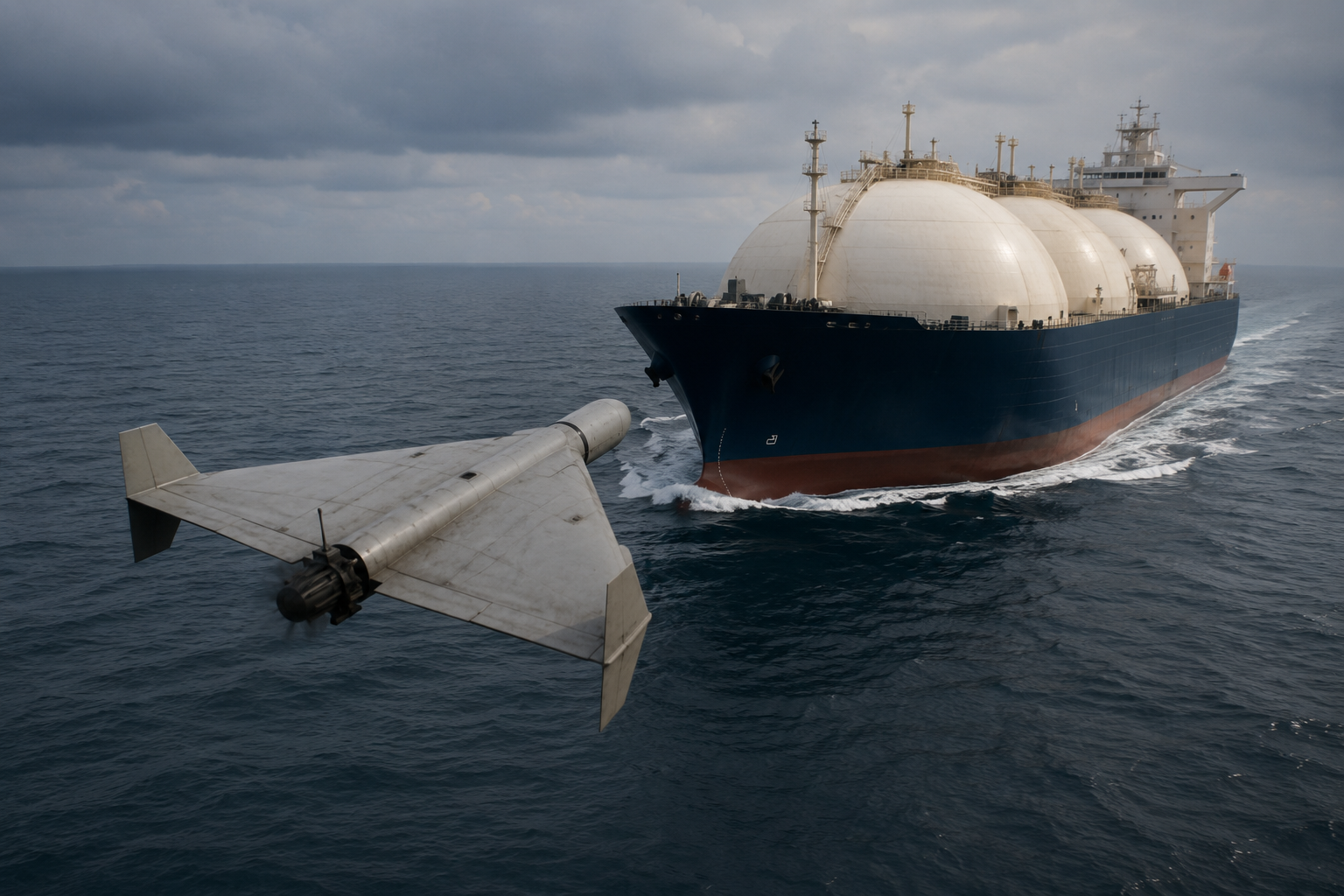
A drone strike on gas carriers at Egypt’s Mediterranean port of Damietta is not merely another isolated military incident. It is a warning to the entire global logistics system.
If attacks are now spreading to areas immediately adjacent to the Suez Canal, international trade may be entering a new phase of risk — one whose consequences will be felt far beyond Egypt and the Middle East.
But the most remarkable part of this story is not only the attack itself.
As with so many major incidents in recent months, no one has officially accepted responsibility.
And that may be one of the most dangerous features of modern warfare.
A War Without a Signature
Egyptian authorities said a preliminary investigation indicated that an unidentified drone caused a fire aboard two vessels at the port of Damietta, located near the northern entrance to the Suez Canal.
According to shipping industry sources familiar with the incident, the drone reportedly struck the U.S.-owned gas carrier Energos Winter, triggering a fire that later spread to a second vessel.
That is where the official clarity ends.
No organization has claimed responsibility.
No government has admitted ordering the operation.
No definitive evidence identifying the attacker has been presented publicly.
And yet the consequences have already begun.
The New Reality of Modern Warfare
Modern conflicts increasingly resemble a chess game in which the pieces move, but the players remain hidden.
Drones appear over strategic infrastructure.
Commercial ships catch fire.
Oil facilities are damaged.
Military bases are attacked.
And almost every time, the world hears the same carefully constructed phrase:
“No one has claimed responsibility.”
Officially, that ambiguity leaves room for diplomacy.
In practice, it creates an environment in which it becomes nearly impossible to determine who initiated the latest round of escalation.
Every side can accuse its enemy. Governments can deny involvement. Armed groups can remain silent. Intelligence agencies can release selective information without revealing the full evidence.
Meanwhile, the international community is left to build theories from incomplete facts.
The Suez Canal Could Become the Next Flashpoint
The location of the attack is what makes the incident particularly alarming.
The Suez Canal remains one of the most important transportation corridors in the world.
It carries containerized trade between Asia and Europe, liquefied natural gas shipments, petroleum products and a significant portion of Saudi Arabia’s alternative oil exports.
Until now, the greatest maritime threats in the region had been concentrated around the Strait of Hormuz, the Red Sea and the Bab el-Mandeb Strait.
The strike in Damietta suggests that the zone of instability may now be expanding toward the Mediterranean entrance to the Suez Canal itself.
For global shipping and logistics, that would fundamentally alter the risk calculation.
Saudi Arabia has increasingly depended on Red Sea export routes as tensions and restrictions disrupt tanker traffic through the Strait of Hormuz. If the Suez route also becomes vulnerable, one of the world’s largest oil exporters could find both of its principal maritime gateways exposed to the same regional war.
The Escalation Is Spreading
At roughly the same time as the incident in Egypt, the U.S. military said it had carried out overnight strikes against Iranian Revolutionary Guard command centers, drone installations and other military targets.
Iranian state media reported deaths among military personnel and civilians, including casualties following strikes in Qeshm and Zanjan provinces.
Iranian authorities also said student housing complexes in the southwestern city of Ahvaz had been damaged.
In response, Iran’s Islamic Revolutionary Guard Corps said it had attacked U.S. military assets in Jordan and Kuwait.
Jordan reported intercepting Iranian missiles, while Iranian media claimed that strikes on Ali Al Salem Air Base in Kuwait had destroyed drone hangars and a fuel storage facility.
Kuwaiti authorities separately reported that an attack struck a building belonging to a Chinese company in northern Kuwait, killing a worker and causing significant damage.
Each of these events carries the same central danger: attacks are crossing borders faster than governments can contain the political consequences.
Saudi Arabia Has Entered the Conflict More Directly
Saudi Arabia has also moved into a more direct military role.
Riyadh publicly joined U.S. strikes against Iran-linked groups in eastern Iraq after drones launched from Iraqi territory reportedly targeted Saudi oil infrastructure.
Saudi and regional assessments reportedly concluded that Yemen’s Iran-aligned Houthi movement coordinated the attacks with armed factions operating in Iraq.
Following the joint operations, Saudi Arabia’s defense minister met with U.S. Vice President JD Vance in Washington and urged the Trump administration to avoid a broader escalation, according to sources familiar with the discussions.
That contradiction captures the current state of the region.
Governments are joining military operations while simultaneously warning that the war must not expand.
They are striking targets while calling for restraint.
They are responding to attacks whose precise chains of command are often difficult to verify publicly.
Who Is Responsible?
This is the question that should be at the center of the entire story.
Who launched the drone that struck the ships in Damietta?
Who authorized the operation?
Was the target deliberately selected because of its American ownership?
Was the attack intended to threaten Egypt, disrupt gas transportation or send a warning about navigation through the Suez Canal?
Or was it another operation designed to create strategic consequences while preserving plausible deniability?
At this stage, there are no publicly verified answers.
That absence of accountability is not a minor procedural problem. It is becoming a central weapon of the conflict.
When no one takes responsibility, there is no clear party to negotiate with.
There is no reliable mechanism for retaliation.
There is no transparent process for determining whether an attack was ordered by a government, conducted by a proxy group or carried out by an organization acting independently.
And there is often no meaningful accountability for the civilian deaths, commercial losses and economic disruption that follow.
Shipping Insurers Are Already Responding
For the maritime industry, the danger is not limited to the physical attacks themselves.
London’s marine insurance market has already expanded its designated high-risk area in the Red Sea following attacks on commercial shipping, extending the zone to cover more of the coastline near Saudi ports.
If similar risk classifications are introduced around the northern Red Sea, the Suez Canal or Egypt’s Mediterranean ports, shipping costs could rise sharply.
War-risk premiums may increase.
Shipowners may demand additional compensation.
Carriers may introduce emergency surcharges.
Some vessels could divert around the Cape of Good Hope, adding thousands of miles and several days to voyages between Asia and Europe.
The result would be higher transportation costs for containers, oil, LNG, manufactured goods and consumer products.
This is how a single unidentified drone can produce consequences across the global economy.
The Strait of Hormuz Remains Under Pressure
The situation around the Strait of Hormuz is adding further instability to energy and shipping markets.
Iran said it had targeted three tankers attempting to pass through the strait using what Tehran described as an unauthorized route.
At the same time, an LNG carrier controlled by QatarEnergy reportedly exited the waterway after receiving Iranian permission, becoming the first vessel of its type recorded leaving the strait since July 11.
Oman has presented Iran with a Gulf-backed proposal for managing navigation through Hormuz, including a system of voluntary transit fees.
Tehran initially rejected the proposal, although Iranian officials later said negotiations with Oman were continuing.
This means commercial access to one of the world’s most important energy corridors may increasingly depend not on established international navigation rules, but on selective political authorization.
Global Markets Are Paying the Price
The widening conflict has already affected global energy and financial markets.
Oil prices surged by more than 8% in one trading session before retreating during volatile trading, with Brent crude remaining near the psychologically significant level of $90 per barrel.
The market is not reacting only to physical supply losses.
It is pricing uncertainty.
Traders do not know whether the Strait of Hormuz will remain accessible.
Shipowners do not know whether the Red Sea and Suez routes can still be considered reliable.
Insurers do not know where the next drone will appear.
Governments do not always know which state or armed group should be blamed.
And consumers ultimately pay for all of that uncertainty through higher fuel, transportation and commodity prices.
A World in Which No One Is Accountable
Wars were once declared openly.
Governments identified their enemies. Military operations carried national insignia. Commanders claimed victories and accepted responsibility for attacks.
That world is disappearing.
Today, some of the most consequential operations are carried out with inexpensive drones, proxy forces, unofficial militias and weapons whose origins can remain disputed for weeks or even months.
A ship can be attacked near one of the world’s most important waterways, and the international response begins not with certainty, but with speculation.
Officials condemn the incident.
Governments promise investigations.
Insurance companies raise prices.
Shipping companies reroute vessels.
Oil markets surge.
But the people responsible may never publicly acknowledge what they did.
This creates a dangerous precedent.
When no one accepts responsibility, there can be no transparent investigation, no clear deterrence and no meaningful accountability.
The global economy is forced to respond not to established facts, but to uncertainty.
And uncertainty has become one of the most expensive forces in international trade.
As drones continue appearing over strategic ports, energy infrastructure and maritime corridors, the central question remains unanswered:
Who is doing this — and why is no one being held responsible?
Until the world can answer that question, the threat to global shipping will continue to grow.
And the absence of accountability may prove just as dangerous as the weapons themselves.