

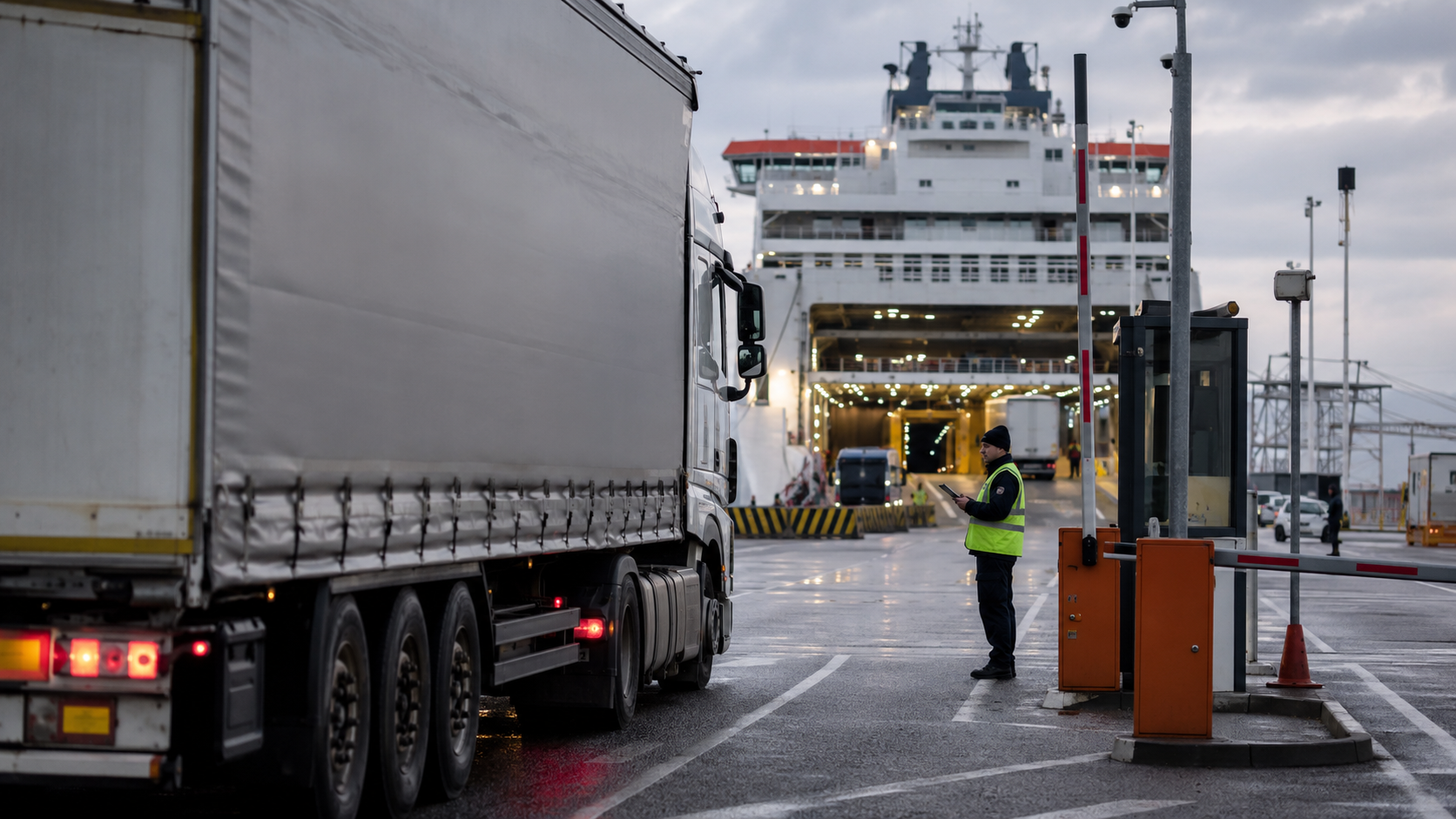
Brexit Has Turned Documentation Into an Operational Risk
Trade between the European Union and the United Kingdom continues to generate major opportunities for logistics companies, but Brexit has made cross-Channel road freight much more dependent on accurate advance documentation.
The challenge is no longer simply whether an import or export declaration exists.
Carriers, freight forwarders, importers and exporters need customs references, cargo information, safety and security filings, SPS documentation and UK border formalities to match the actual movement before the truck arrives at the terminal.
Since April 20, 2026, another mandatory element has been added on the French side: ELO.
For RoRo operators, it is one of the most significant procedural changes affecting France–UK freight movements in recent years.
What ELO Actually Is
ELO stands for Enveloppe Logistique Obligatoire, officially translated as the Obligatory Logistics Envelope.
It was developed by French Customs as part of the post-Brexit Smart Border.
ELO groups cargo information and references to the required customs and safety/security formalities under one digital reference and barcode.
The basic principle is straightforward: one transport unit equals one ELO.
The requirement applies to both loaded and empty trucks using the French Smart Border.
Depending on the movement, ELO can support import, export and transit operations in either direction.
The single barcode, however, does not eliminate the underlying declarations.
ELO is an envelope around existing formalities, not a replacement for them.
Preparation Must Happen Before the Truck Reaches the Port
One of the most important aspects of the new system is timing.
An ELO has to be created before the border crossing.
Participants in the supply chain should agree in advance which person or organisation will be responsible for assembling and closing the envelope.
The driver normally only needs the completed ELO reference or barcode at check-in.
If the envelope has not been prepared correctly, however, the problem appears immediately at the terminal.
This makes last-minute customs preparation increasingly risky for cross-Channel transport.
A Truck Without ELO Can Miss Its Crossing
French Customs allows ferry or shuttle operators to refuse boarding to a transport unit that does not have the required ELO.
If a vehicle is nevertheless accepted, another problem may arise.
Its related customs formalities may not be processed automatically during the crossing.
For exporters, that can create difficulties in obtaining confirmation that the goods have exited the customs territory correctly.
For the haulier, the operational consequences are more immediate: a missed sailing or shuttle, rebooking costs, vehicle downtime and lost driver hours.
ELO Does Not Replace the UK GMR
One of the most important details is that ELO is a French system.
The United Kingdom continues to operate the Goods Vehicle Movement Service, or GVMS.
Where GVMS applies, the movement is linked to a Goods Movement Reference, or GMR.
The two systems perform broadly similar consolidation functions, but they are not interchangeable.
A movement may require a GMR for the British side and an ELO for the French Smart Border.
French Customs specifically states that the GMR reference should not be entered into ELO.
UK customs formalities are also not simply copied into ELO because they concern the same truck.
The two digital border systems operate in parallel.
One Journey Now Interacts With Two Digital Borders
Since Brexit, a truck crossing the Channel can interact with both EU and UK customs environments during a single journey.
On the French side, ELO connects relevant French and EU declaration references.
On the British side, GVMS brings required references together into a GMR and supports the pre-lodgement model used on relevant RoRo routes.
Once a vehicle checks in and embarkation is confirmed, GVMS can trigger the arrival of the corresponding UK customs declarations.
Sequence therefore matters.
Declarations need to exist before the relevant envelope is created, refer to the correct consignment and have the appropriate status.
A valid-looking barcode cannot repair an incorrect customs declaration underneath it.
Data Inconsistency Is the Biggest Operational Risk
This is particularly important in RoRo because transit times are short.
A truck can enter a terminal and be on the other side of the Channel only a short time later.
Unlike long-distance container shipping, there may be very little time between customs preparation and arrival.
If an MRN refers to the wrong declaration, a reference is missing, the cargo has changed or SPS information does not match the actual consignment, the problem can emerge immediately at check-in or border control.
A few incorrect characters in a digital system can therefore immobilise an expensive truck carrying a commercially critical load.
Zero Tariffs Do Not Mean No Customs Border
Another continuing misunderstanding is that the EU–UK Trade and Cooperation Agreement preserved something close to pre-Brexit trade.
It did not.
The agreement allows qualifying goods to benefit from zero tariffs when the relevant rules of origin are met.
Zero duty is a preferential treatment, not the elimination of the customs border.
The origin of the goods must be established and the preferential treatment correctly claimed.
A product does not automatically become EU-origin simply because it was shipped from an EU member state.
Goods originally imported from a third country may therefore fail to qualify for the EU–UK preference unless the relevant origin rules have been satisfied.
An origin error can consequently lead not only to a delay but also to customs duty becoming payable.
EORI Numbers Remain Part of the Process
Companies also need to understand in which customs jurisdiction they are acting.
EORI registrations are used for customs operations, and depending on a company’s role, appropriate EU and UK registrations may be required.
But EORI numbers alone do not make a movement compliant.
A single international truck journey can involve an export declaration, import declaration, transit procedure, ENS, ELO, GMR and additional documents for controlled commodities.
The real challenge is therefore allocating responsibilities correctly between the exporter, importer, customs representative, forwarder and carrier.
Drivers Should Not Be Building ELO at the Barrier
The French model is specifically designed for advance preparation.
One party designated within the logistics chain creates the ELO before the transport unit reaches the border.
The driver receives the completed reference or barcode.
For hauliers, that requires a different form of dispatch control.
Before departure, a dispatcher should not simply ask whether “customs has been done.”
They need to know that all digital border references are ready and relate to the specific movement.
Changes to the consignment immediately before departure can therefore have consequences for the customs workflow even when the physical journey itself remains unchanged.
Returns Are Particularly Sensitive
Returned goods remain one of the more complicated areas of post-Brexit logistics.
Goods may originally move from the EU to a British customer, be rejected and then return through France.
Commercially, it may look like the same product coming back.
Customs law sees another movement across the EU’s external border.
The parties need to determine the customs status, the correct return procedure and whether Returned Goods Relief or another arrangement can be used.
If the shipment is also subject to sanitary or phytosanitary controls, the documentation becomes even more complex.
The physical road may be exactly the same in reverse, while the required documentation is entirely different.
SPS Controls Remain a Separate Layer
ELO does not replace sanitary and phytosanitary requirements.
Great Britain has progressively implemented its own import control framework under the Border Target Operating Model, or BTOM.
Animals, animal products, plants and other controlled commodities are placed into different risk categories.
Depending on the category, a consignment may require IPAFFS pre-notification, a health or phytosanitary certificate, documentary controls, identity checks and physical inspections.
Medium- and high-risk goods generally face more extensive requirements than low-risk shipments.
A truck can therefore have a perfectly valid ELO and GMR and still face a problem because the required SPS documentation is missing.
Import Conditions Can Change Very Quickly
International agri-food logistics faces an additional challenge because SPS restrictions can change in response to disease outbreaks.
A clear example emerged on May 1, 2026.
Great Britain suspended imports of porcine offal from the United States after an outbreak of Aujeszky’s disease was confirmed on a commercial pig farm.
Fresh porcine meat and meat products not containing offal were not subject to the same blanket suspension.
Additional treatment requirements were subsequently introduced for meat products containing domestic porcine offal.
For EU–UK road freight, the significance of the example is not the American origin of the cargo.
It shows how quickly the regulatory status of a commodity can change.
A product that was legally admissible under one set of conditions can require different documents or become temporarily restricted shortly afterwards.
Digital Borders Increase the Value of Customs Expertise
Automation is sometimes presented as reducing the role of customs specialists.
In practice, the opposite can happen.
When several processes are linked to one barcode, errors become visible sooner.
A poorly prepared shipment may previously have generated a problem after arrival.
Under the Smart Border model, it may fail before boarding.
AC Porath president Joanna Porath argues that companies gain an advantage when they eliminate border risks before the vehicle reaches the port.
That increasingly describes the economics of RoRo transport: fast physical movement depends on careful administrative preparation long before departure.
Responsibility Is Shared Across the Supply Chain
The driver cannot carry the entire compliance burden.
Exporters are responsible for accurate commercial information and origin documentation.
Importers need to ensure that destination-country requirements are met.
Customs representatives prepare declarations within their mandates.
Freight forwarders coordinate the movement and documentation.
Hauliers need to make sure they hold the references required for the route and can comply with check-in and inspection instructions.
For ELO specifically, the logistics chain should clearly designate the party responsible for creating the envelope.
If that is not agreed in advance, responsibility is often discussed only when the truck is already waiting at the terminal.
The Cost of a Documentation Error Can Exceed the Customs Fee
For a haulier, a delay is not simply a few lost hours.
The truck may miss a booked ferry or shuttle, the driver’s working-time schedule may be disrupted, a delivery slot can be lost and the movement may have to be rebooked.
Temperature-controlled cargo creates additional exposure.
In just-in-time manufacturing, one delayed truck can affect an entire production line.
The customer’s cost of disruption may be far higher than the freight charge.
Post-Brexit customs compliance has therefore moved from an administrative function into operational cost management.
K2Cargo.News has previously examined wider operational and regulatory problems affecting international road freight in Europe. ELO adds another digital control point to that increasingly complex environment.
What Changed on April 20
ELO did not introduce another conventional customs declaration.
It introduced a mandatory link between existing formalities and the individual transport movement.
That distinction matters.
Previously, businesses could focus on whether each document existed independently.
Now the full sequence needs to work as one process before the vehicle reaches the terminal.
Companies should know who creates the ELO, whether declaration references have the correct status, whether the consignment data is consistent, whether a GMR is ready where GVMS applies, and whether ENS, SPS and origin requirements have been satisfied.
Returns and re-export movements require particular attention.
Brexit’s Border Is Digital, but It Has Not Disappeared
The main misconception is that digitalisation automatically makes cross-border trade simple.
It can certainly make a correctly prepared movement faster.
One ELO barcode is easier for a driver to present than several separate French references.
At the same time, the Smart Border exposes unprepared journeys more quickly.
Since April 20, 2026, the competitive advantage on EU–UK routes increasingly belongs to companies whose documentation is created once, contains consistent data and is complete before the truck leaves.
In modern cross-Channel RoRo logistics, the border is no longer crossed only at the port.
In operational terms, the truck often crosses it earlier — in the customs or forwarding office where the ELO, GMR and underlying declarations are prepared.
Read also: Problems in Europe’s International Road Transport Sector