

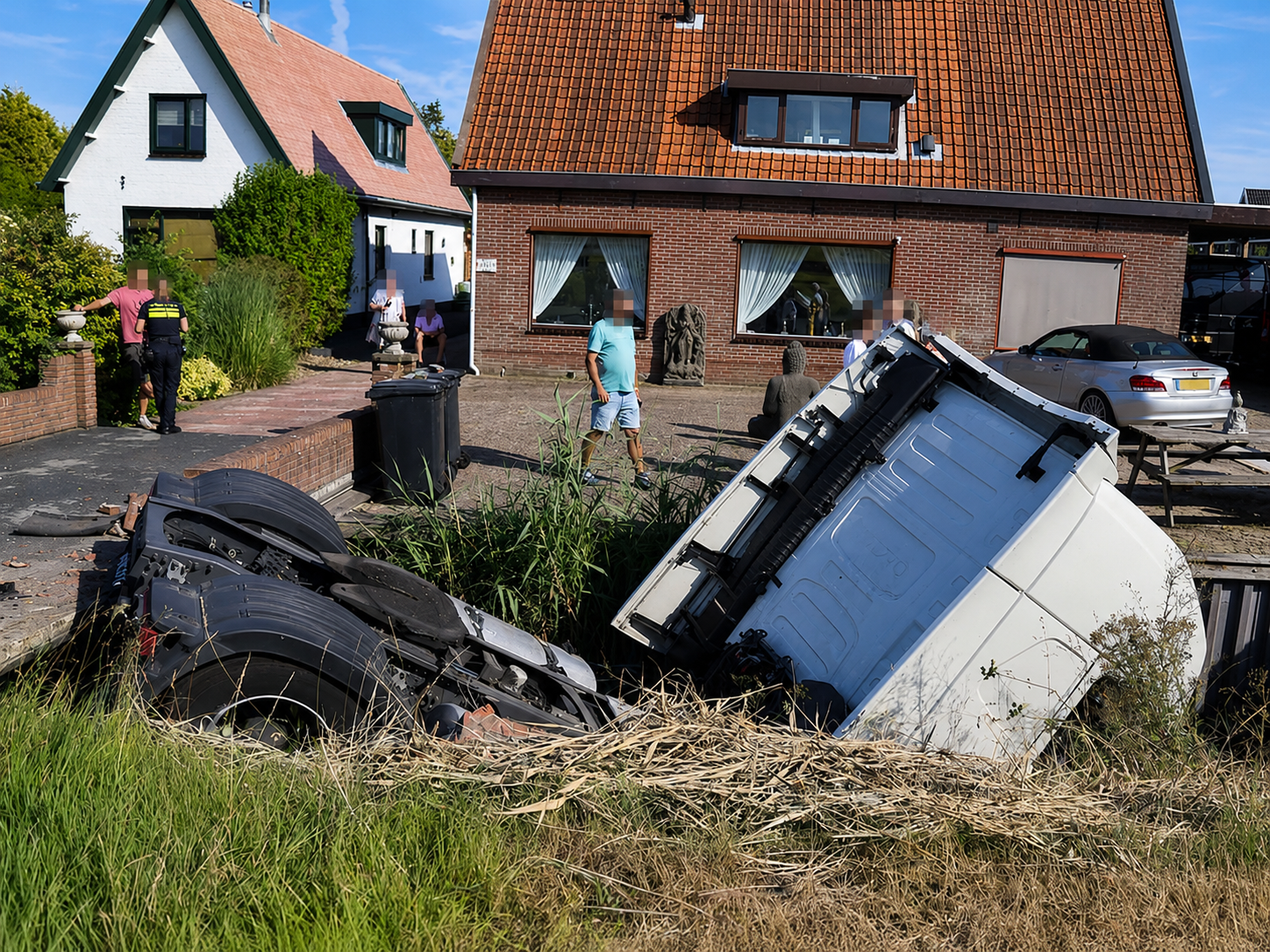
Truck Leaves Aalsmeerderweg
A heavy goods vehicle left the road and entered the water beside Aalsmeerderweg in the Dutch village of Rijsenhout.
The incident occurred on Sunday. Firefighters, police officers and ambulance personnel were dispatched to the location.
Paramedics examined the driver, who reportedly escaped without serious injury and did not require hospital treatment.
No information has been released about the vehicle type, its cargo, the transport company or the precise time of the crash. It is also unknown whether the truck was loaded or returning after a delivery.
Investigators have not established why the vehicle left the road.
Driver Was Taken to a Police Station
Following the medical assessment, police took the driver to a station because officers suspected that alcohol or drugs may have been involved.
Being taken to a police station does not prove that the driver committed an offence. A legal conclusion will depend on the results of the relevant tests.
At the time of publication, police had not announced whether alcohol or prohibited substances were detected. Authorities had also not disclosed whether the driver’s licence had been confiscated.
The case should therefore be described as an investigation into suspected impairment rather than a confirmed drink- or drug-driving offence.
Why Test Results May Take Time
Dutch police can initially investigate suspected drug use through an oral-fluid test and an assessment of psychomotor functions, speech and physical reactions.
Where the preliminary examination indicates possible drug consumption, a blood sample may be collected and sent to an authorised laboratory.
The final result can take several weeks. The Dutch government says police will often receive a laboratory report within approximately one month. The absence of an immediate public result therefore does not mean that the investigation has ended.
For the carrier, this creates an uncertain period in which decisions about the driver, truck and cargo may be required before the authorities complete their legal assessment.
Different Alcohol Limits Apply
An experienced driver in the Netherlands may not drive with a blood-alcohol concentration above 0.5 per mille.
A stricter limit of 0.2 per mille applies to novice drivers during the first five years after obtaining their initial licence. The limits also apply when the vehicle being operated is a heavy truck.
Separate legal thresholds exist for controlled drugs, while driving when the substances impair vehicle control is prohibited.
Where drugs are combined with alcohol or with other drugs, zero limits apply. Even relatively small quantities may therefore lead to prosecution when combined use is established.
Truck Remained in the Water Until Monday
The truck was not removed immediately and remained in the water until Monday.
A delayed recovery does not necessarily indicate a slow emergency response. Removing a heavy vehicle from water requires an assessment of its position, the strength of the surrounding ground and the ability to place lifting equipment safely.
Recovery teams must determine whether the truck can be lifted while still carrying its load. A loaded trailer can significantly increase the difficulty of the operation and create a risk of structural failure, cargo movement or crane instability.
In some cases, cargo must be unloaded or pumped out before the vehicle can be recovered. No information has been released about what the Rijsenhout truck was carrying or whether its contents had to be transferred.
Immersion Creates an Environmental Risk
A truck in water may create an environmental concern even when it is not transporting dangerous goods.
Diesel, engine oil, transmission fluids and hydraulic liquids can escape if tanks, pipes or components were damaged during the crash.
Before lifting the vehicle, specialists may inspect it for leaks and deploy containment equipment where necessary.
If the truck had been carrying chemicals, fuel, fertiliser or another regulated commodity, additional procedures would have been required. However, no dangerous cargo has been reported in this case, and there is no confirmed information that pollution occurred.
The bank and waterway may also require inspection after recovery, particularly where the vehicle damaged the slope or drainage infrastructure.
Aalsmeerderweg Runs Beside Polder Waterways
Aalsmeerderweg is not a major motorway. It is a straight polder road characterised by grass verges and waterways running alongside sections of the carriageway.
Municipal planning documents classify most of it as a local access road. A 60 km/h limit applies to sections outside built-up areas, while some developed sections operate under a 30 km/h regime.
Local authorities have previously noted that through traffic uses the road as an alternative to the busier A4 and N201 routes. Its layout, soft verges and adjacent waterways leave less room for recovery when a vehicle departs from its lane.
These characteristics do not establish the cause of Sunday’s incident. Investigators have not said whether the crash involved a mechanical problem, driver error, a medical event, distraction or impairment.
The Incident May Have Affected Local Freight
Rijsenhout is located in a transport-intensive area of North Holland near Aalsmeer, Schiphol Airport, greenhouse businesses and distribution facilities.
Local roads carry flowers, plants, food products, packaging, building materials and supplies for businesses across the region.
Keeping a heavy vehicle in the water until the following day may have required restrictions around the recovery site. Local carriers could therefore have faced diversions, altered arrival times or delays reaching nearby businesses.
There is no evidence of widespread freight disruption or a major impact on Dutch supply chains. The event should be viewed as a local road incident rather than a national logistics interruption.
The region’s principal motorways continued to carry transit traffic, while the operational impact remained concentrated around the recovery site.
Carrier Must Assess the Damage
Once the vehicle is removed, the transport operator will need a detailed technical inspection.
Even if the engine was not running underwater, damage may affect the electrical system, control modules, wiring, brakes, cab, transmission and wheel assemblies.
Attempting to start an engine before checking whether water entered it can increase the repair bill. Modern trucks contain extensive electronic equipment, and restoration after immersion may sometimes be commercially impractical.
The trailer and cargo must be assessed separately. Goods may appear undamaged but become unusable because of water exposure, contamination or a breach of storage conditions.
The insurer may request police documents, recovery reports, tachograph data, telematics and information about the driver’s condition.
Impairment Findings Could Affect Insurance
Where drink- or drug-driving is confirmed, the consequences can extend beyond an ordinary traffic fine.
A driver may face a driving ban, licence action, a compulsory education programme or a medical assessment. Repeat offences can result in the licence becoming invalid and the driver having to qualify again.
The transport company may also face an insurance dispute. The insurer may examine whether the driver complied with the policy and whether the employer maintained an effective safety and substance-control system.
Potential costs include vehicle recovery, repairs, environmental work, cargo transfer, replacement transport and missed delivery commitments.
The final allocation of those costs will depend on the investigation, ownership arrangements and the terms of the applicable insurance policies.
Driver Condition Remains a Central Safety Issue
Lane-keeping assistance, emergency braking and driver-monitoring systems can improve safety, but they do not remove human responsibility.
Alcohol and drugs can reduce reaction speed, coordination, distance assessment and the ability to control a heavy vehicle on a narrow road. Fatigue, mobile-phone use and medical problems can create similar risks.
A previous K2Cargo News report on the first fatal Tesla Semi crash examined a case in which loss of driver alertness became a preliminary investigative theory. It demonstrated that even advanced vehicles cannot fully compensate for a driver who is no longer able to respond safely.
Fleet safety therefore requires more than vehicle maintenance and tachograph compliance. Companies need a clear process for stopping a journey when dispatchers, colleagues or the driver have doubts about fitness to continue.
Carrier Needs an Internal Review
Regardless of the police test results, the transport company will need to reconstruct the events surrounding the crash.
The review should examine the route, speed, driving and rest periods, technical condition, tachograph records, telematics, dispatcher communications and any available camera footage.
An internal investigation should not assume that the driver was responsible. Its purpose is to determine whether the road departure could have been prevented and what measures are necessary before the vehicle or employee returns to service.
Carriers should also maintain procedures for vehicles entering water. These need to cover emergency notifications, cargo protection, environmental response, communication with insurers and replacement transport.
Police Investigation Will Determine the Cause
The cause of the Rijsenhout crash has not been officially established.
The results of the driver examination, technical inspection and reconstruction of the road departure have not been published.
It is therefore not possible to state that alcohol or drugs caused the incident. The confirmed point is that police considered further testing necessary and took the driver to a station.
The continuing investigation must determine whether the accident resulted from human condition, mechanical failure, road circumstances or a combination of factors.
Until official findings are released, the driver remains entitled to the presumption of innocence.
Read also: Nearly Half of Trucks Inspected in France Violated Driver Rest Rules