

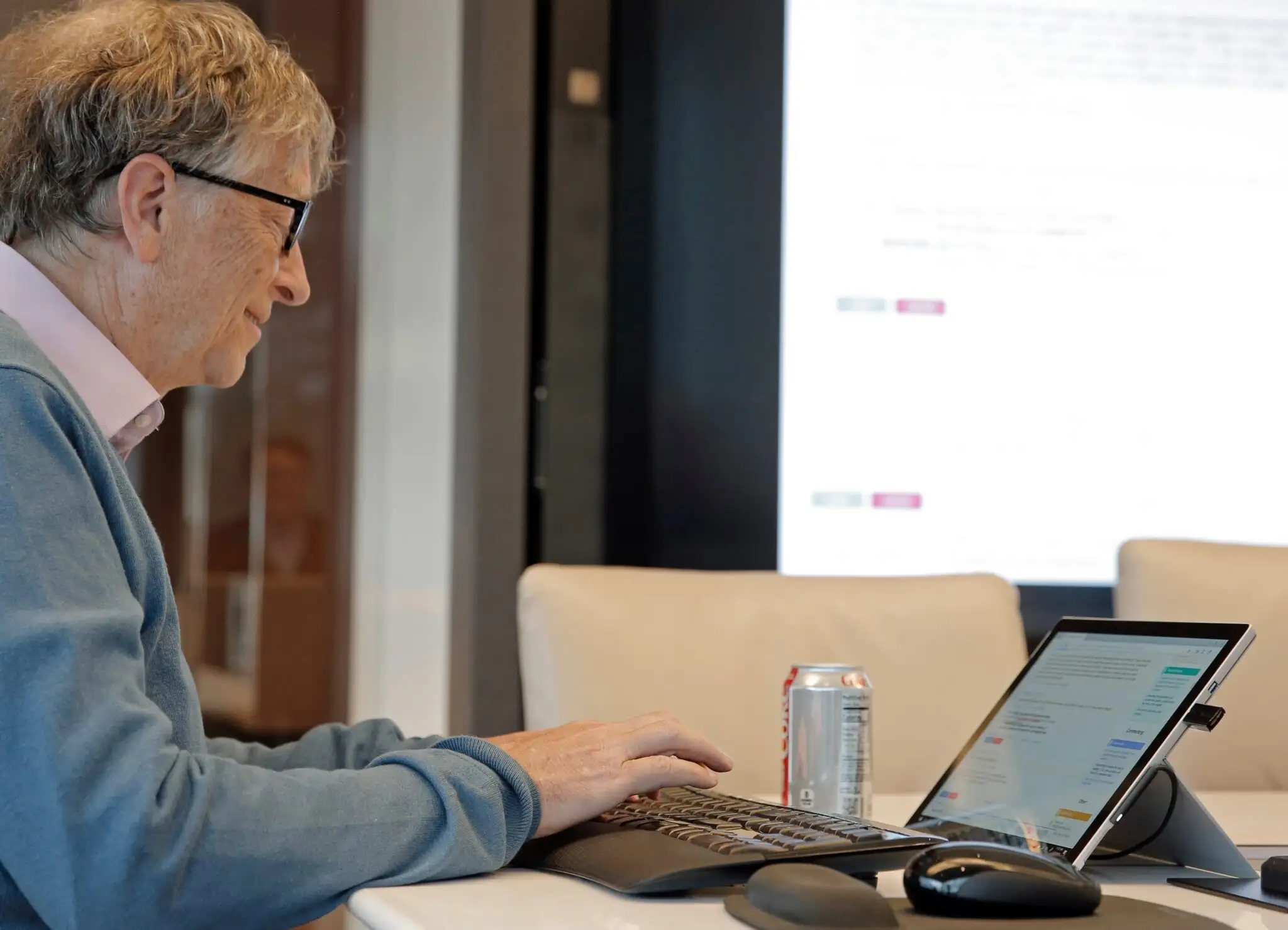
The Human Reserved concept would preserve occupations in which care, responsibility and direct human contact are considered essential
Some Jobs Could Be Protected From Automation
Microsoft co-founder Bill Gates has urged governments to prepare for the large-scale disruption that artificial intelligence could bring to the labor market. One of his proposals is a new Human Reserved category covering work that society deliberately chooses to keep in human hands.
The concept is not limited to jobs that AI cannot technically perform. Gates argues that some functions should remain human even if machines eventually become capable of completing them because their value depends on empathy, trust and personal relationships.
He cited the caregivers who looked after his father during the later stages of Alzheimer’s disease, describing the care they provided as irreplaceably human.
The same principle could apply to delivering a terminal diagnosis, caring for elderly people, raising children and performing other tasks in which the way a service is delivered matters as much as its measurable outcome.
Up to 40% of Jobs Could Remain Human
In an interview accompanying his major essay on artificial intelligence, Gates suggested that society might be able to preserve up to 40% of current jobs for humans.
This figure is not a proposed legal quota or an immediate ban on automating a fixed share of the economy. Gates acknowledges that important questions remain unanswered, including who would select protected occupations, which criteria would apply and how companies would be prevented from bypassing the rules.
Policies could also differ between countries. Economies with sufficient labor may choose to preserve human caregiving, while countries facing aging populations and severe worker shortages could be more willing to use robots.
Gates expects education and mental healthcare to adopt a mixed model in which a human professional remains responsible while using AI to increase productivity and expand access to services.
AI Tax Would Finance Retraining
Gates’s second major proposal involves restructuring taxation. He argues that governments should tax AI tokens and robots.
Employers currently pay payroll taxes and social contributions on employee earnings, while automated equipment can often be deducted as a business expense. Gates believes this creates a financial incentive to replace people with machines.
“The tax system nudges you toward replacing people with machines”
Revenue from the proposed tax could finance retraining, stronger social protection and assistance for communities where automation causes concentrated job losses or declining wages.
The measure would have to be targeted carefully. Gates warns that taxation should not delay beneficial AI applications that could make healthcare, education and other essential services less expensive and more widely available.
Implications for Logistics
Transport, warehousing and delivery are among the industries experiencing the fastest automation. AI is already being used for route planning, load allocation, demand forecasting, document processing and inventory management. Warehouses are deploying autonomous robots, automated conveyors and increasingly sophisticated order-picking systems.
A tax on AI usage and robotic equipment could alter the economics of these investments. Automated warehouses could take longer to deliver a return, while operators would have to reassess the relative cost of machines and human labor.
The Human Reserved concept could also affect safety-critical and accountability-related functions. Potential examples include dangerous-goods supervision, emergency response, critical dispatch decisions and communication with customers during major disruptions.
Gates has not proposed a specific list of transport or logistics occupations that should receive protection. Any designation would require consultation involving employees, companies, regulators and professional organizations.
Different Rules Could Distort Global Trade
Gates also highlights an international challenge. If one country restricts automation while another allows robots to perform almost every manufacturing operation, their companies will operate under different cost structures.
Businesses based in less restrictive jurisdictions could reduce production expenses more quickly, potentially influencing decisions on where to locate factories, warehouses and distribution centers. Robot taxes or protected-job categories may therefore require at least partial coordination between major economies.
Without common principles, policies intended to protect domestic workers could encourage companies to transfer automated production abroad and import the resulting goods.
Gates Calls for U.S.–China Cooperation
Gates argues that national regulation alone will be insufficient because the most serious AI risks extend across borders. He proposes an international oversight system combining elements of nuclear inspections, global aviation regulation and environmental agreements.
One of its responsibilities could be monitoring AI systems’ ability to design molecules and facilitate biological attacks. Governments may also need common restrictions on the release of models considered particularly dangerous.
Gates believes the United States should take the first step by proposing clear safety criteria, after which China could join the initiative. His representatives are working to arrange a possible meeting with Chinese President Xi Jinping during a tentatively planned November visit to China.
Human Reserved Remains a Concept
Gates’s proposal is not legislation and does not yet include a mandatory list of protected jobs. Instead, it raises a broader question: should societies preserve certain work for people even when machines can perform it faster and at lower cost?
Implementation would require rules for selecting occupations, financing worker support and managing international competition. Gates’s central argument is that governments must begin this work before widespread unemployment and social disruption emerge, rather than after the effects of automation become difficult to reverse.
