

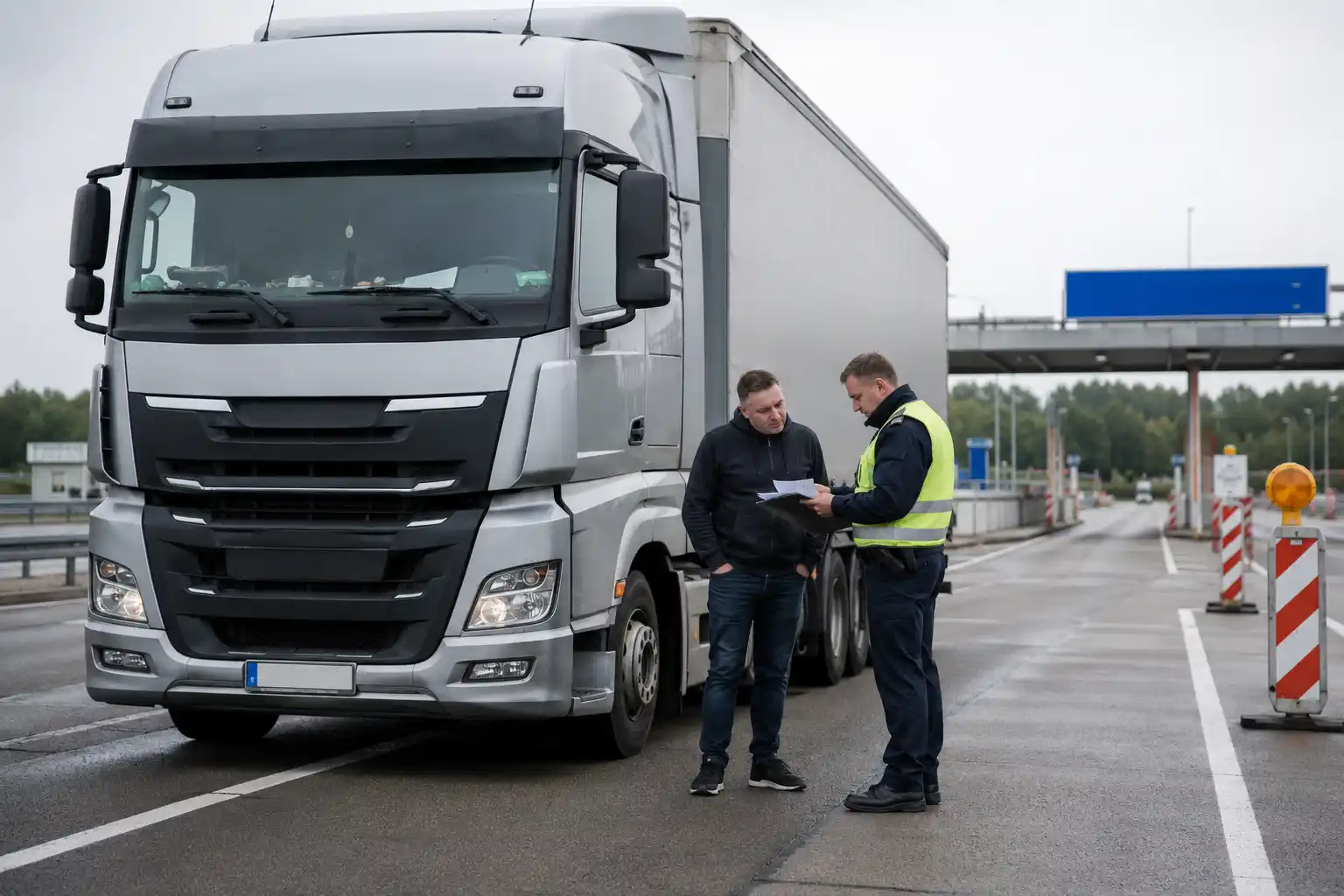
Foreign hauliers must apply German remuneration rules to qualifying driver postings, while MiLoG violations can result in fines of up to €500,000
Germany’s statutory minimum wage increased to €13.90 gross per hour on January 1, 2026. It will rise again to €14.60 on January 1, 2027, according to the Federal Ministry of Labour and Social Affairs.
The requirements are not limited to German companies. Foreign employers must also comply with German remuneration conditions when their employees perform work in the country and the operation qualifies as a posting.
This may require a Polish, Lithuanian, Romanian or other foreign haulier to pay its driver at least €13.90 gross for qualifying working time in Germany. However, the obligation depends not only on the driver’s physical presence but also on the type of transport operation being performed.
Germany adopted its Minimum Wage Act, known as the Mindestlohngesetz or MiLoG, on August 11, 2014. The nationwide statutory minimum wage took effect on January 1, 2015.
“The minimum wage has been €13.90 since January 1, 2026, and will increase to €14.60 on January 1, 2027,” the German Federal Ministry of Labour said
MiLoG requires workers to receive at least the statutory amount for every qualifying hour. An employer’s registered office outside Germany does not by itself remove this obligation.
Compliance is assessed by comparing the German minimum rate with the remuneration attributable to the relevant work. Allowances may be included only under specific conditions. Payments intended solely to reimburse the driver for travel, accommodation or food expenses cannot automatically be counted towards the minimum wage.
The claim that MiLoG applies identically to every hour spent by every foreign driver in Germany requires qualification. Special road transport posting rules under Directive (EU) 2020/1057 have applied since February 2, 2022.
A driver is considered posted when conducting cabotage in Germany and generally when performing a cross-trade operation between Germany and another country while the haulier is established in neither of those states.
Simple transit through Germany without loading or unloading is not treated as a posting under Directive 2020/1057. Bilateral transport between the haulier’s country of establishment and Germany is also exempt, including a limited number of additional activities permitted by the directive.
A haulier must therefore classify the journey before applying posting procedures. The presence of a truck on German territory does not by itself mean that an IMI declaration is required or that German remuneration conditions apply under the posting regime.
Where a driver qualifies as posted, the transport operator must submit a declaration before the operation begins through the EU Road Transport Posting Declaration portal.
A separate declaration is required for each host country. It can cover a period from one day to six months and must be updated when relevant information changes.
The portal is connected to the Internal Market Information System, or IMI. It replaced national notification procedures for hauliers established in EU member states. The European Commission confirms that the specialised driver-posting rules have applied since February 2, 2022.
During a roadside inspection, the driver must be able to present a paper or electronic copy of the declaration, evidence of the transport operation and tachograph records. Inspectors cannot automatically demand the company’s complete employment and payroll archive during every roadside check.
German enforcement authorities may subsequently request documents demonstrating compliance with remuneration rules. These can include an employment contract, payroll calculations, proof of payment, time records and information identifying the hours worked in Germany.
Requests to EU hauliers are submitted through IMI. The operator is generally required to provide the documents within eight weeks. Authorities may request German-language records or translations.
Section 17 of MiLoG requires employers covered by its recording obligations to document the beginning, end and duration of working time and retain those records for at least two years. This should not be interpreted as a universal two-year retention period for every corporate and accounting document, as other records may be subject to different employment, tax and commercial requirements.
For hauliers, tachograph records must be consistent with transport documents, IMI declarations and payroll calculations. Contradictory data may trigger a more extensive investigation.
As K2Cargo.News previously reported, EU road freight reached 1.886 trillion tonne-kilometres, with Germany remaining a major market for foreign operators. German labour requirements therefore affect a substantial volume of cross-border transport.
MiLoG is enforced by Finanzkontrolle Schwarzarbeit, the Financial Control of Undeclared Work unit within the German customs administration. Its inspectors can audit companies, review employment records and examine transport operations in Germany.
During a roadside check, officers can establish the driver’s identity, examine the circumstances of the work and request the documents permitted under the posting rules. The company may later receive a separate request for payroll records and proof of payment.
Enforcement covers both the amount and timing of remuneration. MiLoG generally requires the minimum wage to be paid no later than the final banking day of the month following the month in which the work was performed, unless an authorised working-time account applies.
Section 21 of MiLoG allows fines of up to €500,000 for failing to pay the statutory minimum wage or paying it late.. The same maximum may apply in certain circumstances to a contracting entity that commissioned the work and knew or should have known that the contractor was violating the rules.
Violations involving notifications, time records, document provision or cooperation with inspectors may result in fines of up to €30,000. The actual penalty depends on the nature and duration of the infringement, the number of workers and the amount underpaid.
A company may also be required to pay wage arrears and the corresponding social security contributions. Serious infringements can lead to exclusion from German public procurement procedures.
Section 13 of MiLoG establishes contractor liability within subcontracting chains. Its purpose is to prevent minimum-wage obligations from being avoided by outsourcing work.
This does not create unconditional liability for every German customer whenever a foreign haulier commits a violation. Its application depends on the company’s role in the contractual chain and the nature of the commissioned service.
German forwarders and shippers may reduce their exposure by requesting MiLoG compliance statements, evidence of IMI declarations and selected payroll documents from transport partners. These checks are particularly relevant to cabotage and cross-trade operations.
Foreign operators should classify each journey, record posting hours, submit declarations in advance and ensure that payroll calculations correspond with tachograph data. Misclassifying an operation can create both documentation violations and significant wage liabilities.
Read also: European truck bans in September 2026: key dates across nine countries