

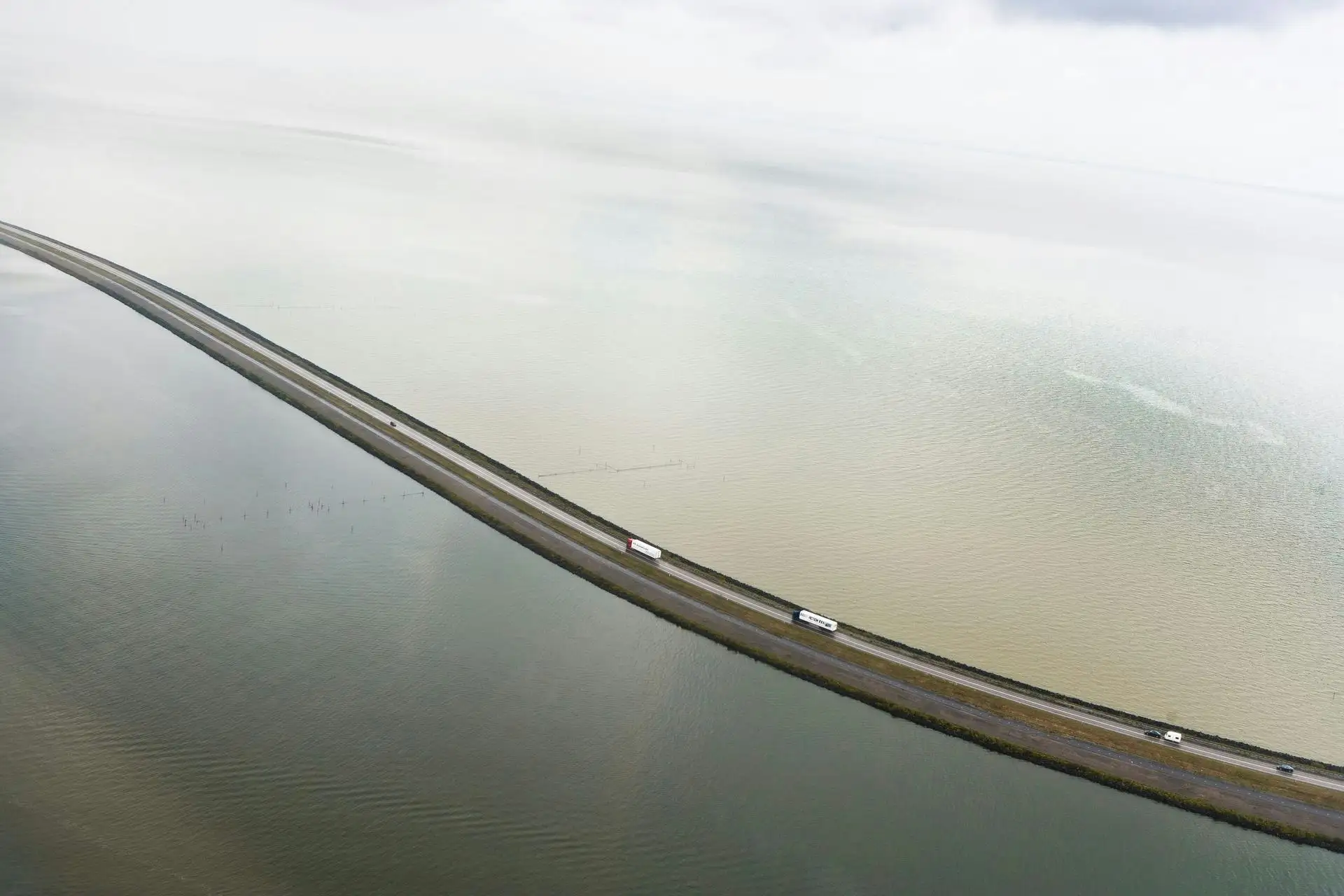
From autumn 2026, trucks exceeding a 7.3-tonne axle-load limit will have to bypass the Houtribdijk via Amsterdam or the Afsluitdijk
The Netherlands will introduce restrictions for heavy vehicles on the N307 across the Houtribdijk between Lelystad and Enkhuizen in autumn 2026. According to the official Rijkswaterstaat announcement, the maximum permitted gross vehicle weight, including cargo, will be 15 tonnes, while the load on any individual axle may not exceed 7.3 tonnes.
Most medium and heavy trucks will be unable to meet these requirements, effectively making the route unavailable to them. Passenger cars, emergency vehicles and vans will still be permitted to use the dam, provided that they remain within the new weight and axle-load limits.
The precise implementation date has not yet been announced. Rijkswaterstaat and the provincial authorities are preparing the required road signs and diversion arrangements. Heavy vehicles will be directed toward the surrounding A6 and A7 motorways.
The approximately 26-km Houtribdijk, also known as the Markerwaarddijk, separates the IJsselmeer from the Markermeer. The N307 running across it provides a direct road connection between the provinces of Flevoland and North Holland.
The restrictions are required because of the condition of the bridges within the Houtrib complex. The structures have been in service for more than 50 years and require replacement. Cracks have been identified in the movable bridges near the Houtrib locks, while the concrete in the fixed structures has deteriorated with age.
Inspections were conducted in early 2026, followed by additional checks on 24 and 25 August. Reducing the loads imposed on the bridges is intended to prevent further damage and keep the route available to lighter vehicles.
Rijkswaterstaat acknowledges that the volume of maintenance required across the Dutch transport network exceeds the available budget. The full reconstruction needed to remove the restrictions will be assessed under the national infrastructure prioritisation framework. No timetable for replacing the bridges has yet been confirmed.
Once the restrictions take effect, heavy vehicles will have to travel through the Amsterdam region or use the Afsluitdijk. Depending on the origin and destination of the journey, the diversion could add approximately 40–90 minutes to travel times.
The additional distance will increase fuel, driver and vehicle maintenance costs. Longer journeys will also make it more difficult to comply with drivers’ hours, complete several deliveries during one shift and arrive within agreed loading or unloading slots.
The greatest effect is expected to fall on hauliers regularly operating between West Friesland, Flevoland and the eastern Netherlands. For these businesses, the N307 provides the shortest connection while avoiding the already congested Amsterdam transport network.
The effect will be compounded by the country’s new road-charging system. As K2Cargo.News previously reported, the Netherlands introduced distance-based truck tolling on 1 July 2026. Longer diversions around the N307 will therefore increase not only fuel consumption but also road-user charges.
Transport en Logistiek Nederland believes the restriction is another sign of a wider problem affecting the country’s ageing infrastructure.
“Safety always comes first. But it is becoming increasingly difficult to explain why another important route is once again disappearing for freight traffic,” TLN director Jan Boeve said
He noted that, following the truck restriction on the Merwede Bridge, operators will again face additional costs, longer journeys and greater uncertainty when planning transport operations.
TLN welcomed the longer interval between the announcement and implementation of the Houtribdijk restriction, which will give companies time to adjust routes and notify customers. However, the association stressed that transport businesses will still bear the financial consequences.
“We are increasingly seeing bridges, viaducts and other critical connections being restricted or requiring accelerated maintenance. These are no longer isolated incidents,” Boeve said
The Houtribdijk problem forms part of a wider infrastructure challenge. A significant share of Dutch bridges and viaducts was built during the 1960s and 1970s. Since then, both traffic intensity and the weight of commercial vehicles have increased considerably.
In July 2026, similar concerns led to a truck ban on the Merwede Bridge carrying the A27 near Gorinchem. An investigation found that the actual strength of steel in certain parts of the arch structure was lower than previously assumed.
The N307 restriction will affect more than transport operators. Longer routes could raise the cost of supplying shops, construction sites and industrial facilities. Diverted traffic may also increase pressure on the A6, A7, the Afsluitdijk and roads around Amsterdam.
Hauliers using the Lelystad–Enkhuizen corridor should review their routes and customer agreements before the measure takes effect. Planning will need to account for the 15-tonne gross vehicle limit, the 7.3-tonne axle-load ceiling, longer journey times and potentially higher road charges. Rijkswaterstaat will announce the exact implementation date separately.
Read also: MSC controls more than one-fifth of the global container fleet