

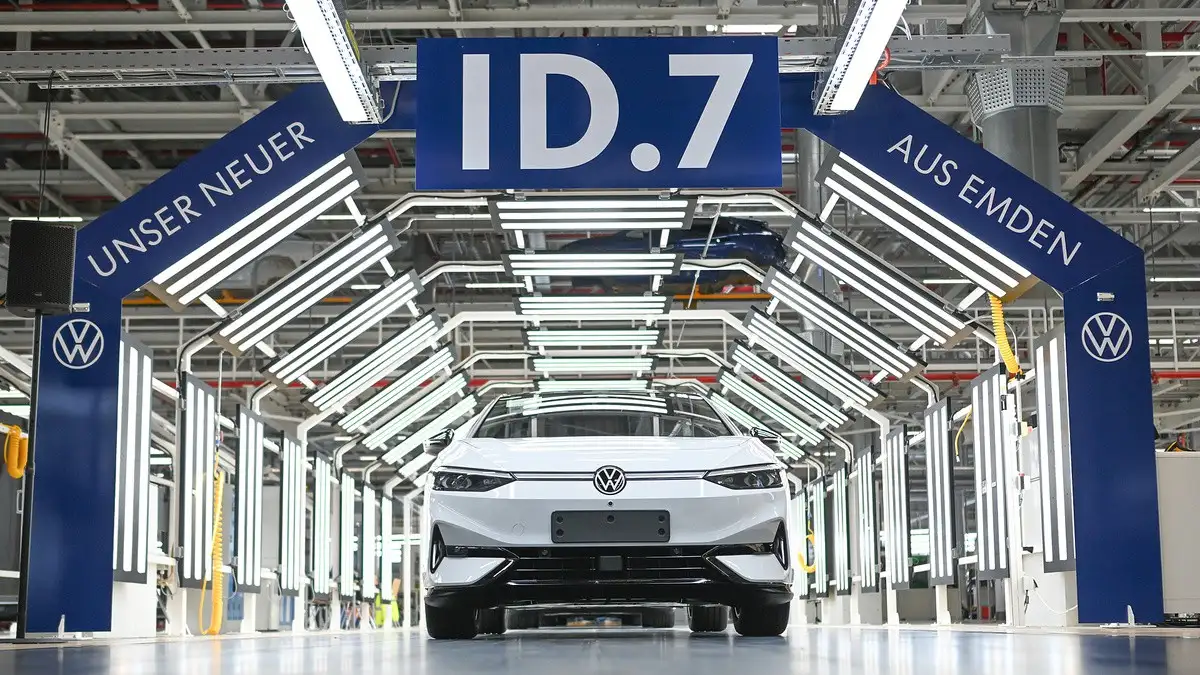
The restructuring programme could bring total workforce reductions across Volkswagen Group to approximately 100,000 positions
Volkswagen’s supervisory board has approved the most extensive transformation plan in the company’s 89-year history. The Future Plan 2030 programme includes approximately 50,000 additional job cuts worldwide, on top of another 50,000 positions already being eliminated.
The group’s total workforce reduction could therefore reach approximately 100,000 jobs. Volkswagen has not yet disclosed when the new round will be completed or how the cuts will be distributed among individual brands, factories and regions.
The restructuring is intended to address excess manufacturing capacity, US import tariffs, weak European demand and growing competition from Chinese automakers. Four major German facilities are under particular scrutiny: Volkswagen plants in Emden, Zwickau and Hanover, together with the Audi factory in Neckarsulm.
Volkswagen has not formally approved the closure of the four plants or specified how many employees could lose their jobs at each location. The group has, however, stopped guaranteeing that new models will be allocated to these factories after their existing production programmes end.
According to Reuters, Volkswagen will evaluate alternative uses for the facilities over the coming months.
Vehicle production at the Volkswagen factory in Emden could end in 2031. The facility specialises in electric vehicles and currently manufactures the Volkswagen ID.4, ID.7 and ID.7 Tourer. Its production capacity has already been reduced in response to underutilisation.
The Zwickau plant faces a similar outlook. It manufactures the Volkswagen ID.3, ID.4 and ID.5, Cupra Born and Audi Q4 e-tron. Volkswagen converted the site into one of its principal electric-vehicle manufacturing centres, but demand has remained below earlier forecasts. New model allocations beyond 2031 are no longer guaranteed.
Volkswagen Commercial Vehicles’ Hanover plant could lose its current production programmes from 2032. The facility manufactures commercial vehicles and participates in electric-vehicle production. Its future is particularly important for Europe’s van market and the associated component supply chain.
Audi’s Neckarsulm factory has the longest transition period. Existing model production could continue until 2034, but the plant may subsequently be left without replacement programmes. Neckarsulm is a major regional employer and manufactures premium Audi vehicles.
Reuters previously reported that more than 45,000 jobs could be at risk across the four factories. That does not mean every position will necessarily disappear. Volkswagen intends to consider alternative production programmes, repurposing and other options for keeping the sites operational.
Volkswagen estimates that its European factories have more than 500,000 units of excess annual production capacity. The company wants to reduce fixed costs while increasing utilisation at the remaining manufacturing lines.
Under Future Plan 2030, the group intends to reduce its model portfolio by approximately 50% and cut product complexity by around 75% by 2035. Investment will be concentrated on fewer models with higher production volumes and a smaller number of technical configurations.
Volkswagen is targeting annual sales of approximately 9 million vehicles and a 9% operating margin by 2030. Its operating margin stood at 3.8% during the first half of 2026.
The company nevertheless plans to invest €135 billion in capital expenditure, research and development between 2027 and 2031. The investment will support new vehicles, software, technology and measures intended to improve the competitiveness of individual brands.
The new workforce reduction will not be limited to the four German factories. Volkswagen has described the plan as a fundamental adjustment of its global workforce capacity, covering production facilities, management structures and divisions across the group.
Volkswagen Group includes Volkswagen, Audi, Porsche, Škoda, SEAT, Cupra, Bentley, Lamborghini and Volkswagen Commercial Vehicles, as well as truck manufacturers MAN and Scania. The company has not identified which brands will account for the largest share of the additional cuts.
It would therefore be inaccurate to claim that all 50,000 new reductions will take place in Germany. The four German factories face considerable uncertainty, but some of the cuts are likely to affect other countries and administrative operations.
“This is a strong signal for the future of Volkswagen Group. We are taking responsibility for our workforce, partners and industrial jobs worldwide.”
Oliver Blume, CEO of Volkswagen Group
Approval of the plan has allowed Volkswagen management to avoid a direct confrontation with labour unions and Lower Saxony, the group’s second-largest shareholder. Management had previously considered calling an extraordinary general meeting to advance the restructuring despite opposition from employee representatives.
The agreed programme will simplify the group’s structure and reduce the number of businesses and holdings owned by Volkswagen by approximately one-third. Management structures are expected to become flatter, with faster decision-making processes.
The supervisory board’s involvement in certain operational decisions will also be limited. Labour representatives have supported the broader transformation plan but insist that employees must not bear the entire burden. Negotiations over the future of Emden, Zwickau, Hanover and Neckarsulm are expected to continue for approximately ten months.
Reduced production at the four German plants could affect not only Volkswagen employees but also component suppliers, logistics companies, rail operators and finished-vehicle carriers.
A smaller model portfolio and the concentration of production at fewer factories could reduce some domestic transport flows. At the same time, transferring production to other locations would alter routes used for batteries, body components, electronics and finished vehicles.
The effects could be particularly significant around Zwickau and Emden, where specialised electric-vehicle supply chains have developed. For logistics providers, the decisive issue will be whether these factories receive alternative products or eventually stop manufacturing vehicles.
As K2Cargo.News previously reported, Chinese manufacturers are simultaneously expanding their European presence, including through the use of local plants to assemble electric commercial vehicles. This development is increasing competitive pressure on established European automakers and their suppliers.
Read also: SuperPanther eTopas 600 Enters European Production at Austria’s Steyr Plant