

Executive Summary
As of July 31, 2026, the situation is no longer merely a preparation for war. It is an ongoing major regional conflict. The U.S. operation against Iran began on February 28, 2026, and U.S. Central Command continued striking Islamic Revolutionary Guard Corps targets and Iran-linked forces at least through July 29. Israel is acting both as an independent belligerent and as Washington’s principal regional military partner. Iran has responded with missile and drone attacks against U.S. infrastructure and Gulf states, coercive maritime operations in the Strait of Hormuz, and the activation of affiliated armed groups in Yemen, Iraq, and Lebanon.
The Strait of Hormuz should be regarded as functionally closed or operating under a selective, force-backed Iranian control regime, but not as physically sealed. Iran has detained or attacked vessels and demanded coordination or permission for passage. At the same time, some tankers are still moving through the waterway. On July 31, two very large crude carriers and several other merchant vessels exited the Gulf, although traffic remained extraordinarily low. Before the war, average traffic was approximately 125 vessels per day, while on some days in July only about 11 passages were recorded. The most accurate description is therefore not a complete physical blockade, but a military, insurance, and operational blockade under which passage remains possible only intermittently and at very high risk.
The claim that China is already supplying Iran with weapons by air has not yet been confirmed as an established fact. Reuters reported an agreement involving as many as 300 to 400 Chinese QW-12 and FN-16 man-portable air-defense systems, valued at approximately $60 million to $70 million, with a proposed route from Urumqi through Pakistan. China and Pakistan have officially denied involvement, and no public evidence has yet demonstrated that the shipment actually arrived. There are no verified images of unloading, no confirmed flight chain, and no public serial-number evidence. This should be described as a credibly reported but disputed preparation for a weapons transfer, not as a proven air bridge.
Claims of Russian maritime supply are more complicated. A Caspian route between Russian and Iranian ports exists, its strategic value has increased sharply, and analysts have reported the movement of food, drone components, industrial goods, and other cargo through the Caspian corridor. Ukraine has said it struck vessels carrying Iran-linked military cargo and has accused Russia of providing satellite reconnaissance support to Iran. However, the contents, direction, and ownership of specific shipments are not always independently verifiable. The delivery of some components and intelligence support appears plausible; a large and continuous flow of complete Russian weapons systems by sea remains only partially substantiated.
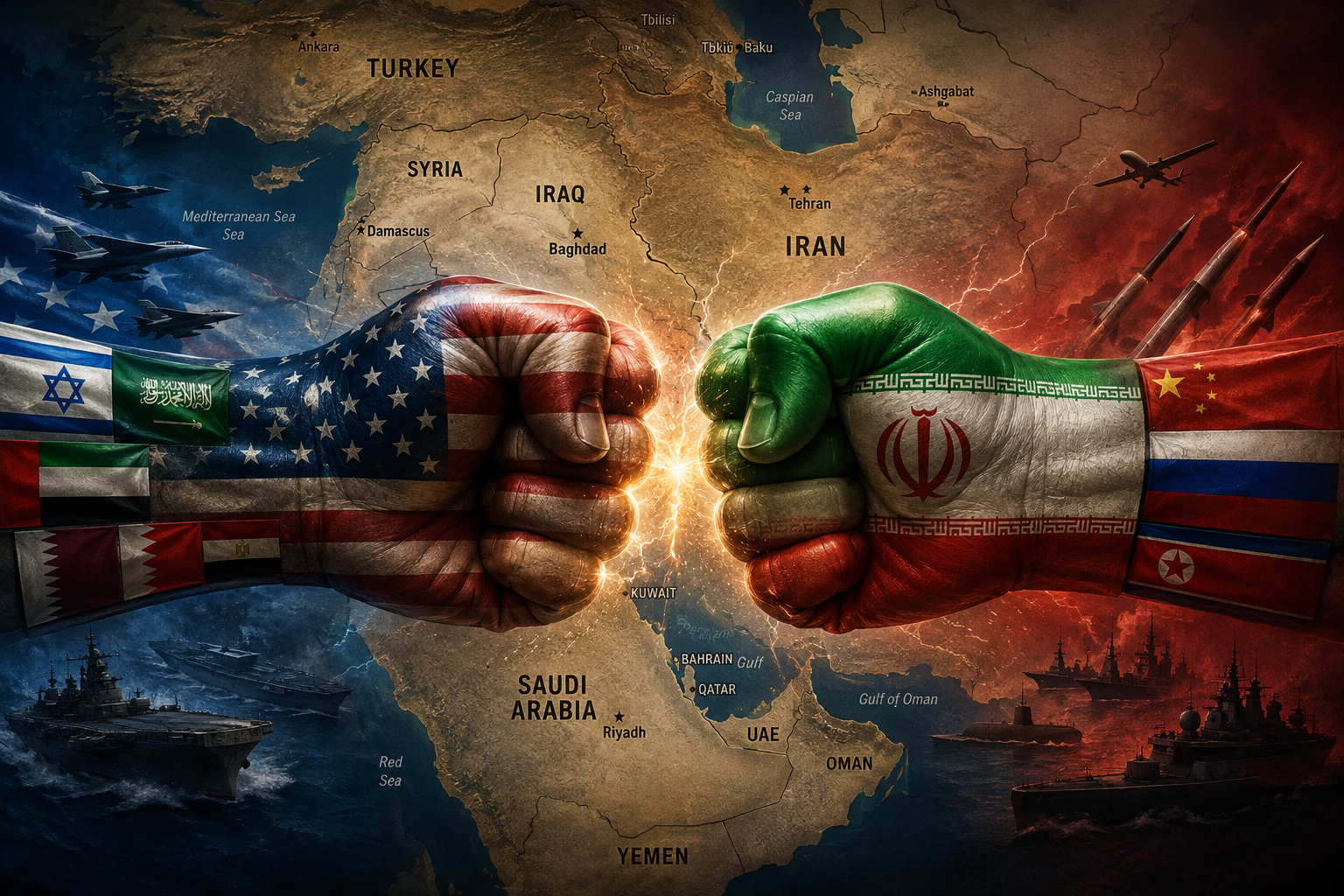
China, Russia, and North Korea do not form an Iran-centered equivalent of NATO. The Russia-Iran strategic agreement provides for military and intelligence cooperation, exercises, training, and port visits, but it does not create a binding mutual-defense obligation. China follows a strategic-partnership model without formal alliance guarantees. South Korean intelligence has assessed that North Korea had not supplied Iran with weapons or military materiel since the start of the war. These countries are therefore better described as external partners of Iran with different levels of involvement, rather than a unified military-political bloc.
The most likely outcome is not an immediate transition to a direct world war between the United States, China, and Russia, but a prolonged, multi-front regional war with global energy, transportation, cyber, and financial consequences. The most dangerous escalation chain would be:
- the simultaneous effective closure of the Strait of Hormuz and the Bab el-Mandeb;
- large-scale attacks on U.S. facilities in Gulf states;
- the entry of Saudi Arabia and other Gulf monarchies into offensive operations;
- expanded Russian and Chinese military support;
- attacks on critical infrastructure, satellites, and cyber systems;
- a crisis involving Iran’s nuclear facilities.
Fact-Checking the Core Claims and Mapping the Real Coalitions
Status of the Key Claims
| Claim | Assessment as of July 31, 2026 | What Is Confirmed | What Is Not Confirmed | Confidence |
|---|---|---|---|---|
| Iran has closed the Strait of Hormuz | Confirmed in a functional sense | A severe decline in traffic, detentions and attacks, vessels turning back, and Iranian demands for permission or coordination | A completely airtight blockade; some tankers continue to pass | High |
| China is supplying Iran with weapons by air | A planned transfer has been reported, but delivery has not been proven | Reports of a contract for 300 to 400 MANPADS and a proposed Urumqi-Pakistan-Iran route | Identified flights, verified unloading, and documented deployment in Iranian units | Medium for the plan; low for completed delivery |
| Russia is supplying Iran with weapons by sea | Components and dual-use shipments through the Caspian are plausible; scale remains unclear | Caspian corridor activity, reports of drone components, military-linked cargo, and satellite assistance | The exact weapons list, shipment volumes, and continuity of a large flow of complete systems | Medium |
| North Korea is actively supplying Iran | Not confirmed | Historical missile and military-technical cooperation | Current deliveries after February 28; South Korean intelligence has not detected them | Medium-high confidence that no visible flow exists |
| China, Russia, and North Korea are obligated to enter the war on Iran’s side | False | Political, economic, intelligence, and military-technical cooperation | A collective-defense treaty requiring intervention | High |
Russian-language media, including RBC and Kommersant, have extensively covered Iranian statements on the closure of Hormuz, Russian-Chinese voting in the United Nations Security Council, and reports of possible Chinese MANPADS deliveries. However, much of this reporting is based on Reuters, CNN, IRGC statements, or government sources. Such outlets are useful for Russian-language context, but specific weapons-transfer claims should be evaluated primarily through primary documents, vessel and aircraft tracking, satellite imagery, sanctions records, and multiple independent confirmations.
The Real Architecture of the Opposing Camps
| Alignment | Main Participants | Nature of the Relationship | Military Role |
|---|---|---|---|
| U.S.-Israeli core | United States, Israel | Close military, intelligence, technological, and operational cooperation | Air superiority, long-range strikes, missile defense, maritime interdiction, intelligence |
| Arabian partner network | Saudi Arabia, United Arab Emirates, Bahrain, Kuwait, Qatar, and partly Jordan | Bilateral defense relationships with the United States; important differences remain among the monarchies | Bases, air and missile defense, logistics, alternative energy routes, port protection |
| Red Sea coalition | Saudi Arabia and 13 states that declared support, including Turkey, Pakistan, Egypt, Sudan, and Djibouti | An emerging maritime coalition without a NATO-style collective-defense clause | Protection of the Red Sea, Bab el-Mandeb, and Gulf of Aden; intelligence sharing |
| Iranian state system | Iranian Armed Forces, IRGC, IRGC Navy, missile and drone branches | A unified state system with parallel conventional and revolutionary military structures | Missile and drone attacks, maritime coercion, mines, coastal missiles, cyber operations |
| Iran-linked regional network | Houthis, Lebanese Hezbollah, Iraqi armed groups, and other partners | Different levels of command and control, ranging from close coordination to situational cooperation | Secondary fronts, attacks on bases and shipping, geographic expansion of the conflict |
| Iran’s external partners | Russia, China, and potentially individual North Korean entities | No unified alliance; cooperation is bilateral and constrained by national interests | Diplomatic protection, oil purchases, components, intelligence, and possible air-defense or aviation support |
The Saudi-created maritime coalition is especially revealing. Representatives of 43 states and the European Union attended the meeting, but only 14 countries formally expressed support. The UAE and Oman were not listed among the supporters. This demonstrates that even the U.S.-aligned camp is not fully unified. Riyadh, Abu Dhabi, Muscat, Doha, and Ankara maintain different relationships with Iran, the Houthis, and Washington.
Military Preparations, Forces, and Infrastructure
Comparison of Military Capabilities and Logistics
| Category | United States, Israel, and Regional Partners | Iran and Affiliated Forces |
|---|---|---|
| Air power | Carrier-based and land-based aviation, stealth aircraft, strategic bombers, aerial refueling, airborne early warning, intelligence, and electronic-warfare platforms | Limited crewed aviation; primary emphasis on ballistic and cruise missiles, inexpensive strike drones, and dispersed launchers |
| Air superiority | Ability to suppress fixed radar sites, command centers, airfields, and known air-defense positions | Reliance on mobile launchers, decoys, tunnels, underground facilities, and large numbers of low-cost attack systems |
| Air and missile defense | Patriot, THAAD, Aegis, Arrow, David’s Sling, Iron Dome, and Gulf radar networks | Iranian and imported surface-to-air systems, short-range mobile systems, MANPADS, and emergency efforts to replace losses |
| Naval power | Carrier strike groups, destroyers with cruise missiles, submarines, naval aviation, amphibious forces, and maritime interception capability | Naval mines, missile boats, fast attack craft, coastal anti-ship missiles, strike drones, and unmanned surface vessels |
| Logistics | Global airlift and sealift, extensive base network, pre-positioned stocks, allied ports and airfields | Domestic industry, dispersed storage, Caspian routes, overland corridors, sanctioned airlines, and shadow shipping networks |
| Intelligence | Satellites, airborne early warning, maritime surveillance, commercial imagery, Israeli intelligence, and Gulf-state intelligence | National satellites and drones, human networks, maritime surveillance, and possible Russian satellite support |
| Main advantage | Precision, range, integrated intelligence-strike systems, and layered missile defense | Mass, low cost, geography, proxy networks, and the ability to impose an unfavorable exchange of cheap drones for expensive interceptors |
| Main limitation | Consumption of expensive interceptors and precision weapons, dependence on exposed bases, and coalition cohesion | Losses to command structures, naval assets, infrastructure, and air defenses; sanctions and dependence on imported advanced electronics |
U.S. Central Command has stated that air, naval, missile-defense, and ground assets were used after the operation began on February 28. Carrier forces, including the USS Abraham Lincoln strike group, were involved, while U.S. forces applied a form of maritime blockade against vessels bound for Iranian ports. CENTCOM’s public release record documented repeated nights of strikes in July, joint U.S.-Saudi attacks against Iran-linked forces in Iraq on July 28, and additional attacks on IRGC targets on July 29.
Iran’s asymmetric strategy does not require defeating the U.S. Navy in a conventional battle. It only needs to preserve the ability to stop, damage, or threaten merchant vessels periodically, create uncertainty over naval mines, persuade crews to refuse voyages, and drive up insurance premiums. A mix of mines, fast boats, anti-ship missiles, aerial drones, and unmanned maritime systems can maintain a threat to shipping even after major Iranian warships are destroyed.
Fleet, Aviation, and Air-Defense Deployments
The U.S.-Israeli side is preparing for a long campaign through carrier and surface-combatant rotations, tanker aircraft support, deployment of additional Patriot and THAAD interceptors, and use of a broad base network surrounding Iran. Publicly known infrastructure includes U.S. naval facilities in Bahrain, command and logistics capacity in Qatar, air bases and missile-defense positions in the UAE, Saudi Arabia, and Kuwait, as well as locations in Jordan and the eastern Mediterranean. Exact current numbers of aircraft, missiles, and personnel are not publicly disclosed, and figures reported by the belligerents require cautious interpretation.
The UAE, Bahrain, and Kuwait have publicly reported interceptions of Iranian missiles and drones. Official Emirati statements have listed very large cumulative interception figures that changed as the war developed. Regardless of the exact totals, the statements confirm a sustained and intense burden on Gulf air-defense systems. Defense analysts have noted that Arab states began accelerating interceptor purchases and counter-drone investments after the initial phases of the war.
Iranian preparations are focused on preserving retaliatory capacity after fixed sites are destroyed. Core elements include dispersal of mobile missile launchers, underground storage, decentralized launch authority, accelerated drone production, deployment of decoys, reconstruction of short-range air defenses, and mining or simulated mining of shipping lanes. Analysts have assessed that Iranian units were able to respond within hours of the initial attacks, indicating that launch procedures had been decentralized in advance.
Strikes on Infrastructure and the Likely Targeting Logic
The observable logic of the U.S.-Israeli campaign includes attacks on command centers, missile production and storage facilities, naval bases, airfields, air-defense positions, IRGC facilities, and sites associated with Iran’s nuclear program. The campaign seeks to reduce the rate of retaliatory launches, disrupt command structures, and prevent Iran from quickly replacing missiles and drones. However, air superiority does not automatically eliminate Iranian retaliation or reopen the Strait of Hormuz.
Iran and affiliated groups prefer targets with the greatest political and economic impact: U.S. bases, airfields, missile-defense radars, oil terminals, refineries, desalination plants, ports, tankers, and export pipelines. The Houthis have already attacked facilities near Yanbu and Jizan. Yanbu has become more important because Saudi Arabia’s east-west pipeline system can divert some oil to the Red Sea and bypass Hormuz. A persistent threat to Yanbu, the Bab el-Mandeb, and the Strait of Hormuz at the same time would sharply reduce the value of alternative export routes.
Supply Routes, Logistics Hubs, and Weapons Transfers
Main Supply Routes
| Route | Likely Hubs | Possible Cargo | Status and Vulnerabilities |
|---|---|---|---|
| United States and Europe → Mediterranean → Suez → Red Sea → Arabian Sea | European bases, Suez Canal, Bahrain, Saudi and Emirati ports | Munitions, missile interceptors, aviation spare parts, fuel, and equipment | Active but dependent on security in the Red Sea and Bab el-Mandeb; routing around Africa increases transit time |
| U.S. strategic air bridge → Gulf states | Qatar, Bahrain, Kuwait, Saudi Arabia, UAE, Jordan | Interceptors, precision munitions, radars, spare parts, and personnel | The fastest channel, but dependent on overflight permissions, runway availability, and airfield protection |
| China → Urumqi → Pakistan → Iran | Urumqi, Pakistani air or ground transit points, Iranian cargo airfields | Reported QW-12 and FN-16 MANPADS, electronics, optics, and dual-use technology | A reported plan; China and Pakistan deny participation; the route is politically sensitive and comparatively easy to monitor |
| China → Indian Ocean → southern Iranian ports | Chinese ports, Strait of Malacca, Indian Ocean, Chabahar or Bandar Abbas area | Container cargo, machine tools, electronics, chemical components, and potentially weapons | Constrained by U.S. maritime surveillance, blockade conditions, and insurance risk |
| Russia → Caspian Sea → northern Iran | Astrakhan, Olya, Makhachkala, Bandar Anzali, and other Iranian Caspian ports | Grain, industrial goods, drone components, spare parts, and potentially air-defense systems or ammunition | Strategic importance has increased sharply; it bypasses Hormuz but remains vulnerable to sanctions, sabotage, and Ukrainian strikes |
| Russia → Azerbaijan → Iran | Rail and road segments of the International North-South Transport Corridor | Heavy and containerized cargo, fuel, and dual-use equipment | Requires Azerbaijani transit approval and political neutrality; border crossings are relatively easy to monitor |
| Russia → Kazakhstan or Turkmenistan → Iran | Caspian ferries and Central Asian railways | Industrial equipment, raw materials, and components | A longer route, but useful for dispersing cargo flows |
| Iran → Iraq, Syria, and Lebanon | Western land crossings, Iraqi roads, and airfields | Missiles, drones, components, cash, and specialists | Exposed to Israeli and U.S. strikes and dependent on local governments and armed groups |
| Iran → Yemen | Arabian Sea routes and transfer to small vessels | Missiles, engines, navigation systems, drone parts, and explosives | Difficult to close completely because parts can be moved separately and assembled locally |
| Iranian aviation network | Mahan Air and affiliated carriers, civilian cargo flights | IRGC personnel, equipment, and weapons components | Under intensive sanctions and monitoring; U.S. authorities describe Mahan Air as an important IRGC logistics channel |
The Caspian route is the most logical channel for Russian support to Iran because it avoids the Strait of Hormuz and maritime chokepoints controlled or monitored by NATO states. Bandar Anzali is widely viewed as a central node in the International North-South Transport Corridor. However, the Caspian can no longer be treated as a completely safe rear area. Ukraine has reported attacks on Russian military and transport vessels linked to Russia-Iran trade.
A Chinese air route would be faster than the Caspian corridor but politically more dangerous for Beijing and Islamabad. Repeated flights by heavy military transports from western China could be tracked by commercial satellites, radar networks, and notices of airspace closures. A more likely method would involve civilian cargo aircraft, transshipment, false cargo declarations, or a combination of air and road transport. This remains an analytical assessment, not proof that such a route has already been activated.
Weapons and Likely Sources
| Recipient | Weapon or Supply Type | Likely Source | Reported Volume | Status |
|---|---|---|---|---|
| Iran | QW-12 and FN-16 MANPADS | China through a commercial intermediary, with reported transit through Pakistan | 300 to 400 systems, valued at $60 million to $70 million | Reuters reported a contract; delivery remains unconfirmed and China and Pakistan deny involvement |
| Iran | Anti-ship missiles | China | No reliably established quantity | Discussions and Iranian interest have been reported, but transfer has not been confirmed |
| Iran | Shahed or Geran drone components, engines, and electronics | Russia, China, and international dual-use procurement networks | Unknown | Reports of a Russian flow through the Caspian are plausible, but exact quantities remain classified or uncertain |
| Iran | Russian-origin aircraft, helicopters, MANPADS, and air-defense equipment | Russia | Analytical sources mention Su-35 and Verba-related agreements; implementation data is incomplete | Partly contracted or discussed; the current delivery rate is opaque |
| Iran | Missile technology and production knowledge | Domestic industry; historically North Korea, China, and Russia | Not publicly quantifiable | Most production is now domestic; current North Korean assistance has not been observed |
| Iran | Naval mines, fast boats, and unmanned surface vessels | Domestic production and adaptation of commercial components | Stockpiles unknown | Capability remains even after losses of larger vessels |
| United States and Israel | Precision-guided bombs, cruise missiles, and anti-radiation weapons | U.S. industry and allied stocks | Current volumes classified | Being consumed actively; a long war will place pressure on production capacity |
| United States and Gulf states | Patriot, THAAD, SM-series, and other interceptors | United States and allied inventories | Independent estimates indicate significant depletion of some inventories | One of the main constraints in a prolonged war |
| UAE and Saudi Arabia | Counter-drone systems, radar, and mobile air defense | United States, Europe, Israel, and domestic industry | Accelerated replenishment without full contract disclosure | A high priority after mass drone and missile attacks |
| Houthis and Iraqi armed groups | Drones, missiles, navigation systems, engines, and explosive components | Iranian industry and covert procurement networks | Unknown | Transfers often occur in component form, with local assembly |
The main military-industrial problem for the U.S.-aligned camp is not a shortage of aircraft but the rate at which missile-defense interceptors are being consumed. Intercepting a ballistic missile or a low-cost drone may require a much more expensive interceptor, and new Patriot, THAAD, and naval missiles are produced more slowly than they can be expended during a multi-month campaign. Analysts have warned of significant depletion of selected U.S. and regional inventories and an urgent need to rearm Gulf states.
Iran faces the opposite problem. It can manufacture large numbers of relatively inexpensive attack systems, but advanced components such as modern processors, optics, engines, inertial navigation systems, radar equipment, and aviation technology depend on imports. Sanctions enforcement therefore targets not only complete weapons but also small intermediaries in China, the UAE, Turkey, Pakistan, India, Iraq, and Southeast Asia.
Economic, Cyber, Intelligence, and Civil-Defense Preparations
| Area | Observed Measures | Military Significance |
|---|---|---|
| Sanctions and financial pressure | Restrictions on Iranian oil, aviation, shipping, and procurement networks, along with pressure on intermediaries and payment channels | Slows the import of electronics, fuel, spare parts, and weapons while increasing the cost of sanctions evasion |
| Marine insurance | Higher war-risk premiums, exclusions from coverage, special surcharges, and crew rights to refuse voyages | Can halt commerce without physically destroying every ship |
| Energy reserves | The International Energy Agency approved the release of 400 million barrels; about 290 million had reportedly been released by July 21 | Reduces the price shock and supports allied economies during a prolonged disruption |
| Rerouting energy flows | Greater use of export routes outside the Gulf, including Yanbu and Fujairah, as well as increased U.S. oil exports | Reduces dependence on Hormuz, but shifts risk toward Red Sea and external terminals |
| Cyber operations | Iran-linked groups targeting poorly secured industrial controllers, water systems, energy networks, transport, and other operational technology | Can disrupt infrastructure without a missile strike and overload emergency services |
| Electronic warfare | Possible GNSS jamming, AIS spoofing, and attacks on drone-control links | Interferes with ship navigation, drone operations, and weapon accuracy |
| Satellite reconnaissance | U.S., Israeli, and commercial systems; reports of Russian imagery support to Iran | Locates bases, radars, aircraft, ships, warehouses, and damage from previous strikes |
| Counterintelligence | Screening at ports and airfields, disruption of sabotage networks, and communications restrictions | Reduces the effectiveness of targeting networks but may weaken civilian administration |
| Information operations | Competing narratives about whether Hormuz is open, combat losses, interception rates, and the legality of strikes | Shapes public support, intimidates shipowners, and builds diplomatic legitimacy |
| Civil defense | Diplomatic evacuations, travel warnings, airspace closures, and shelter activation | Reduces casualties and signals expectations of continued escalation |
| Diplomacy and international law | U.N. resolutions, Russian-Chinese vetoes, Omani mediation, and maritime coalitions | Creates legal and political frameworks for escort missions, sanctions, inspections, and military operations |
Energy and Insurance Warfare
In March, global oil supply reportedly fell by 10.1 million barrels per day, which the International Energy Agency described as the largest supply disruption in history. The U.S. Energy Information Administration estimated that Saudi Arabia, Iraq, Kuwait, the UAE, Qatar, and Bahrain were forced to curtail millions of barrels per day of production as storage filled and normal exports became impossible. After a temporary June arrangement, shipping partly recovered, but renewed escalation in July increased the risk of another sharp decline.
The insurance mechanism can be as important as naval mines. In active war zones, war-risk premiums can rise dramatically. For a large tanker, the surcharge may approach $1 million for a single voyage. If major protection-and-indemnity clubs exclude Hormuz, the Bab el-Mandeb, or individual ports from standard coverage, shipowners may suspend traffic even without a formal Iranian order.
Russia has an economic interest in a prolonged but controlled crisis. Higher prices increase its oil and gas revenues, while restrictions on southern Iranian ports make Tehran more dependent on Caspian routes and Russian infrastructure. However, a full-scale war in the Caspian, collapse of the Iranian state, or a direct clash with the United States would create far greater risks for Moscow than benefits.
China faces an even sharper contradiction. Beijing wants Iran to survive as an anti-U.S. partner and oil supplier, but it does not benefit from a long closure of Hormuz, which carries a large share of Asian energy imports. The most rational Chinese strategy would therefore be diplomatic pressure, selective defensive support, economic assistance to Iran, and efforts to secure exceptions for Chinese shipping, rather than direct entry of the People’s Liberation Army Navy into the war.
Cyber Operations, Electronic Warfare, and Intelligence
In an updated July 22 warning, the U.S. Cybersecurity and Infrastructure Security Agency said Iran-linked groups continued targeting internet-accessible industrial controllers and other operational technology. Likely targets include energy, water, transportation, ports, logistics companies, and facilities symbolically connected to the United States or Israel. Cyber operations are attractive to Iran because they can expand the geographic scope of conflict while preserving uncertainty over state responsibility.
Ukrainian reports that Russia has supplied Iran with satellite imagery cannot be regarded as fully independently proven, but they are technically plausible. Even without transferring complete weapons, Russia could provide commercial or military imagery, electronic-intelligence products, assessments of airfield activity, ship movements, and battle-damage analysis. Such support is politically less risky than deploying Russian military units, but it could materially improve Iranian targeting.
Early indicators of air or maritime operations include an increase in GNSS interference, false AIS positions, mass transponder shutdowns, navigational warnings closing sea areas, unusual NOTAMs, internet restrictions, and the transfer of national networks to internal operating modes. Each indicator can have a benign technical or administrative explanation. Their simultaneous concentration around ports, bases, and chokepoints is far more significant.
Information and Legal Warfare
Iran uses a dual legal and political formula. Domestic and regional audiences are told that the strait is closed and that the IRGC determines the conditions of passage. Internationally, Tehran can argue that navigation has not been completely prohibited, but merely subjected to “security coordination.” This allows Iran to intimidate shipowners while avoiding a formal declaration of a classical blockade, which could be treated as an act of war.
The United States, by contrast, demands unconditional passage through international shipping lanes without Iranian fees or permission. The United Nations Security Council adopted Resolution 2817 on March 11, condemning Iranian missile and drone attacks on regional states. A later draft demanding the opening of Hormuz failed because of opposition from Russia and China. This demonstrates that Moscow and Beijing are prepared to provide diplomatic protection to Iran without directly entering the war.
Preparing Civilian Populations
British and U.S. travel advisories issued in July 2026 recommended avoiding travel to Iran, reconsidering transit through the region, and monitoring airport operations. Similar guidance for Israel, the UAE, and Saudi Arabia referred directly to renewed strikes after July 8 and the risk of unpredictable escalation. Governments are therefore treating aviation disruption, border closures, and new attacks as practical possibilities rather than remote scenarios.
Comprehensive civil-defense preparations in the region would require distributed shelters, backup water and energy sources, hardened command centers, medical reserves, multilingual public-warning systems, and evacuation plans for foreign workers. The UAE, Qatar, Bahrain, and eastern Saudi Arabia are particularly vulnerable because population centers and industry are concentrated around ports, energy facilities, desalination plants, and U.S. bases.
Escalation Scenarios and Timeline
Scenario Comparison
| Scenario | Probability | Consequences | Main Triggers |
|---|---|---|---|
| Limited navigation arrangement | Medium | Partial restoration of exports, lower prices, continued strikes outside the strait | Omani mediation, notification and inspection mechanisms, temporary pause in attacks on shipping |
| Prolonged regional war of attrition | High | Periodic strikes, selective Hormuz access, missile-defense depletion, sanctions, and permanently higher insurance costs | Failed negotiations combined with reluctance to begin a ground war |
| Simultaneous crisis in Hormuz and Bab el-Mandeb | Medium-high | Severe global transport and energy shock, overloaded routes around Africa, threats to Suez and Yanbu | Mass Houthi attacks, a Saudi offensive in Yemen, and attacks on Red Sea ports |
| Full Saudi and partial GCC entry into offensive operations | Medium | Expansion of the air war and Iranian attacks on Gulf oil infrastructure and cities | Mass casualties at a base or oil facility, attack on Yanbu, or major civilian deaths |
| Expanded Russian and Chinese military support | Medium for covert support; low for overt intervention | Restoration of Iranian air defenses, drones, and intelligence, plus heavier sanctions pressure on Russia and China | Threat of regime collapse, destruction of most Iranian air defenses, or a prolonged blockade |
| Direct U.S. confrontation with Russia or China | Low, but increasing if miscalculation occurs | Transition from a regional war to a global confrontation | Strike on a Russian or Chinese ship or aircraft, death of military advisers, or an attempt to force a blockade |
| Attack on nuclear facilities with a radiological incident | Low-medium | Mass evacuation, international crisis, and increased risk that Iran moves toward a nuclear-weapons program | Loss of IAEA access, signs of accelerated enrichment, or strikes on facilities containing nuclear material |
| Internal collapse or civil war in Iran | Low-medium | Loss of control over missiles, ports, and nuclear sites, with possible foreign intervention | Collapse of central command, IRGC fragmentation, mass protests, or regional separatism |
The most dangerous scenario is a two-strait crisis. Hormuz constrains exports from the Persian Gulf, while the Bab el-Mandeb controls access between the Red Sea and Indian Ocean. Attacks on Yanbu and Jizan show that the Houthis can threaten infrastructure specifically designed to bypass Hormuz. The emerging Saudi maritime coalition is a response to this risk.
Direct Russian or Chinese entry remains less likely than covert arms transfers, diplomatic protection, satellite intelligence, and economic assistance. Russia has no treaty obligation to defend Iran. China avoids alliances that automatically pull it into war and depends heavily on stable energy imports. North Korea has also remained distant so far.
Timeline
February 28, 2026
- Start of the U.S. operation against Iran.
- Expansion of the U.S.-Israeli air campaign.
- First major Iranian missile and drone retaliation.
March 2026
- Severe reduction in traffic through Hormuz.
- Strikes on bases and Gulf-state infrastructure.
- Deployment of additional air and missile defenses.
- Adoption of U.N. Security Council Resolution 2817.
- International Energy Agency decision to release 400 million barrels from reserves.
April-May 2026
- U.S. maritime blockade measures and vessel inspections.
- Continued attacks on Iranian naval, air-defense, and missile infrastructure.
- Russian-Chinese blocking of a resolution on Hormuz.
- Higher insurance premiums and partial production shutdowns in Gulf states.
- Expansion of the Russia-Iran Caspian route.
June 2026
- Temporary U.S.-Iran arrangement.
- Partial recovery in shipping.
- Lower oil prices and expectations of de-escalation.
July 8-31, 2026
- Renewed U.S. and Iranian strikes.
- Another severe decline in traffic through Hormuz.
- Houthi attacks on Saudi infrastructure.
- U.S.-Saudi strikes on Iran-linked groups in Iraq.
- Formation of a Saudi-led maritime coalition.
- Reports of a planned Chinese MANPADS transfer.
- New tanker incidents on July 31.
Coming Weeks
- De-escalation option: an Oman-mediated passage regime.
- Escalation option: mass delivery of air-defense systems to Iran.
- Escalation option: new attacks on U.S. bases and Gulf infrastructure.
- Escalation option: expansion of Saudi operations against the Houthis.
One to Three Months
- Possible simultaneous disruption of Hormuz and Bab el-Mandeb.
- Depletion of missile-defense interceptors and precision-guided munitions.
- Increased covert supply through the Caspian and Central Asia.
- Expansion of cyberattacks against energy, water, and transportation systems.
Three to Twelve Months
- A prolonged war of attrition.
- Risk of a crisis involving nuclear facilities.
- Possible internal political crisis in Iran.
- Low-probability direct involvement of major powers.
Early-Warning Indicators and Final Assessment
Recommended Monitoring System
| Indicator | Normal or Moderate Level | Warning Level | Critical Level |
|---|---|---|---|
| Shipping through Hormuz | Sustained growth in passages and no attacks | Fewer than several dozen passages per day, tanker turnarounds, and AIS shutdowns | Single-digit or zero passages, confirmed mines, or a ship hit while under escort |
| Bab el-Mandeb and Red Sea | Scattered threats with shipping still moving | Several attacks per week, higher insurance premiums, and port closures | Simultaneous attacks on convoys, Yanbu, Jizan, and vessels near Suez |
| U.S. force posture | Routine rotations | Arrival of additional carriers, bombers, tankers, and missile-defense units | Deployment of large amphibious forces, field hospitals, and supplies for a ground operation |
| Chinese aviation logistics | Normal civilian flights | A series of heavy cargo flights from western China to Pakistan or Iran | Simultaneous military transport arrivals, closed airfields, and verified unloading of military equipment |
| Caspian route | Growth in normal trade | Increased Ro-Ro and container traffic by sanctioned vessels | Escorted convoys, unusual nighttime unloading, or strikes on ports and transport ships |
| Iranian air defense | Local procurement and replacement | Deployment of new mobile systems and unidentified radars | Verified arrival of large Chinese or Russian air-defense shipments |
| Missile and drone stocks | Periodic launches | Renewed growth in mass salvos after a decline | Simultaneous salvos against Israel, U.S. bases, and oil infrastructure in multiple states |
| Allied missile-defense stocks | Routine procurement | Emergency contracts and movement of Patriot or THAAD units | Interceptor rationing or requests to transfer missiles from Europe or Asia |
| Embassies and civil aviation | Risk advisories | Departure of diplomatic families and mass flight cancellations | Full embassy evacuations, airspace closures, and closed land borders |
| Cyber environment | Phishing and reconnaissance | Attacks on operational technology, ports, water, and energy systems | Coordinated outages involving power, desalination, pipelines, and communications |
| Navigation and electronic warfare | Localized interference | Persistent GPS or AIS anomalies near straits and bases | Mass navigation loss coinciding with a maritime or missile operation |
| Diplomacy | Active mediation | Failed negotiations and emergency U.N. Security Council sessions | Broken diplomatic relations, formal ultimatums, and coalition rules of engagement |
| Nuclear track | IAEA access maintained | Restricted inspections and loss of material accountability | Signs that highly enriched uranium is being moved, a radiological incident, or an official shift toward weaponization |
For practical early warning, combinations matter more than isolated events. A single Chinese cargo flight proves very little. A series of flights from Urumqi, closure of a Pakistani air corridor to civilian traffic, arrival of Iranian transport aircraft, and the appearance of new MANPADS in Iranian units would form a much stronger chain of evidence.
The same principle applies to the Caspian. One Russian cargo ship may be carrying grain. Several sanctioned Ro-Ro vessels escorted by military ships and unloaded at night in Bandar Anzali would indicate a systematic military supply operation.
From a maritime perspective, the most reliable measure is not an official declaration that Hormuz is “closed,” but the combined operational picture: the number of passages, vessel drafts and destinations, turnarounds, queues near Fujairah and Oman, insurance availability, crew warnings, AIS behavior, and reports of mines. As of July 31, that combined picture indicates an extremely severe restriction of Hormuz with some selective passages still taking place.
The clearest indicator of a shift from regional war to global war would not be the mere transfer of weapons to Iran, but the presence of Russian or Chinese military units escorting shipments or directly participating in air defense, intelligence, or maritime operations. The next escalation threshold would be a U.S. or Israeli strike on a site containing confirmed Russian or Chinese military personnel, or an attempt by a Russian or Chinese warship to break the blockade by force. No such development has yet been confirmed.
Final Assessment
First, the conflict has already reached a regional scale and is producing global economic consequences, but it is not yet a war between two formal global blocs. The U.S.-Israeli side has a major advantage in aviation, intelligence, and long-range precision strikes. Iran retains the ability to impose a long and expensive asymmetric conflict through missiles, drones, mines, partner forces, and threats to strategic shipping lanes.
Second, the Strait of Hormuz is substantially closed to normal commercial traffic, but the word “closed” should not be understood as meaning that all shipping has stopped. Iran has created a blockade effect mainly through attack risk, permission requirements, insurance costs, and psychological pressure.
Third, reports of Chinese MANPADS are an important early indicator that Beijing may be moving from political and economic support toward limited restoration of Iranian air-defense capacity. However, it remains premature to claim that China has already established an operational weapons air bridge.
Fourth, the Russian Caspian channel is the most plausible route for covert assistance to Iran. The most credible current forms of support are drone components, electronics, intelligence, training, and dual-use technology. Public evidence of a continuous maritime flow of large, complete Russian weapons systems remains insufficient.
Fifth, North Korea does not currently appear to be an active supplier to Iran. Its role could grow if Tehran requests basic ballistic-missile technologies, artillery ammunition, or production equipment, but current intelligence assessments indicate no postwar supply flow.
The principal near-term danger is the convergence of three escalation tracks: a new wave of attacks on U.S. bases and Gulf oil infrastructure, expansion of the Houthi conflict into a full Saudi campaign, and the appearance of verified Chinese or Russian military deliveries. If all three occur at the same time, the probability of the war shifting from a regional conflict with global consequences into direct confrontation among major powers would rise sharply.