

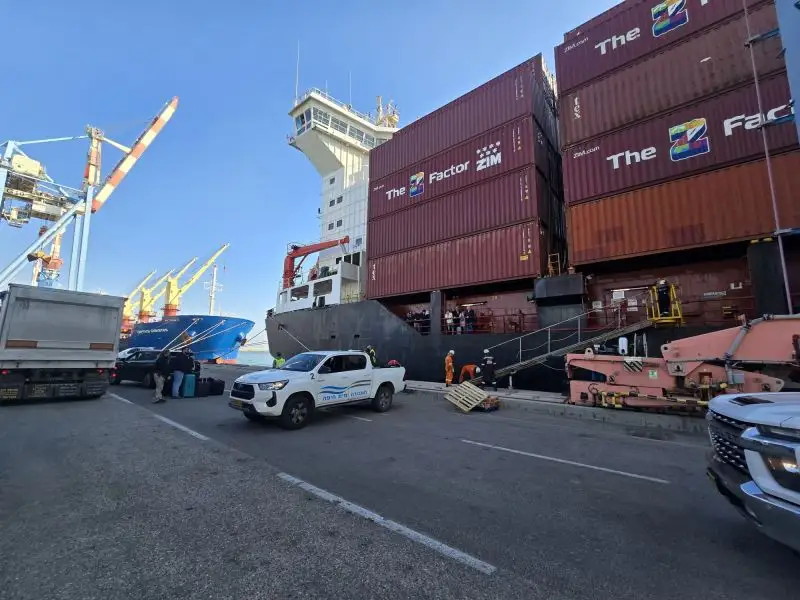
Most Israeli agencies reviewing Hapag-Lloyd’s proposed acquisition of ZIM reportedly oppose the transaction over concerns about control of the country’s strategic merchant shipping capacity
No Final Decision Has Been Made
Israeli government bodies are leaning toward rejecting the proposed sale of container carrier ZIM to Germany’s Hapag-Lloyd and Israeli investment fund FIMI. However, as of September 1, 2026, the government has not issued a final decision.
A meeting of the eight agencies expected to submit their positions on the transaction has been postponed until September 9. According to Calcalist, a majority of the participating authorities are currently expected to oppose the proposed acquisition structure.
Following the inter-agency review, Hapag-Lloyd and FIMI are expected to receive a hearing before Israel’s Government Companies Authority. That process may provide the buyers with a final opportunity to address the state’s concerns.
The defence, economy, agriculture and transport ministries have already reportedly opposed the deal. The Transport Ministry’s assessment relies heavily on the professional opinion of the Shipping and Ports Authority. The Finance Ministry and National Security Council have not announced final positions, although the Finance Ministry’s Accountant General Department is also reported to be against the transaction.
Hapag-Lloyd Is Offering $35 per Share
The companies signed the merger agreement on February 16, 2026. Hapag-Lloyd plans to acquire all outstanding ZIM shares for $35 in cash per share, valuing the company’s equity at approximately $4.2 billion.
ZIM shareholders approved the merger on April 30 with 97.36% of the votes cast. Shareholder approval does not complete the process, as the transaction still requires consent from the State of Israel and other regulators.
Israel holds a Special State Share, commonly described as a “golden share”, giving the government particular rights connected to strategic shipping services and access to maritime capacity during emergencies.
The buyers are targeting completion by late 2026, but that remains an expected timetable rather than a confirmed closing date. If Israel refuses to release the existing obligations or transfer them to the proposed new carrier, the acquisition cannot proceed in its current form.
New ZIM Would Operate 16 Ships
To address Israel’s strategic concerns, FIMI plans to create a separate national container carrier called New ZIM. The company would inherit the ZIM brand, assume the Special State Share obligations and begin operating with 16 vessels. The current golden-share mechanism requires a minimum of 11 ships.
Under the buyers’ proposal, New ZIM would connect Israel directly with ports in the European Union, the United States, the Mediterranean and the Black Sea. It would receive commercial support from Hapag-Lloyd and access to the global Gemini Cooperation network.
The plan provides for an Israeli regional division employing approximately 200 people and a technology centre with 250–300 employees. The buyers have also pledged to retain Israeli crews, maintain a local agency network and guarantee employment for part of the workforce for ten years.
New ZIM would begin operating without debt. By comparison, the existing ZIM reported net debt of $2.77 billion as of June 30, 2026, slightly below the $2.9 billion figure cited in earlier reports.
Regulator Questions Effective Independence
Tzadok Radker, head of Israel’s Shipping and Ports Authority, has submitted a second opinion maintaining the authority’s opposition to the transaction. Its central concern is that New ZIM could remain Israeli in formal ownership while becoming operationally dependent on Hapag-Lloyd.
Control of the global network, access to transport capacity and much of the supporting commercial infrastructure would remain with the German group. The authority therefore questions whether the carved-out carrier could preserve its economic and operational independence over the long term.
“The cumulative weight of the positive data presented is limited in relation to the fundamental issues relating to effective control, economic and operational independence, the company’s sustainability over time and the preservation of the national interests underlying the special share,” the Shipping and Ports Authority’s opinion stated
The authority acknowledged certain positive commitments, including the proposed training of additional Israeli seafarers. It nevertheless concluded that these measures did not resolve the principal concerns.
FIMI Disputes the Review
Hapag-Lloyd and FIMI argue that the government review has not provided sufficient opportunity for a substantive discussion of the revised transaction. The buyers received 174 questions from eight agencies, answered 120 and submitted 40 files containing approximately 600 pages.
The proposal is supported by opinions from EY, Boston Consulting Group and former Shipping and Ports Authority director Yigal Maor. FIMI argues that a debt-free balance sheet, a dedicated fleet and access to an international network would make New ZIM more resilient than critics suggest.
“The new ZIM will be an independent and strong Israeli company at all levels of its activity, independent of any foreign entity,” FIMI said
The buyers also note that the combined international business would operate more than 400 vessels with capacity exceeding 3 million TEU. Annual cargo volume could surpass 18 million TEU in 2027.
ZIM’s Quarterly Profit Rises to $64 Million
The regulatory review continues as ZIM reports improved quarterly results. Revenue increased by 9% year on year to $1.78 billion in the second quarter of 2026, while net income rose from $24 million to $64 million.
The carrier transported 922,000 TEU, an increase of 3%, while its average freight rate rose by 8% to $1,590 per TEU. For the first half as a whole, however, ZIM recorded a net loss of $22 million, compared with a $320 million profit one year earlier.
Approval would strengthen Hapag-Lloyd’s position as the world’s fifth-largest container carrier and contribute to further market concentration. Rejection by Israel would force the parties to revise the structure or pursue another ownership solution for ZIM.
For cargo owners, the essential issue is the continuity of reliable services connecting Israel with major overseas markets. The government is therefore assessing more than the purchase price and vessel count: it must determine whether shipping capacity can be guaranteed during war, port disruption or another national emergency.