

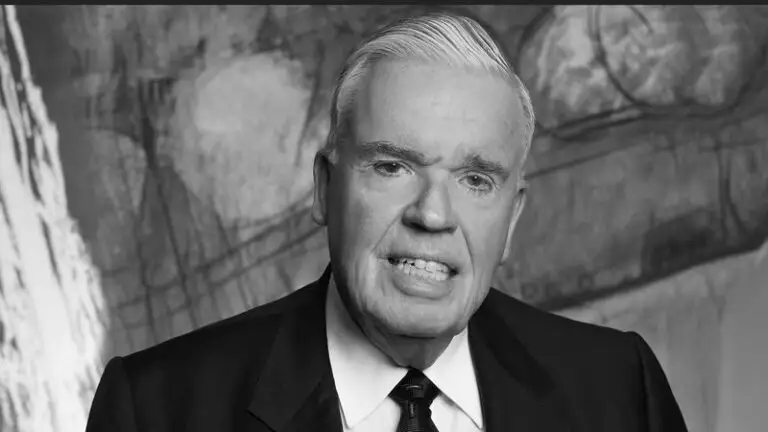
The entrepreneur transformed his family forwarding business into a global logistics group and funded major cultural, educational and sporting projects, but never resolved the debate surrounding Kühne+Nagel’s Nazi-era history
Kühne Dies at His Home in Switzerland
German logistics entrepreneur and philanthropist Klaus-Michael Kühne died at the age of 89 during the night of August 23–24, 2026, following a prolonged illness. His death was confirmed by Kühne+Nagel and the Kühne Foundation.
“With the passing of Klaus-Michael, we have lost a visionary, a great entrepreneur and an extraordinary personality,” Kühne+Nagel Chairman Joerg Wolle said.
Born in Hamburg on June 2, 1937, Kühne joined the family business in 1958. He became chairman of its management board in 1966, served as chief executive of Kühne+Nagel International from 1975 and chaired the company’s board of directors between 1992 and 2011.
Under his leadership, the freight forwarder developed into one of the world’s largest providers of sea, air and contract logistics. Through Kühne Holding, he retained control of the group while building an investment portfolio that included major stakes in container carrier Hapag-Lloyd and Lufthansa.
From Logistics to Culture and Education
Kühne established his foundation with his parents in 1976. The organisation now runs projects covering logistics, climate research, medicine and culture. It employs around 800 people across its programmes and expects to provide approximately CHF65 million in funding during 2026.
One of Kühne’s most important educational projects was Kühne Logistics University in Hamburg, which he founded in 2010. The university’s obituary said its long-term future had been secured through the foundation during his lifetime.
Cultural patronage became another central part of his public legacy. According to the Kühne Foundation, it has supported the Salzburg Festival since 2013, the Lucerne Festival since 2008 and the Lucerne Festival Orchestra as a principal partner since 2020.
The foundation was also among the earliest supporters of Hamburg’s Elbphilharmonie, helping finance its construction and initial concert programme. Other commitments include the Zurich Opera House, emerging artists and a new Hamburg State Opera building that is intended to be donated to the city after completion.
HSV and Hamburg Development Projects
Kühne was a long-standing supporter of Hamburger SV. Kühne Holding became the second-largest shareholder in the club’s professional football operation, while the entrepreneur provided funding for players and other investments.
He also purchased the stadium naming rights, allowing the venue to return to its historic Volksparkstadion name. In its official tribute, HSV described him as a loyal shareholder, supporter and passionate fan.
Kühne was additionally connected to efforts to restart construction of Hamburg’s unfinished Elbtower. He was not its original developer, but considered investing up to €100 million through Kühne Holding while publicly warning that the rescue plan still lacked sufficient financing and tenants.
The Unresolved Nazi-Era Controversy
Kühne’s legacy remains contested because of how the family and company addressed Kühne+Nagel’s history under National Socialism. Born in 1937, he bore no personal responsibility for the company’s wartime conduct. The controversy instead concerns his later resistance to commissioning a comprehensive independent examination of the corporate archives.
According to historical reporting by NDR, Kühne’s father and uncle, Alfred and Werner Kühne, forced Jewish partner Adolf Maass out of the company in 1933 and subsequently joined the Nazi Party. Maass and his wife Käthe were later murdered at Auschwitz.
During the Second World War, Kühne+Nagel participated in transporting household property looted from deported and displaced Jewish families in occupied Western Europe. The operation, known as the M-Aktion, involved belongings taken from tens of thousands of homes.
The company has previously expressed regret over work performed for the Nazi regime. Historians, journalists and descendants of victims nevertheless continued to criticise Kühne for not initiating a full independent study of the family company’s past.
His legacy therefore combines two difficult-to-separate elements: the creation of one of Europe’s largest logistics businesses and extensive philanthropic programmes, alongside an unresolved public debate over the historical foundations of the family fortune.
The Foundation Will Continue His Work
Klaus-Michael and Christine Kühne, who married in 1989, had no children. Much of the ownership and philanthropic framework surrounding his assets had already been organised through Kühne Holding and the Kühne Foundation.
The foundation says it will continue the programmes established by its founder, including logistics education, climate and medical research, cultural partnerships and the proposed new opera house in Hamburg.
Kühne’s death is therefore unlikely to end his principal initiatives. It will, however, renew scrutiny of corporate succession, major investments and the historical responsibilities attached to one of Germany’s most influential business families.
Read also: Maersk Moves SLC Aegean Sea Service from Hamburg to Wilhelmshaven