

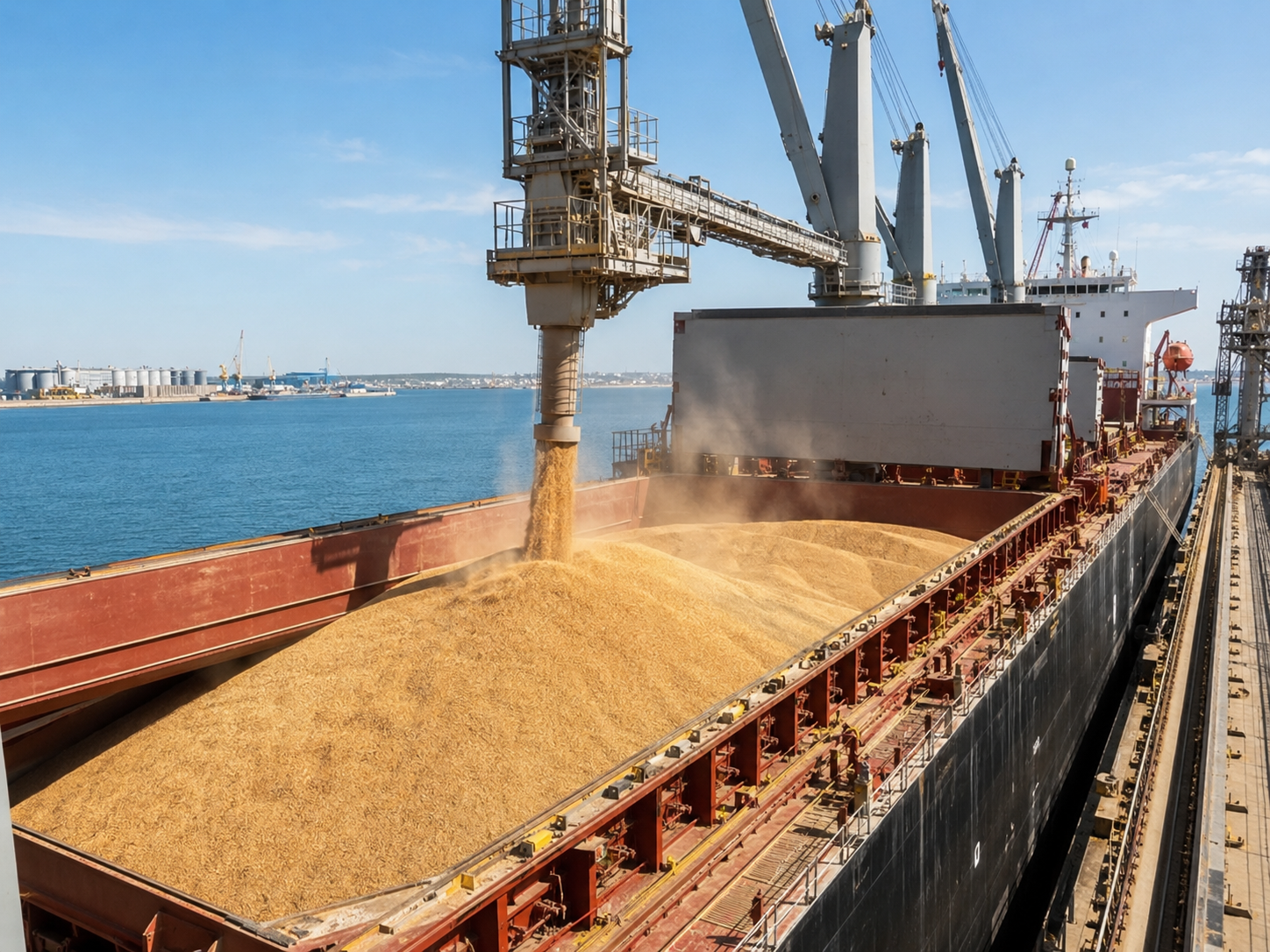
Ukraine’s maritime grain corridor has already handled more than 8,000 vessels since it began operating, according to Dmytro Pletenchuk, spokesperson for the Naval Forces of the Armed Forces of Ukraine. The result highlights the strategic role of the Black Sea route for Ukrainian exports, port activity and global food supply chains.
For Ukraine, sea exports are not just one transport option among many. They are the main channel for moving large volumes of grain, oilseeds, metals and other export products to international markets. Keeping a maritime corridor open during a full-scale war has therefore become both an economic and security priority.
Pletenchuk said that the operation of the corridor is one of the key achievements of the Ukrainian Navy. According to him, the ability to maintain an open sea route independent of land borders gives Ukraine more room to conduct its own foreign economic policy and sustain trade with global partners.
The corridor has also allowed Ukraine to return to pre-war export indicators for some categories of goods. This is especially important for agricultural exports, where logistics costs, route stability and delivery time directly affect farmers, traders, ports and international buyers.
As K2Cargo News previously reported in Ukrainian Ports Handle Over 40 Million Tons of Cargo Despite Ongoing Attacks, Ukrainian seaports have continued to process large cargo volumes despite repeated attacks on port infrastructure and the difficult security situation in the Black Sea.
Why the Corridor Matters for Ukraine
The Ukrainian maritime corridor has become a central element of the country’s export resilience.
Before the full-scale invasion, Ukraine’s Black Sea ports were the backbone of the country’s agricultural and industrial trade. Grain, sunflower oil, iron ore, steel products and other bulk cargo moved through ports because maritime transport is the most efficient option for large volumes.
When sea access is restricted, the burden shifts to rail, road and Danube routes. These alternatives are important, but they cannot fully replace the capacity and cost advantages of Black Sea ports.
This is why the reopening and continued operation of the maritime corridor changed the logistics balance. It gave exporters a route that is more scalable than land corridors and more commercially viable for many bulk commodities.
For Ukraine’s economy, this means export revenue, tax income, port employment and support for agricultural producers. For global markets, it means more stable access to Ukrainian grain and other commodities.
The Navy’s Role Became Critical
The functioning of the corridor would not be possible without security work.
Ukraine’s Navy, together with other defense forces, has played a central role in securing the passage of civilian ships. This includes monitoring threats, supporting navigation, responding to risks and maintaining conditions under which commercial vessels can enter and leave Ukrainian ports.
The challenge is complex because the corridor operates in a war zone. Civilian ships must navigate a maritime environment affected by missile and drone threats, sea mines, attacks on port infrastructure and wider military activity in the Black Sea.
For shipowners and insurers, every voyage requires risk assessment. For Ukraine, every successful passage reinforces confidence that the corridor can remain operational.
This is why the number of vessels matters. More than 8,000 ships using the route is not only a statistic. It is evidence that a system of maritime security, port operations, logistics coordination and international trust has been built under extremely difficult conditions.
Grain Is Still Central, but the Corridor Is Broader
Although the route is often called the grain corridor, its importance is wider than grain exports alone.
Ukraine’s maritime corridor supports agricultural cargo, metallurgical products, containers and other commercial shipments. This wider cargo base is essential because ports need diverse flows to remain economically viable.
For grain exporters, the route is critical because Ukraine remains one of the world’s major agricultural suppliers. Maritime transport allows large shipments to reach buyers in Europe, the Middle East, Africa and Asia.
For metallurgical exporters, sea access is equally important because bulk cargo and heavy industrial goods are expensive to move over long land routes.
The corridor therefore supports not only one sector, but the broader structure of Ukrainian foreign trade.
Independence from Land Borders
One of Pletenchuk’s key points was that the maritime corridor gives Ukraine independence from land borders.
This matters because overland exports can face bottlenecks, political disputes, infrastructure limitations and border queues. During the war, Ukraine has repeatedly had to rely on alternative routes through neighboring countries, but those routes have capacity limits and can become sensitive when local markets are affected.
Sea exports reduce that dependency. They allow Ukraine to move large volumes directly to global markets without relying entirely on transit through neighboring land borders.
For logistics companies, this improves route flexibility. For exporters, it can reduce costs. For the state, it strengthens economic sovereignty.
Black Sea Risks Remain High
Despite the corridor’s success, the risks remain serious.
Ukraine’s ports and merchant vessels continue to operate under threat. Attacks on port infrastructure, ships and logistics facilities remain a constant challenge. Each strike can affect loading schedules, insurance costs, vessel availability and confidence among foreign shipowners.
This makes the resilience of the corridor even more notable. Ports, sailors, logistics operators, insurers and the military must coordinate in an environment where the risk level can change quickly.
For international buyers, the corridor has become a sign that Ukraine can continue supplying goods even under wartime pressure. But the security situation means that long-term stability cannot be taken for granted.
Antwerp-Bruges Partnership Adds European Dimension
The future of Ukraine’s ports is also linked to European cooperation.
The Ukrainian Sea Ports Authority recently signed a memorandum of cooperation with the Port of Antwerp-Bruges and the Antwerp/Flanders Port Training Center during URC 2026. The partnership is aimed at supporting the integration of Ukraine’s port sector into the European transport space, attracting international expertise and strengthening institutional capacity.
This is important because Ukraine’s maritime logistics will need not only wartime resilience, but also post-war modernization. Port management, training, digitalization, safety standards and infrastructure renewal will determine how competitive Ukrainian ports can become in the long term.
Cooperation with one of Europe’s largest port systems can help Ukraine prepare for deeper integration with European logistics networks.
What It Means for Global Logistics
The success of the Ukrainian corridor has implications beyond Ukraine.
It shows that maritime trade can continue even under severe security pressure when military, port and commercial actors coordinate effectively. It also shows how important route diversification has become for global supply chains.
For agricultural markets, the corridor helps stabilize supply. For shipping companies, it creates a difficult but functioning route. For logistics providers, it confirms that Black Sea transport remains strategically relevant despite the war.
At the same time, the corridor’s operation depends on continued security, international support and infrastructure resilience. If attacks intensify or insurance conditions deteriorate, costs and uncertainty could rise again.
A Lifeline That Became a System
More than 8,000 vessels using Ukraine’s maritime corridor is a major milestone.
What began as an emergency route has become a functioning export system. It supports farmers, ports, exporters, sailors, logistics companies and global buyers. It also gives Ukraine an independent channel for foreign trade at a time when economic resilience is directly tied to national security.
The next challenge will be to keep the corridor stable while modernizing port infrastructure and deepening cooperation with European partners.
Ukraine’s maritime corridor has already proven that it can work under extreme pressure. Now its role is expanding from crisis response to long-term economic strategy.
Read also: Ukrainian Ports Handle Over 40 Million Tons of Cargo Despite Ongoing Attacks
