

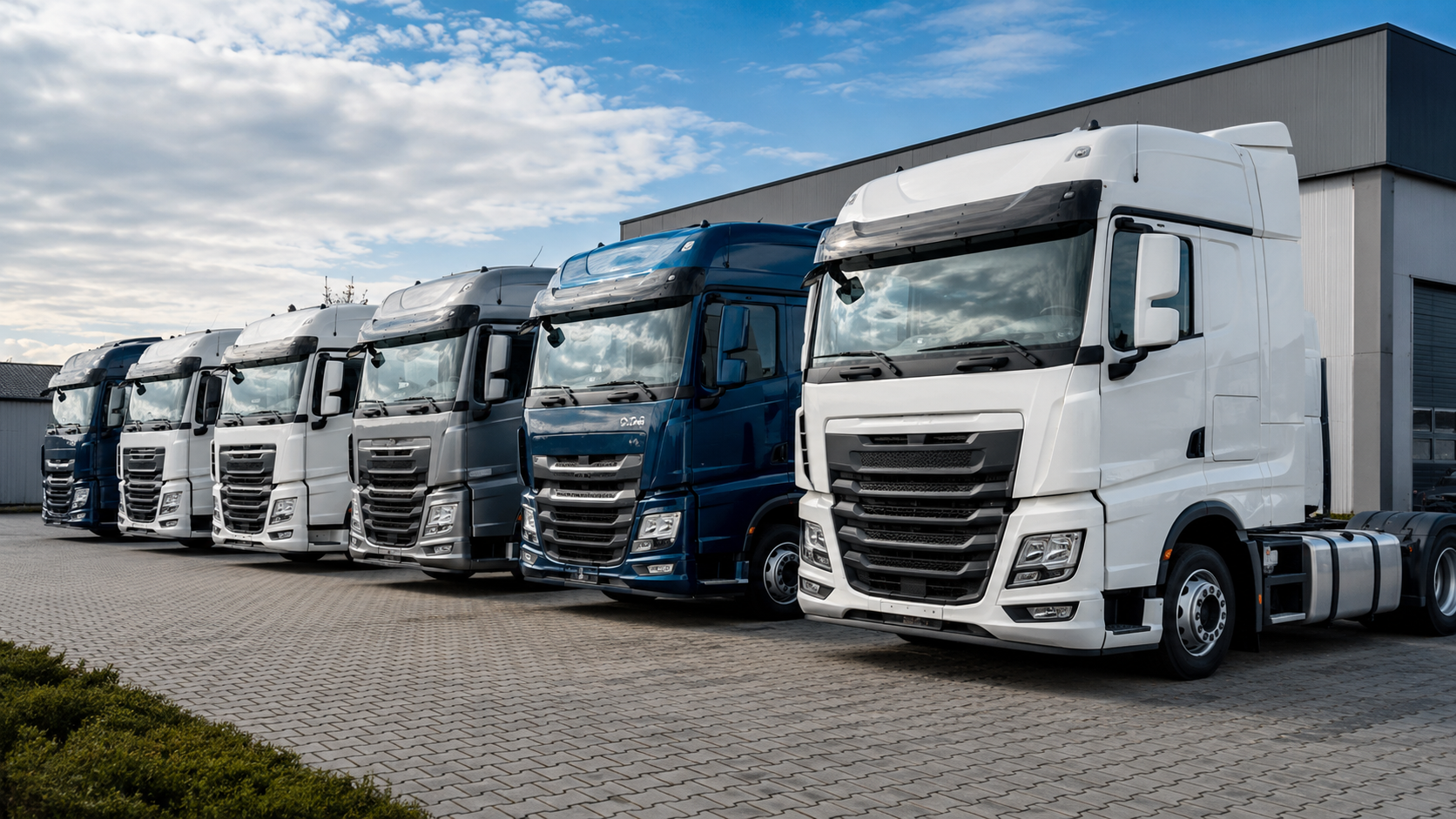
The Polish truck market has moved from crisis to clear recovery. According to the latest data from the Polish Automotive Industry Association, covering January to June 2026, registrations increased in every major heavy vehicle segment.
The strongest signal came from the market for tractors above 16 tonnes. PZPM recorded 14,263 new registrations in the first half of the year, up 30.1% from 10,967 units in the same period of 2025. This is not just a rebound from a weak period. It is the best first-half result for the Polish tractor market in the current decade.
The recovery is important for the wider logistics sector. New truck registrations show how confident carriers are about future demand, fleet renewal and investment. When transport companies buy more tractors, it usually means they expect higher utilization, more stable freight flows or better access to financing.
At the same time, the market remains selective. Some brands gained strongly, while others lost momentum. Volvo Trucks kept its leadership, Mercedes-Benz became the biggest surprise, and Scania found itself under pressure from DAF.
As K2Cargo News previously reported in New Report Reveals Widespread Problems in Europe’s International Road Transport Sector, European road transport still faces pressure from labor shortages, regulation and operating costs. Poland’s truck sales recovery therefore shows resilience, but not the end of all challenges.
Tractors Drive the Recovery
Tractors remain the most important part of the Polish heavy truck market.
In the first half of 2026, the segment above 16 tonnes reached 14,263 new registrations. That is about 3,300 more than a year earlier and well above the usual first-half level of around 11,000–12,000 units.
This suggests that Polish carriers are renewing fleets more actively after a difficult period. Several factors may be behind the rebound: replacement demand after delayed purchases, improved confidence, pressure to modernize fleets and the need for more efficient vehicles.
For truck manufacturers, Poland remains one of Europe’s most important markets. The country has a large international road freight sector and a strong base of carriers operating across the EU. A strong Polish market therefore matters not only for local dealers, but also for the wider European truck industry.
Chassis Sales Also Improve
The recovery was not limited to tractors.
From January to June, Poland registered 1,693 new chassis with gross vehicle weight between 3.5 and 16 tonnes. This represented a 23.3% increase year-on-year. In the heavier chassis category above 16 tonnes, registrations reached 2,952 units, up 10.5%.
Although chassis volumes are smaller than tractor volumes, the segment is important because it reflects demand for distribution trucks, municipal vehicles, construction vehicles and specialized bodies.
The growth in medium chassis is especially interesting because Iveco strengthened its position significantly. The Italian brand increased sales in the 3.5–16 tonne chassis segment by 28% and approached a 58% market share.
One possible explanation is the regulatory change from July 1, 2026, when EU tachograph rules started applying to light commercial vehicles between 2.5 and 3.5 tonnes used in international transport. Some carriers may prefer heavier vehicles such as 5- or 7-tonne Iveco Daily models to adjust their operating model.
Volvo Leads, Mercedes Surges
In tractors, Volvo Trucks remained the market leader.
Between January and June, Volvo held more than 22% of tractor registrations in Poland, continuing its leading position from 2025. This confirms the brand’s strong position among Polish international carriers, where fuel efficiency, service networks and residual value are key purchasing factors.
The battle for second and third place was much tighter. Scania took 18.62% of the tractor market, while DAF followed very closely with 18.52%. For Scania, this means a visible weakening compared with recent years. For DAF, it shows another attempt to regain its former strength in Poland.
The biggest surprise was Mercedes-Benz. Registrations of new Mercedes-Benz tractors rose by more than 120%, from 1,135 units in the first half of 2025 to 2,501 units in the first half of 2026. Its market share increased from 10.34% to 17.52%.
This may indicate strong market acceptance of the new Actros ProCabin. The model’s aerodynamic design and efficiency-focused positioning appear to fit the needs of carriers looking to reduce fuel consumption and improve long-distance comfort.
MAN, Renault, Iveco and Ford Stay Behind
Behind the top four brands, MAN took 13.72% of the tractor market, while Renault Trucks reached 7.57%.
At the lower end of the ranking, Iveco and Ford Trucks recorded identical tractor results in the first half of 2026: 126 units each. This gave both brands a market share of 0.88%.
The figures show how concentrated the Polish tractor market remains. Volvo, Scania, DAF, Mercedes-Benz and MAN dominate the segment, while smaller players struggle to gain scale.
However, a weak tractor position does not necessarily mean a weak brand position overall. Iveco is a good example: it remains marginal in Polish tractor registrations, but extremely strong in medium chassis.
A Strong Result, But Not a Simple Market
The first half of 2026 confirms that Poland’s truck market has overcome the worst phase of the downturn.
High tractor registrations show that carriers are investing again. Growth in chassis confirms broader demand beyond long-haul transport. Strong brand competition shows that fleet buyers are actively comparing technology, service, financing and efficiency.
But the recovery should not be seen as automatic stability. Transport demand can still be affected by fuel prices, freight rates, labor shortages, road restrictions and changing EU rules. The market may also be partly supported by purchases made before regulatory changes, which means the second half of the year will be important for understanding real underlying demand.
For now, the message is positive: Polish carriers are buying trucks again, and manufacturers are seeing one of the strongest starts to a year in recent memory.
If this momentum continues, 2026 may become one of the best years of the decade for Poland’s heavy truck market.
Read also: New Report Reveals Widespread Problems in Europe’s International Road Transport Sector
