

For decades, conventional wisdom held that modern e-commerce required an extensive banking system, standardized street addresses and a mature logistics network before online retail could truly flourish.
Africa is proving otherwise.
Across the continent, logistics companies are not waiting for traditional infrastructure to catch up. Instead, they are building an entirely different digital ecosystem—one designed around the realities of African markets rather than the assumptions of developed economies.
The transformation is being accelerated by growing competition from global retail companies including Amazon, Walmart, Temu and Shein. Their expansion is increasing pressure on regional logistics providers to deliver goods faster, more affordably and more reliably.
A Different Model for Digital Commerce
Rather than relying on widespread credit card adoption or formal postal systems, African logistics operators are embracing technologies that match local conditions.
- Mobile money allows customers without traditional bank accounts or credit cards to pay for international purchases and delivery services.
- GPS coordinates are increasingly replacing formal street addresses, helping drivers locate customers in cities and communities with limited addressing infrastructure.
- Cloud-based logistics platforms connect customers, warehouses, customs intermediaries and delivery operators across multiple countries.
- Digital shipment consolidation combines several international purchases into a single shipment, reducing transportation costs.
- Real-time parcel tracking gives consumers greater visibility into cross-border deliveries.
- Artificial intelligence is beginning to support route optimization, warehouse management and delivery planning.
Afrety Demonstrates the New Approach
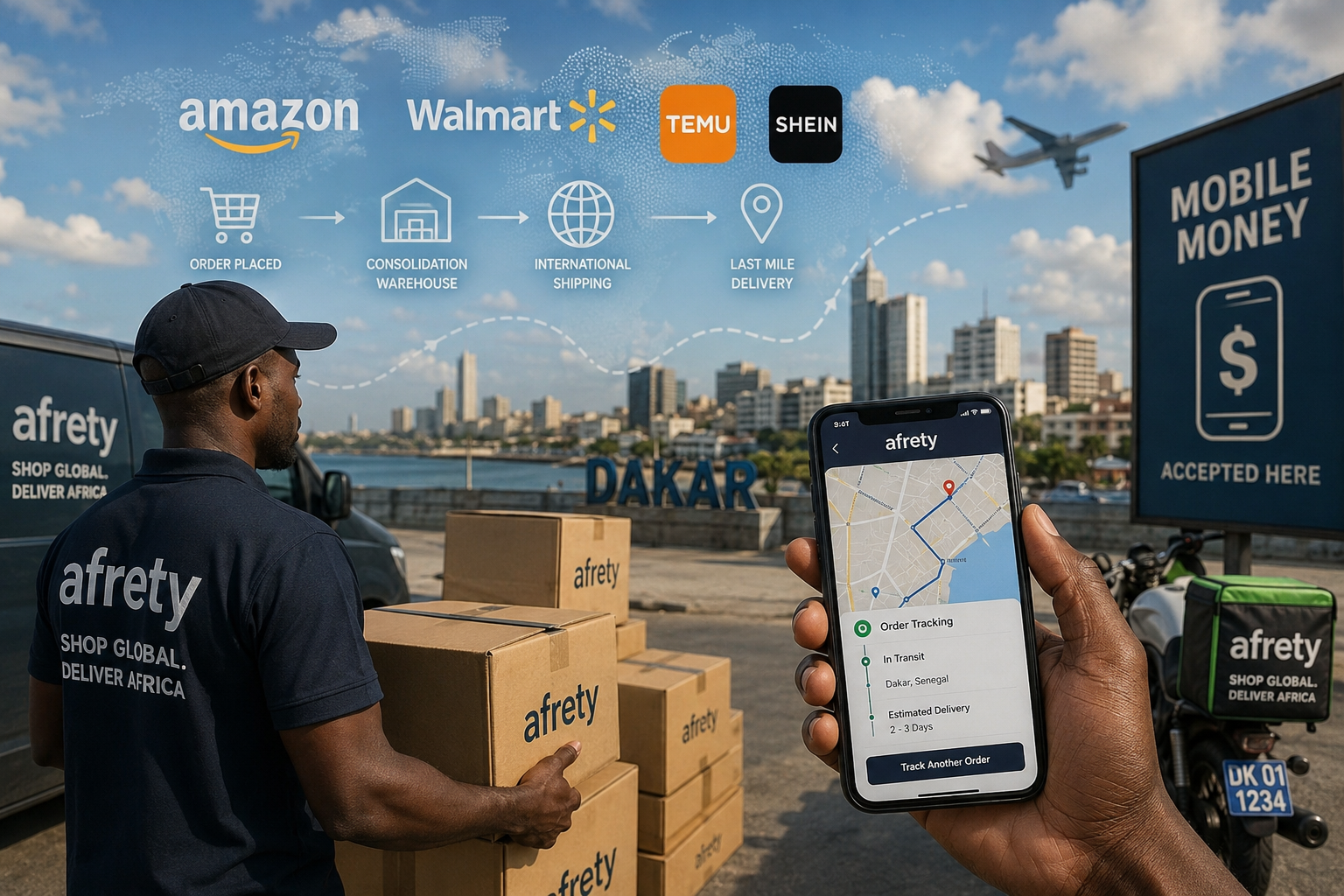
One of the clearest examples of this emerging model is the Senegalese logistics startup Afrety.
The company provides customers with virtual delivery addresses in the United States, France and China. Consumers can order products from international retailers and have them delivered to Afrety’s overseas facilities.
Multiple purchases can then be automatically consolidated at a foreign warehouse before being shipped together to Senegal. This reduces the cost of international transportation and simplifies the delivery process for the customer.
Once a shipment reaches Dakar, delivery drivers can use GPS coordinates instead of relying exclusively on conventional postal addresses.
Payment also reflects Africa’s distinctive digital economy. Customers can use mobile wallets to pay for services without maintaining a traditional bank account.
Afrety’s model connects consumers in Senegal with retailers in the United States, Europe and China through a single digital logistics system.
Competition Is Accelerating Innovation
The rapid expansion of international e-commerce is intensifying technological investment throughout the African logistics sector.
Aramex continues to expand its digital international delivery network and cross-border logistics capabilities.
Jumia is strengthening its proprietary logistics platform while expanding pickup locations, fulfillment services and last-mile delivery infrastructure in key African markets.
At the same time, competition from Amazon, Walmart, Temu and Shein is forcing regional operators to improve delivery speed, shipment visibility, payment systems and warehouse automation.
The competition is no longer limited to online retail. It is becoming a race to build the digital infrastructure that will support Africa’s next generation of commerce.
Why This Matters
History often suggests that economic development follows a predictable sequence: roads are built, banking systems expand, postal addresses are standardized and e-commerce develops afterward.
Africa is beginning to reverse that order.
Digital technology is allowing logistics companies to bypass some of the traditional obstacles that have historically slowed the growth of online commerce.
Instead of waiting for expensive physical infrastructure to reach every community, the market is using:
- mobile payment systems;
- GPS-based navigation;
- cloud logistics platforms;
- digital shipment consolidation;
- automated order processing;
- AI-assisted delivery planning.
This does not mean that roads, warehouses, ports and reliable transportation networks are no longer important. They remain essential. But digital systems are making existing infrastructure more efficient and allowing companies to serve customers who were previously difficult or expensive to reach.
Africa Is Building Its Own Logistics Model
The most important element of this transformation is that Africa is not simply reproducing the e-commerce model developed in the United States or Europe.
It is building a system adapted to local economic and geographic conditions.
Mobile wallets can replace credit cards. GPS coordinates can replace street numbers. Pickup points can replace expensive door-to-door delivery in remote areas. Consolidated shipments can make international purchases affordable for a broader group of consumers.
Global retailers may be helping accelerate this transformation, but African logistics companies are determining how the technology will work on the ground.
If this trajectory continues, Africa may become not merely a follower of global logistics innovation, but one of its most influential testing grounds. And that may prove to be one of the most important e-commerce stories of the year.
Read also: Jumia Doubles Down on Pick-Up Networks as Africa’s E-Commerce Race Intensifies