

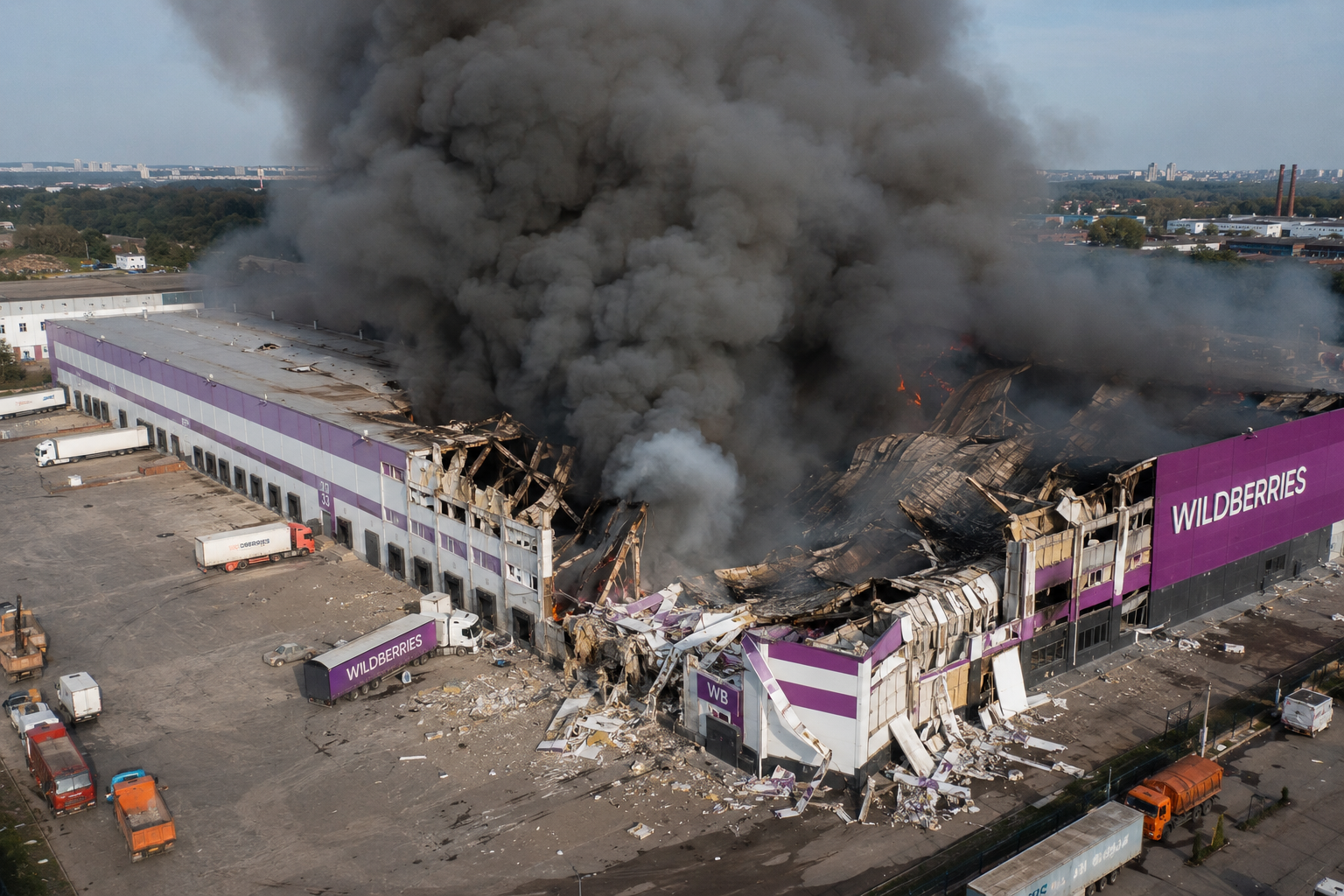
Attacks and Alerts Affected 11 Facilities
Between July 18 and July 27, 2026, eleven Wildberries facilities across different Russian regions and Crimea were affected by direct strikes, drone threats or temporary operating restrictions.
The events involved locations in Elektrostal, Kotovsk, Krasnodar, Nevinnomyssk, Voronezh, St Petersburg, Novosaratovka, Simferopol, Yekaterinburg and Sarapul. Some facilities suffered direct impacts and fires, while others were evacuated or temporarily stopped accepting goods during security alerts.
The most serious consequences were reported at major logistics complexes in Elektrostal, Kotovsk, Krasnodar and Nevinnomyssk. Buildings, equipment and goods stored inside the facilities were damaged. Employees were killed and injured.
An estimate based on publicly available information placed the combined area of the first five affected complexes at around 802,000 square metres, equivalent to approximately 14.3% of the Wildberries logistics network. This does not mean that all of this capacity was permanently lost, but it demonstrates the scale of the facilities whose operations were disrupted or reorganised.
Insurers Suspended New Warehouse Risks
The attacks quickly changed conditions in the Russian logistics property insurance market.
By the evening of July 24, some insurance companies had stopped accepting new warehouse risks. In several cases, restrictions covered not only protection against drone attacks but also standard warehouse property programmes.
Insurers that continued offering coverage increased their rates by as much as fourfold. At the beginning of 2026, the additional premium for drone-related risk was around 0.05–0.06% above a typical base rate of approximately 0.1%. Following repeated attacks, the additional charge reached or exceeded the cost of basic coverage.
The central problem for insurers is that repeated strikes against similar logistics facilities are becoming harder to classify as rare and accidental events. When the probability of another loss rises sharply, conventional insurance models become less effective.
One Warehouse Requires Three Different Policies
The statement that a warehouse is insured does not mean that every potential loss is automatically covered.
Warehouse logistics normally involves three separate types of insurance. The first protects the building structure and engineering systems and is generally purchased by the property owner.
The second covers inventory stored inside the facility. It may be purchased by the owner of the goods, the seller or another participant in the supply chain.
The third is warehouse operator liability insurance. It applies when damage results from the actions or omissions of the company receiving, storing, picking and dispatching the goods.
A building policy does not automatically compensate for destroyed inventory. Operator liability may also be inapplicable when the damage was not caused by the operator. In addition, policy limits can be considerably lower than the value of the goods concentrated inside a major distribution centre.
Standard contracts frequently exclude war, terrorism, sabotage and related events. Insurance held by Wildberries or the property owner therefore does not guarantee full compensation for the marketplace or its sellers.
What the Attacks Mean for Wildberries
The first consequence is the direct cost of repairing buildings, equipment, sorting systems and other infrastructure. When the relevant risk is excluded from insurance, a substantial share of these expenses may remain with the company or the property owner.
The second consequence is the redistribution of cargo flows. Supplies previously sent to damaged or temporarily closed sites must be redirected to other logistics centres. This increases pressure on neighbouring warehouses, sorting hubs and road transport routes.
Certain regions may experience longer receiving times, fewer available delivery slots, rescheduled shipments and slower customer delivery. Wildberries’ extensive national network helps preserve operations, but it cannot eliminate the additional transport and handling costs.
The third consequence is the cost of supporting sellers. After the initial attacks, the company announced storage discounts at selected warehouses and free transit shipments to regional facilities. Affected businesses were also offered credit holidays and other financial measures.
These programmes are intended to help sellers restore inventory and maintain turnover. For Wildberries, they mean lower commission income in some areas, additional financial expenditure and the need to reserve funds for possible compensation.
Sellers Will Have to Distribute Inventory
Sellers face more than the direct risk of losing their goods. Even when a shipment remains undamaged, the temporary closure of a facility can interrupt sales, freeze inventory or require a new delivery to another warehouse.
Keeping a large share of inventory at one location is becoming more dangerous. Sellers will have to divide shipments between several regions, reduce the size of individual batches and use different fulfilment models.
One option is wider use of the FBS model, under which goods remain at the seller’s own warehouse until an order is placed. This reduces the concentration of inventory inside a single marketplace distribution centre, although it places greater demands on the seller’s own logistics operations.
Demand for voluntary inventory insurance may also increase. Sellers will need to check separately whether policies include drone attacks, sabotage and other war-related risks, and whether the compensation limit is adequate.
Warehouse Insurance Will Become More Expensive
The consequences extend beyond Wildberries. Insurers are reassessing the entire large-scale warehouse property segment.
Higher tariffs were previously associated mainly with specific border regions. A major logistics cluster itself may now be treated as a high-risk area regardless of its geographic location.
A modern distribution centre can concentrate a building, automated equipment and goods worth tens or hundreds of billions of roubles in one place. Damage to a single facility therefore creates a large accumulated loss that may be difficult to distribute among insurers.
New contracts could include higher deductibles, lower limits, additional exclusions and requirements to divide inventory between locations. Very large facilities may require participation from several insurers and a reinsurer.
Higher insurance expenses will also affect the economics of new warehouse developments. Developers and operators will have to include the increased cost of protection when calculating investments and rental rates.
Russia’s logistics property market is already adapting to changes in demand and transport routes. K2Cargo.News has examined how Russia’s warehouse market is reshaping delivery chains.
Engineering Protection Creates Additional Questions
Electronic warfare systems are being considered as one possible way to reduce the threat of drone attacks. However, such equipment could create new liability for warehouse owners.
When a system alters a drone’s trajectory and the aircraft damages a neighbouring facility, vehicle, residential building or other infrastructure, questions may arise over compensation for third-party losses.
A conventional warehouse property policy will not normally cover this liability. Requirements to install protective equipment would therefore need to be accompanied by changes to liability insurance and clear rules governing the use of such systems.
Companies are also likely to strengthen alert systems, evacuation procedures, backup power supplies, fire protection and business continuity plans.
Wildberries May Accelerate Network Decentralisation
The principal long-term consequence for Wildberries could be a shift away from concentrating goods in several very large hubs towards a more distributed logistics model.
The company will have an incentive to develop regional sorting centres, backup routes and the ability to redirect supplies rapidly between facilities. This could improve network resilience, although it may raise the cost of processing individual orders.
Additional investment will be required for security, repairs, automated inventory control and data backup. Conditions for data backup. Conditions for sellers may also change, with the marketplace encouraging a more even distribution of goods and limiting excessive concentration of particular product categories at one location.
The impact on customers is likely to vary by region. The national network should preserve most deliveries, but areas dependent on damaged hubs could experience delays, revised delivery dates and temporary reductions in available product ranges.
The attacks demonstrate that marketplace resilience depends on more than the number of warehouses. The ability to reroute cargo, obtain adequate insurance, support sellers financially and maintain operations when several major facilities are restricted at the same time is becoming equally important.
Read also: Pickup Points 3.0: No Cashier, No Clerk