

Sometimes the clearest signs of change come not from politicians, but from market charts.
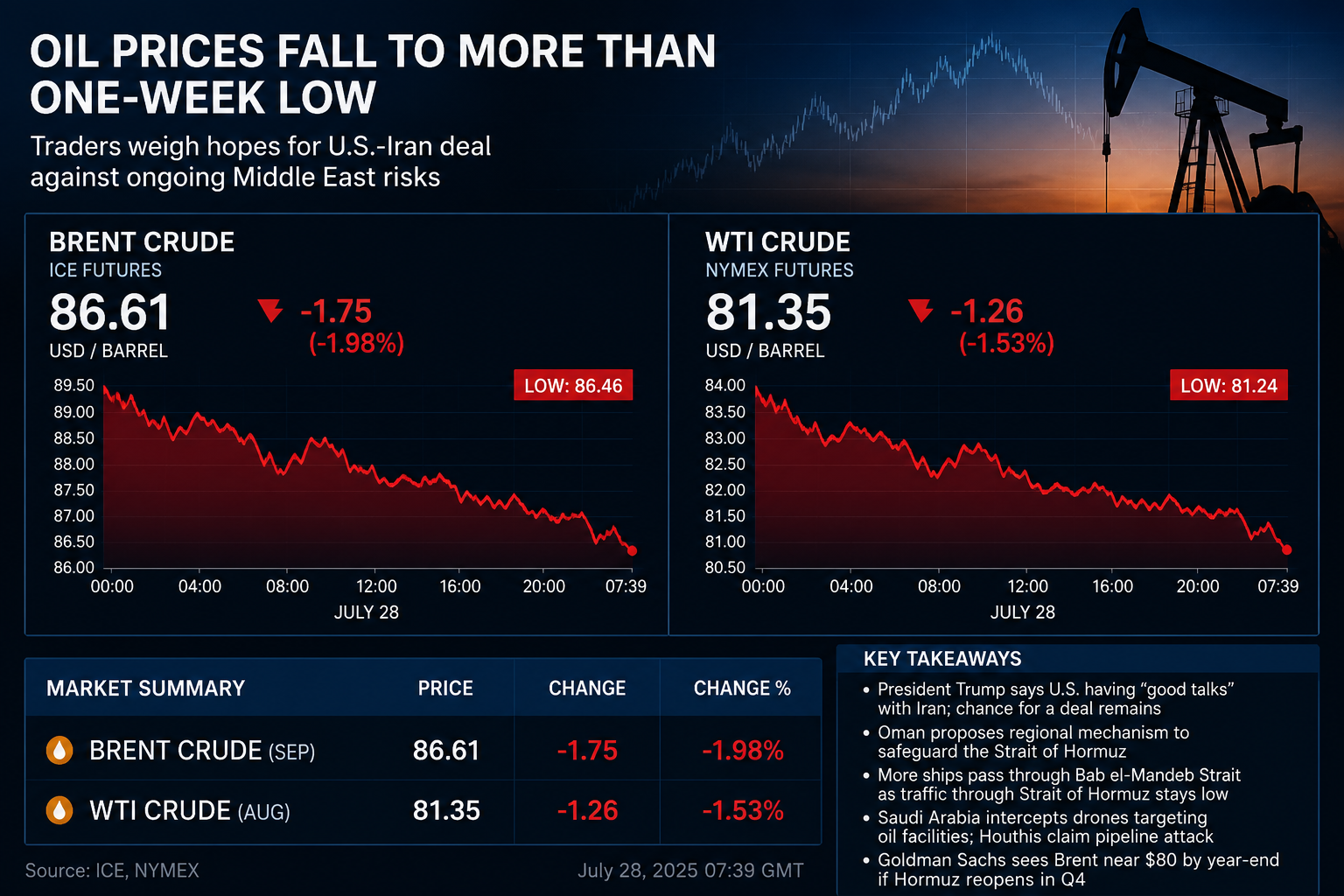
Global oil prices fell to their lowest levels in more than a week on Tuesday. For traders, the decline offered a signal that although the danger of further escalation in the Middle East remains high, the market is beginning to price in the possibility of a diplomatic resolution.
Brent crude futures declined for a third consecutive trading session, falling to $86.61 per barrel. U.S. West Texas Intermediate crude traded near $81.35 per barrel.
Only days earlier, oil prices had surged as markets feared a broader crisis around the Strait of Hormuz. Now, the mood has begun to shift.
Washington and Tehran Return to the Negotiating Table
The immediate catalyst was a statement from U.S. President Donald Trump, who said Washington was holding “good talks” with Iran and that an agreement remained possible.
At the same time, the White House made clear that military strikes could resume if diplomacy fails. Tehran issued a similar warning, saying it was prepared to retaliate if the United States launched new attacks.
The result is an uneasy pause: neither peace nor open escalation, but a narrow diplomatic window that energy markets are watching closely.
Oman Proposes a New Framework for the Strait of Hormuz
Attention has once again turned to Oman, a country that has traditionally served as an intermediary between Washington and Tehran.
According to sources familiar with the discussions, Muscat has presented Iran with a proposal to establish a joint regional mechanism for managing security and commercial navigation through the Strait of Hormuz. The initiative would reportedly be supported through voluntary contributions from participating countries.
If the proposal advances, it could become one of the first practical steps toward reducing tensions around one of the world’s most strategically important maritime corridors.
The Strait of Hormuz carries roughly one-fifth of global oil consumption. Any prolonged disruption to vessel traffic can immediately affect energy prices, maritime insurance premiums, freight rates and international supply chains.
Shipping Activity Begins to Recover
There are already early signs of cautious improvement elsewhere in the region.
According to shipping analytics firm Kpler, the number of vessels passing through the Bab el-Mandeb Strait increased to 28 on Monday, reaching a four-day high.
Traffic through the Strait of Hormuz, however, remained significantly below normal levels.
Even so, the increase in vessel movements near the Red Sea has been interpreted by some market participants as an early indication that confidence may be returning to regional shipping routes.
But that confidence remains fragile.
Saudi Oil Infrastructure Remains Under Threat
Saudi Arabia reported intercepting drones targeting oil facilities, including sites near Riyadh. Saudi authorities blamed Iran-backed armed groups operating from Iraq and said the kingdom reserved the right to respond.
At the same time, Yemen’s Houthi movement said it had attacked Saudi Arabia’s strategic East–West Pipeline in response to alleged Saudi drone incursions.
The pipeline carries crude oil from Saudi Arabia’s eastern production regions to the Red Sea port of Yanbu. It is widely regarded as one of the kingdom’s most important alternatives to routes passing through the Strait of Hormuz.
Any sustained disruption to that infrastructure could undermine efforts to bypass the Gulf and create a new source of pressure on global oil supplies.
The Market Is Pricing Hope, Not Certainty
For that reason, many analysts view the current decline in oil prices as a reflection of diplomatic hope rather than proof that the crisis has been resolved.
Goldman Sachs expects Brent crude to fall toward $80 per barrel by the end of the year if the Strait of Hormuz fully reopens by the fourth quarter.
But further attacks on Saudi energy infrastructure, renewed disruptions in the Red Sea or a collapse in U.S.–Iran negotiations could quickly reverse the trend and send prices higher again.
U.S. Inventories Return to Focus
As geopolitical tensions temporarily ease, investors are also turning their attention back to market fundamentals.
Preliminary estimates suggest that U.S. crude oil and gasoline inventories declined last week, while distillate stockpiles may have increased.
Those figures could influence short-term price movements, but for now, developments in the Middle East remain the dominant force shaping the global energy market.
The events of recent weeks offer a familiar reminder: diplomatic language can push the price of oil lower within hours, but a single strike on critical energy infrastructure can erase that optimism just as quickly.