

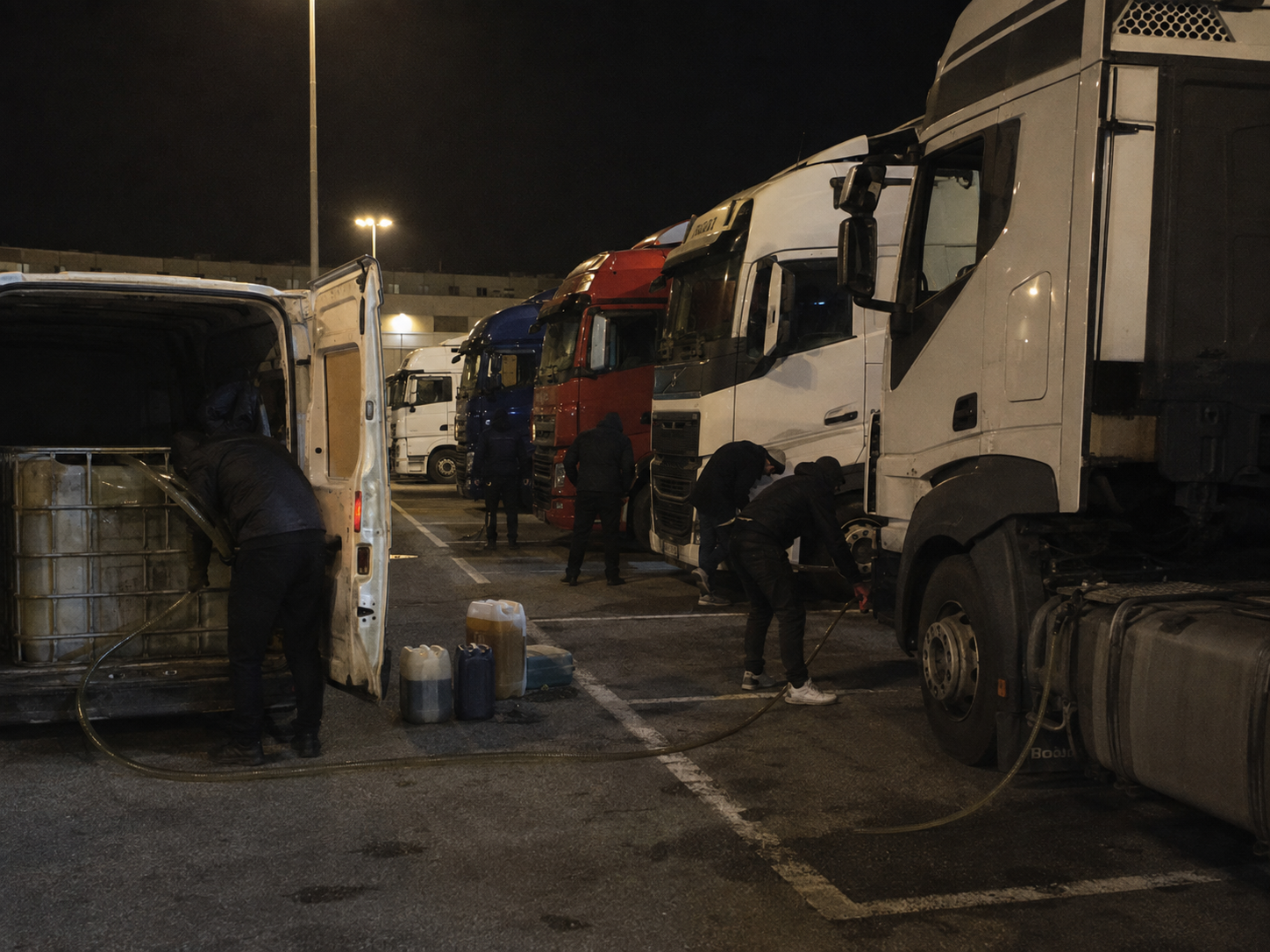
Five Trucks Drained Before Departure
Rising diesel prices are being accompanied by more frequent thefts from commercial trucks in Italy, according to Claudio Sensi, vice-president of the Italian road haulage federation’s Liguria branch, FAI Liguria, and chief executive of dangerous-goods transport specialist DLM Coop.
Sensi told Quotidiano.net that his company had experienced two incidents within several months in which thieves emptied the tanks of parked trucks.
The most serious case occurred in May 2026 in the northwestern province of Alessandria. Criminals siphoned diesel from five trucks that had been prepared for departure.
Sensi said similar thefts were occurring during the day and at night across Italy. However, the published report did not include official nationwide statistics showing the precise number of incidents or the rate at which they are increasing.
Criminals Use Vans Equipped With Tanks
According to the industry representative, highly organised groups target trucks parked at unsecured rest areas, near service stations, on urban and suburban roads, and close to loading or unloading depots.
The criminals reportedly use trucks or vans fitted with pumps, tanks and drums capable of holding up to 1,000 litres. Universal keys and specialist tools allow them to open fuel tanks without causing obvious damage. If the cap cannot be opened, they may drill a hole and siphon the diesel through a hose.
The operation can be completed within minutes and may go unnoticed when the driver is sleeping in the cab. Fully fuelled trucks left overnight without surveillance are particularly vulnerable.
Stolen Diesel Sells for 30–40 Cents Less
Sensi linked truck fuel theft to Italy’s illegal diesel market and cross-border smuggling. According to an industry estimate, stolen or smuggled diesel may be resold for 30–40 euro cents per litre below the legal market price.
The figure is not an official estimate from the Italian police, Customs Agency or Financial Police. Sensi noted that identifying supply channels, concealed storage facilities and buyers remains the responsibility of law-enforcement and customs authorities.
Illicit diesel may enter hidden depots before being distributed through a wider network of buyers. Demand for discounted fuel then provides income for criminal organisations.
Illegal Supply Routes Continue to Change
Significant volumes of petroleum products with varying origins move through Eastern and Southern Europe. Sensi identified Slovenia as one sensitive transit point but stressed that the sources and routes are highly diverse.
He said supply chains could involve Germany and Russia, as well as North Africa and Greece. Increased scrutiny of established corridors is encouraging criminal organisations to search for alternative routes.
In Sensi’s assessment, higher prices make theft and smuggling more profitable. When diesel prices remain within the range familiar to transport operators, the financial incentive for illegal trading falls.
Drivers May Act as Insiders
Transport companies also face the risk of an employed driver cooperating with thieves. An insider could provide details about the route, parking location, rest period and volume of fuel in the vehicle.
Fleet protection therefore cannot rely exclusively on locking devices. Operators also need internal controls, fuel-consumption monitoring and procedures for investigating discrepancies between refuelling volumes and actual mileage.
Secure Parking Remains the Main Defence
Sensi recommends leaving trucks at illuminated and controlled facilities equipped with access restrictions and video surveillance. Operators should exercise particular caution immediately after refuelling, when the large volume of diesel makes a truck a more attractive target.
Special caps, locks and other mechanical devices can make a tank harder to access, but they cannot guarantee protection against a well-equipped group. Planning stops at secure facilities, monitoring vehicle movements and quickly detecting abnormal fuel consumption remain the most practical safeguards.
Read also: Spain Builds Covered Truck Parking for 383 Trucks