

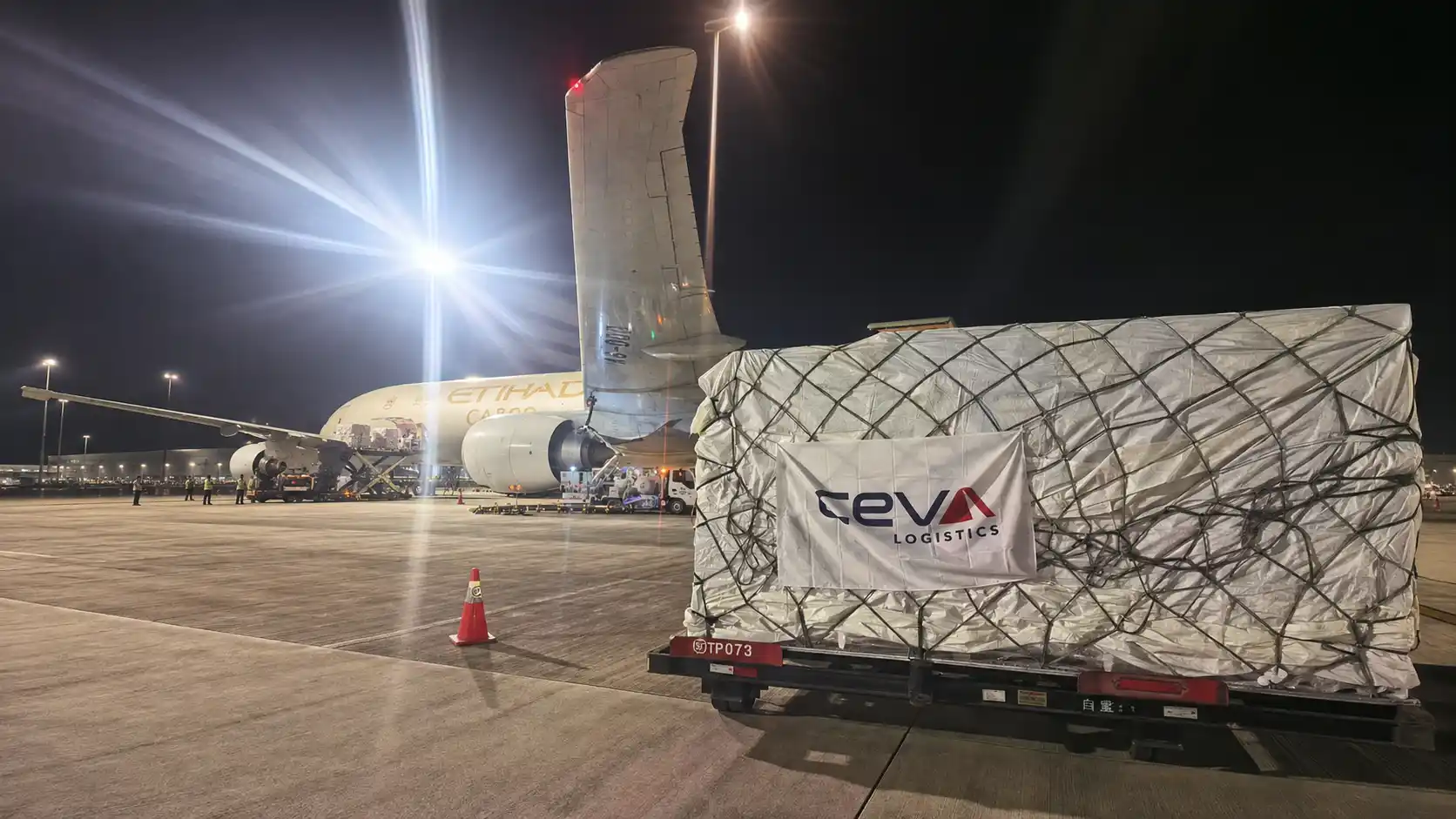
The urgent shipment demonstrated how Abu Dhabi can support supply-chain continuity between Asia, the Gulf and other Middle Eastern markets
CEVA Deploys a Dedicated Aircraft
CEVA Logistics has successfully completed a full air charter from China to Abu Dhabi, helping maintain supply-chain continuity for its customer. The dedicated freighter gave the logistics operator greater control over capacity, routing and departure time without relying on available space aboard scheduled services.
CEVA has not publicly disclosed the type of cargo, departure airport, aircraft model, shipment weight or exact transit time. It is also unclear whether the shipment was destined for the UAE or subsequently distributed to other regional markets.
Nevertheless, the operation highlights Abu Dhabi’s growing importance as an entry point for urgent cargo originating from Asia’s major manufacturing centres.
Why a Full Charter Was Required
A full charter is typically used when a delayed shipment could interrupt production, create a shortage of critical components or prevent a supplier from meeting contractual obligations. Unlike scheduled air freight, a charter gives the customer access to an entire aircraft and allows its routing to be aligned with a specific delivery deadline.
CEVA Logistics’ air charter service operates around the clock. Its in-house control tower selects aircraft according to payload, dimensions, range and handling requirements while managing the shipment from collection to customs clearance and final delivery.
The service is designed to “keep critical supply chains moving when capacity is tight.”
Charters cost more than conventional air freight. However, they can be economically justified when the potential cost of a production shutdown or missed delivery exceeds the price of deploying a dedicated aircraft.
Abu Dhabi Expands Its Cargo Capacity
The selection of Abu Dhabi coincides with rapid growth in the emirate’s cargo infrastructure. According to Abu Dhabi Airports, its five-airport system handled nearly 770,000 tonnes of cargo in 2025, representing year-on-year growth of 12%.
Expansion continued in 2026. Average daily throughput increased from 1,878 to 2,216 tonnes, while cargo carried by dedicated freighters rose by 119%. The airport system handled 171,794 tonnes during the first quarter, according to the operator’s latest cargo update.
This growth improves Abu Dhabi’s ability to accommodate unscheduled charters, process large shipments and distribute cargo across the UAE and neighbouring Gulf states.
China Connectivity Becomes Strategically Important
China remains a major supplier of industrial products, electronics, machinery and components to Gulf economies. Regular air connectivity supporting these flows is also expanding.
In January 2026, Air China launched four weekly flights between Beijing and Abu Dhabi. Dedicated cargo links are being developed by Etihad Cargo and SF Airlines, connecting Abu Dhabi with major Chinese aviation gateways.
CEVA’s charter complements this scheduled network by providing a contingency option for shipments that cannot be delayed or divided among several flights. Regional businesses therefore gain additional capacity during schedule disruption, sudden demand increases or shortages of available cargo space.
New Infrastructure Will Extend Regional Distribution
Abu Dhabi plans to open the East Midfield Cargo Terminal at Zayed International Airport in 2027. The 90,000-square-metre facility will be capable of handling up to 1.5 million tonnes annually and will be integrated with the airport free zone and surrounding logistics infrastructure.
More than 500 companies are already registered in the Abu Dhabi Airports Free Zone, according to Abu Dhabi Airports. Bonded corridors and combined air, road, warehouse and customs services allow the emirate to function as both a final destination and a distribution platform for the Gulf, the wider Middle East and parts of Africa.
This is particularly relevant to the automotive, aerospace, energy, healthcare and technology sectors. An urgent shipment can arrive from China by charter, clear customs and continue to a production site or regional inventory centre.
What the Operation Means for the Region
A single charter does not alter global air cargo capacity. It does, however, demonstrate that Abu Dhabi has the infrastructure and operational capability to handle time-critical and non-standard shipments moving between Asia and the Middle East.
The regional impact is threefold:
- manufacturers gain a contingency route when scheduled supply chains are disrupted;
- shippers receive more options for urgent, high-value and mission-critical cargo;
- Abu Dhabi strengthens its position as a centre for customs processing, storage and regional distribution.
If demand for rapid-response logistics continues to grow, the emirate could attract additional regional warehouses, inventory-control centres and aftermarket operations. CEVA’s charter therefore provides a practical example of how air logistics can support both an individual customer and Abu Dhabi’s wider transport and industrial ecosystem.
Read also: KEZAD Invests AED 112 Million in an Abu Dhabi Industrial and Logistics Hub