

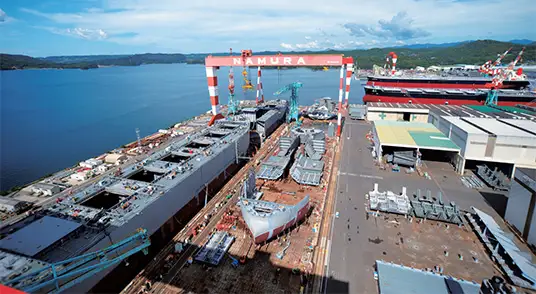
Japan is preparing to resume LNG carrier construction after a seven-year hiatus. The government has already begun talks with major shipbuilders, shipowners and energy companies.
Japan is looking to revive domestic construction of liquefied natural gas (LNG) carriers after a seven-year hiatus. Tokyo aims to establish capacity to build up to five such vessels annually by 2035, but the industry will first have to restore lost expertise and production infrastructure.
The government is focusing on returning to a segment that was once one of the key pillars of Japan’s shipbuilding industry. Tokyo has brought together major shipyards, shipowners and energy companies to assess the feasibility of restarting LNG carrier construction domestically.
According to Splash 24/7, Japan’s Ministry of Land, Infrastructure, Transport and Tourism held a meeting with industry representatives. Discussions focused on potential order volumes, construction schedules, investment requirements for shipyards and the government support needed to restart production.
The talks involved Imabari Shipbuilding, Kawasaki Heavy Industries and Namura Shipbuilding, as well as the Japan Shipbuilders’ Association, the Japan Shipowners’ Association and JERA, the country’s largest LNG buyer.
Tokyo’s ambitions are specific: from 2035, Japan wants to have the capacity to build between three and five LNG carriers annually. Several decades ago, the country was one of the global leaders in this segment. However, Japanese shipyards have not built a single LNG carrier domestically since 2019, losing ground to South Korea and, increasingly, China.
The main challenge is not simply a lack of orders. During the prolonged hiatus, Japan lost part of its practical expertise and some of the infrastructure required for LNG carrier construction. In particular, the country needs to restore its capabilities in manufacturing membrane containment systems, which are now widely used on LNG carriers.
Three Japanese shipyards are already considering cooperation to rebuild these capabilities. Collaboration with South Korea, including the use of its technologies and components, is also being considered.
Potential customers are prepared to support the return of Japanese shipyards to the market, but with one key condition: Japanese-built vessels must remain internationally competitive in terms of cost. Domestic shipowners, meanwhile, have indicated that they could give preference to Japanese-built vessels if they are competitively priced.
Japanese shipping and energy companies currently control around 200 LNG carriers, providing a potential base for future orders.
The government must now determine how many vessels the market will require, what investments shipyards will need and what level of state support would be necessary to make LNG carrier construction in Japan economically viable again.
Read more: China strengthens its gas fleet with 99,000-cubic-meter carrier