

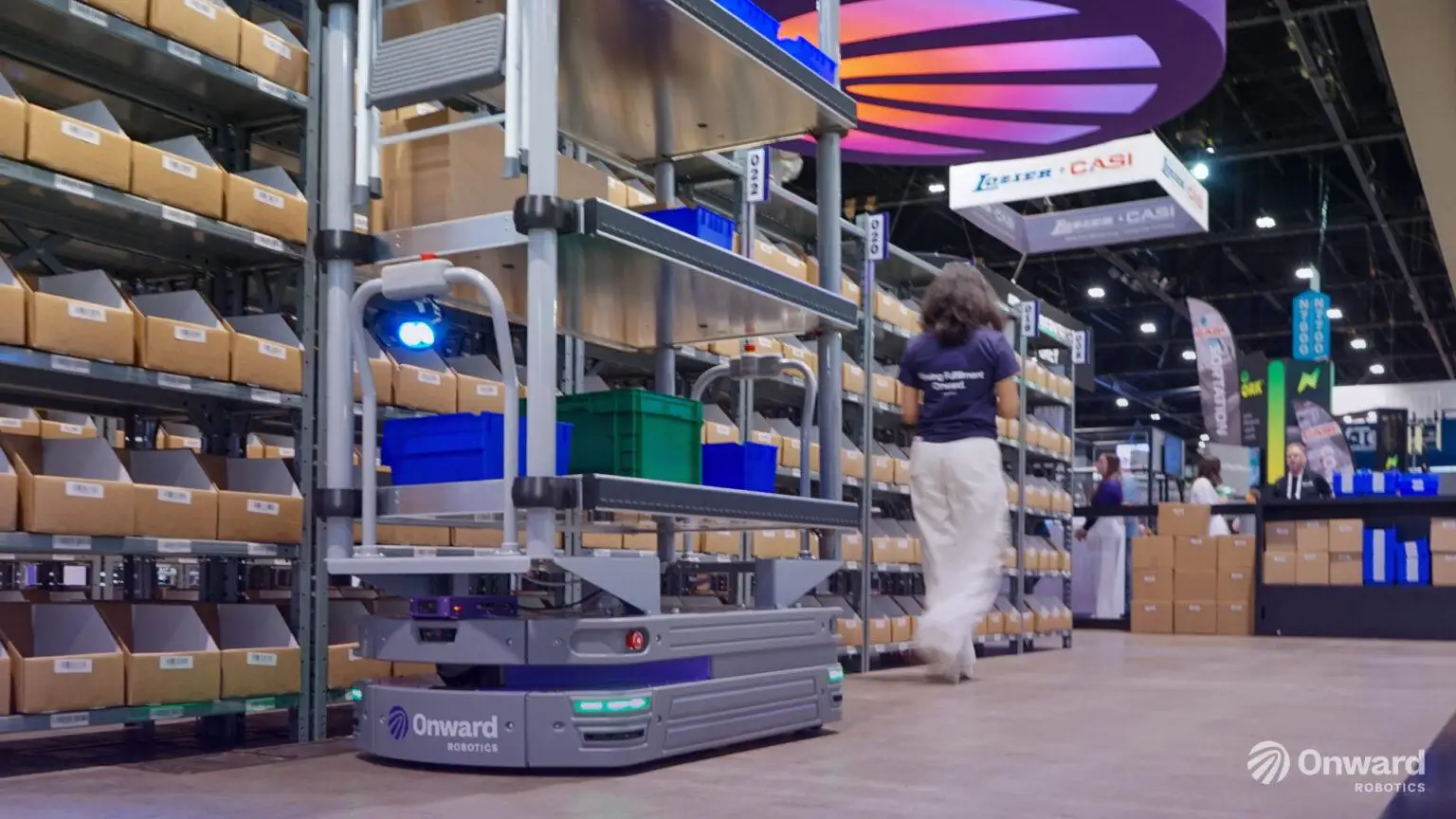
Mobile robots could capture 45% of the market and become a central tool for moving raw materials, packaging and finished products across industrial facilities
Market could nearly double
The U.S. robotics market serving packaging and processing operations, valued at more than $440 million in 2025, is projected to approach $800 million by 2031. This would represent a compound annual growth rate of approximately 10.3%.
The forecast comes from the Robotics in Packaging & Processing 2026 report prepared by PMMI Business Intelligence in partnership with market research company Interact Analysis.
The assessment covers robotic solutions used for material movement, production and packaging line support, product handling, palletizing and other internal operations.
Growth is expected to come not only from more companies adopting automation but also from businesses assigning a broader range of tasks to robotic systems.
Mobile robots could capture 45%
Traditional industrial robots remained the largest segment in 2025, accounting for 63% of U.S. robotics revenue in packaging and processing. Mobile robots represented 32%, while collaborative robots, commonly known as cobots, held a share of approximately 5%.
The structure of the market is expected to change substantially by 2031. Mobile robots are forecast to increase their share to 45%, overtaking conventional industrial systems as the largest category.
This segment includes automated guided vehicles and autonomous mobile robots. The machines can transport raw materials, packaging, components and finished products between warehouses, production areas and shipping zones.
Unlike equipment that follows fixed routes, many AMRs can calculate their own paths and navigate around temporary obstacles. This flexibility makes them suitable for facilities where layouts, production volumes and operating sequences change regularly.
Robots move from warehouses to factory floors
Mobile robots have traditionally been associated with warehouses and distribution centers. The technology is now moving directly onto production and packaging floors.
Robots can supply materials to machinery, remove finished products, transport pallets and containers, and keep lines operating without requiring forklifts for every movement.
The report identified a substantial gap between available technology and current adoption. Raw-material transport solutions are offered by 56% of surveyed equipment manufacturers, yet only about 9% of end users currently deploy robots for this purpose.
This difference indicates considerable room for growth, although it also shows that factory-floor mobile robotics remains at a relatively early stage of adoption.
Robotics adoption could reach 95%
Approximately 72% of surveyed end users currently employ robotics in some capacity. The report expects that figure to reach 95% by 2031.
Another 61% of respondents plan to increase investment in robotic systems during the 12 months following the survey. The leading objectives are higher throughput and productivity, lower operating costs, improved product quality and more consistent processes.
Automation is particularly attractive to facilities facing labor shortages, employee turnover or the need to maintain multi-shift operations. Robots can also reduce repetitive physical work and limit the risk of product damage.
However, these figures represent a market forecast based on survey responses. They do not guarantee that 95% of every packaging and processing business in the United States will have deployed robotics by 2031.
Mobile manipulators emerge as a new category
One of the most promising areas involves combining an autonomous mobile platform with a collaborative robotic arm. These systems can move independently through a facility and carry out tasks at multiple workstations.
A robot could deliver packaging materials to a production line, load them into machinery, collect completed boxes and take them to a palletizing area. This would reduce the need to permanently assign equipment to a single location.
Humanoid robots are also expected to develop, although they remain largely at the pilot stage and currently represent only around 0.1% of the market. Their share could reach 5% by 2031, but wider commercial adoption will depend on reliability, safety and cost.
Cost remains a significant barrier
High initial investment and integration complexity remain the biggest obstacles to robotics adoption. New equipment must be connected to existing packaging lines, warehouse systems and business software.
The total project cost includes much more than the robot itself. Companies must account for process design, installation, maintenance, employee training and infrastructure upgrades.
Reliability, uptime and service availability are therefore becoming central purchasing criteria. A robot failure at a critical point can interrupt an entire packaging line or delay product shipments.
As a result, businesses are increasingly evaluating automation not only as a substitute for manual labor but also as an investment in production and supply-chain resilience.
Implications for warehouse logistics
The expansion of mobile robotics is gradually removing the operational boundary between factories and warehouses. Material flows can be managed as a single system covering inbound raw materials, packaging, palletizing and finished-goods dispatch.
For logistics operators, this will increase demand for integration between robots, warehouse management systems, enterprise resource planning software and order-control platforms. Companies will also require more accurate information about inventory and the location of goods inside facilities.
K2Cargo.News previously reported that Amazon is assigning some warehouse-management decisions to artificial intelligence. Mobile robotics extends this trend by enabling software platforms not only to analyze operations but also to direct the physical movement of goods.
If the PMMI forecast proves accurate, mobile robots will become the largest segment of the U.S. packaging and processing robotics market by 2031. The pace of adoption, however, will depend on project returns, the availability of qualified integrators and the ability of the equipment to operate reliably in real industrial environments.
Read also: Amazon Hands Warehouse Decisions to AI