

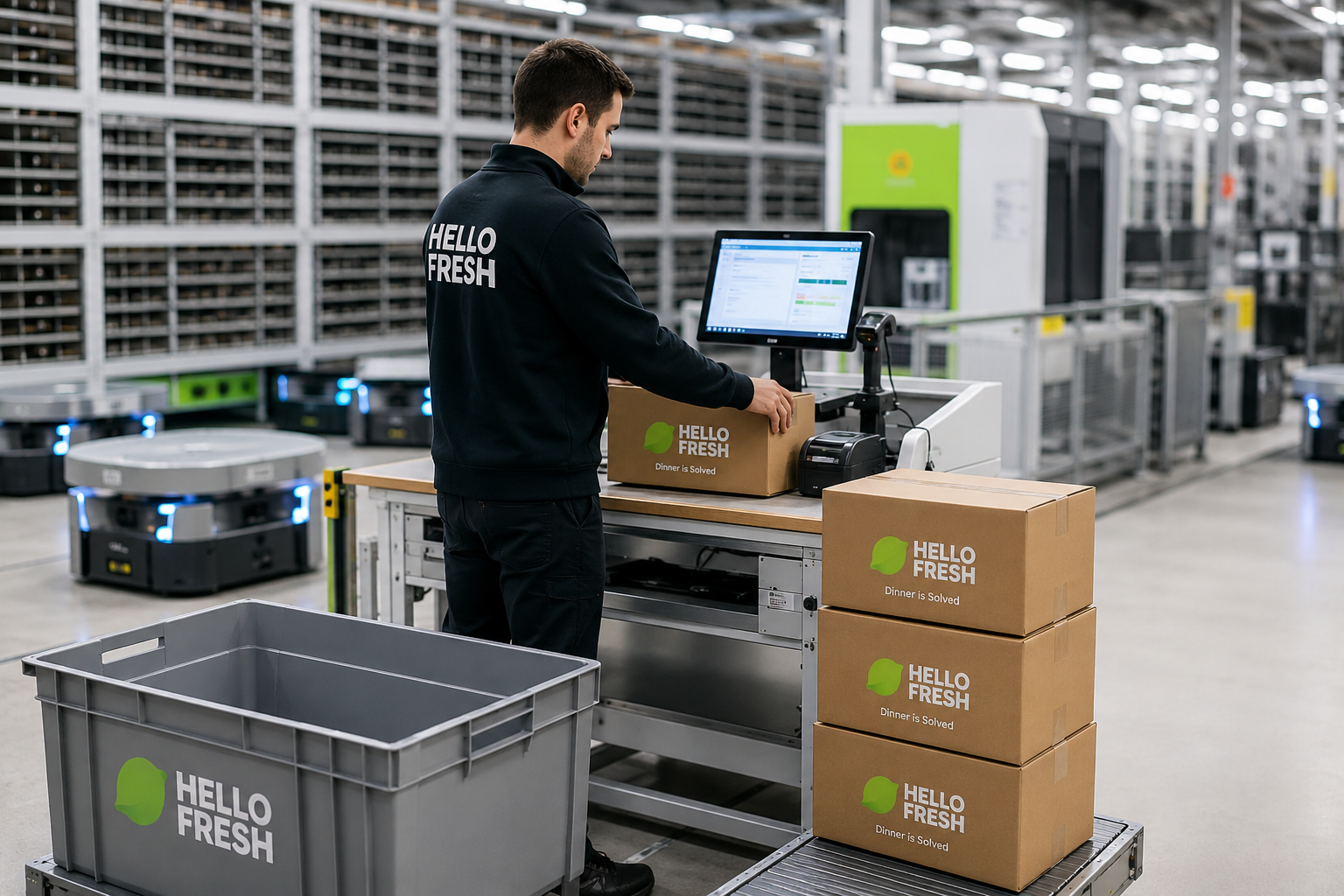
AMRs Take Over Internal Chilled-Warehouse Movements
HelloFresh has expanded the range of products handled in its temperature-controlled fulfillment operation from 100 to 500 stock-keeping units after introducing autonomous mobile robots developed by Locus Robotics.
The technology is used inside a refrigerated warehouse rather than for road transportation. Locus Origin robots move orders between induction, picking and drop-off areas, reducing the amount of repetitive walking and manual product movement required from employees.
The project supports chilled fulfillment for Factor, a ready-to-eat meal brand owned by HelloFresh. The wider product range gives the company more flexibility to offer different meals and serve several brands through the same logistics infrastructure.
The Robot Fleet Grew From 13 to 39 Units
Factor introduced 13 Locus Origin robots during an initial pilot in July 2025. After the system demonstrated stable performance, HelloFresh added another 26 units within three months, bringing the fleet to 39 robots.
The average mission from order induction to box drop-off takes three minutes and 36 seconds. The robots serve approximately 12,000 square feet of chilled warehouse space, including two high-speed meal-kit picking lines.
Unlike fixed conveyor systems, AMRs can navigate independently and adjust their routes around workers and other equipment. Additional robots can also be introduced without reconstructing the entire warehouse, making the system easier to scale when order volumes or product ranges change.
The project reflects the broader automation trend previously examined by K2Cargo News in its article on how AI is transforming Europe’s logistics industry.
Cold Storage Required Special Hardware
Standard battery-powered robots can lose efficiency in refrigerated environments. Low temperatures affect batteries, motors and charging equipment, while condensation and continuous operation create additional reliability requirements.
HelloFresh needed the robots to remain inside the chilled zone while working and charging. Locus Robotics therefore developed heated motor components and modified the charging system to support continuous operation in cold conditions.
The project shows that warehouse automation cannot always be transferred directly from a conventional fulfillment centre into a cold-storage facility. Hardware, charging infrastructure and maintenance procedures must be adapted to the operating temperature.
Flexible Automation Supports a Wider Product Range
Expanding from 100 to 500 chilled SKUs makes warehouse operations more complex. Employees must identify more products, assemble a wider range of orders and maintain accuracy while limiting the time temperature-sensitive goods spend outside controlled conditions.
AMRs do not replace every warehouse task. Workers continue to handle picking and order preparation, while the robots perform time-consuming transport movements between operational zones.
This division of work can increase throughput without requiring a proportional increase in warehouse space or manual labour. It also allows operators to add robots gradually instead of committing immediately to a large fixed automation system.
For food logistics, the HelloFresh project demonstrates how flexible robotics can support greater product variety while preserving speed, traceability and cold-chain control. Similar technologies are likely to become increasingly important as grocery delivery and temperature-controlled e-commerce continue to grow.
Read also: Last-Mile Delivery Market to Reach $333 Billion by 2034