

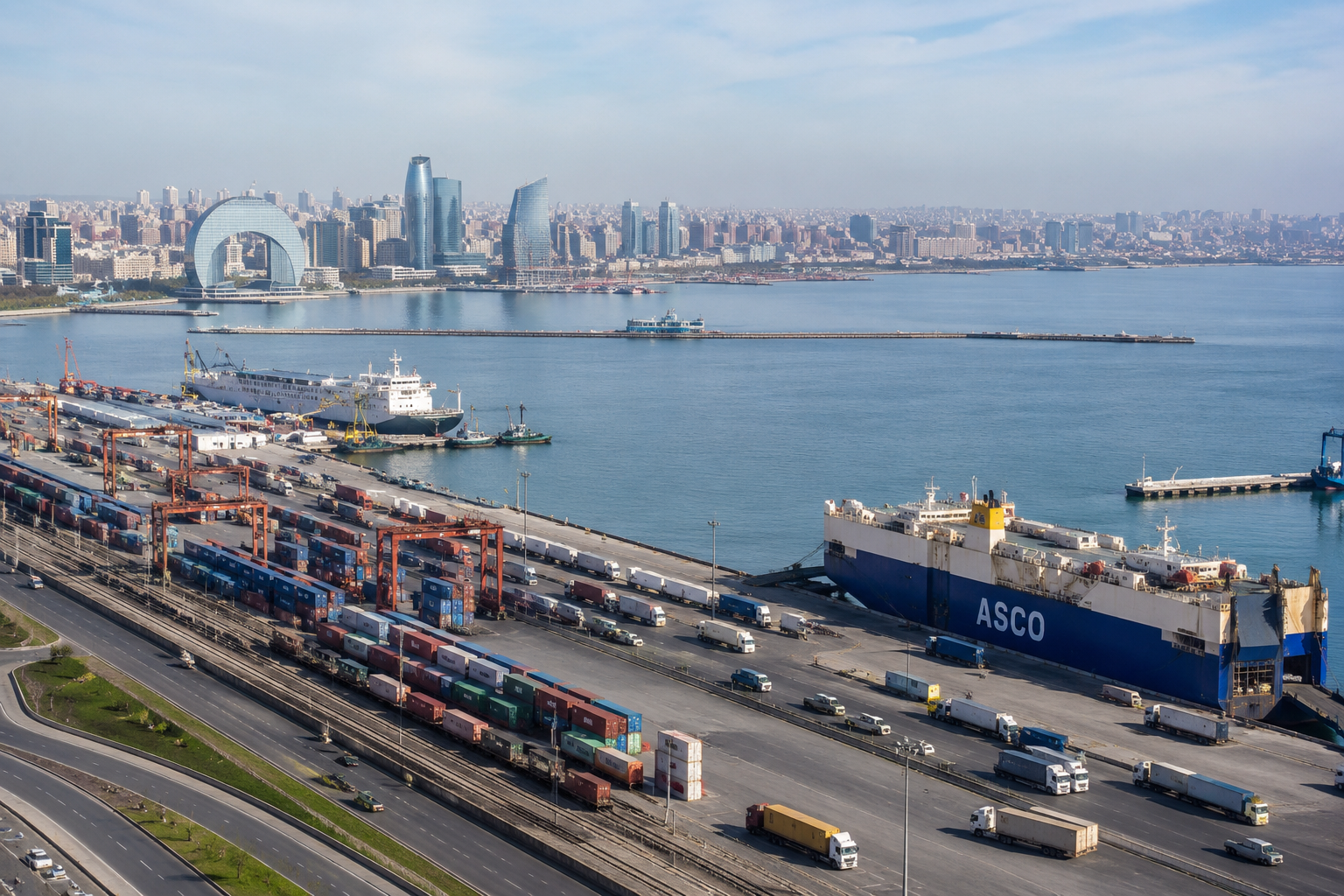
Azerbaijan is preparing for a major expansion of its transit capacity as the country seeks to turn its geographic position into a stronger economic advantage. President Ilham Aliyev announced the plan during the opening ceremony of the 2026 Annual Meetings of the Islamic Development Bank Group in Baku, where transport connectivity was presented as one of the country’s key strategic priorities.
According to Aliyev, Azerbaijan currently handles around 14–15 million tonnes of cargo moving through its territory each year. The government now aims to double that figure to approximately 30 million tonnes annually in the coming years.
The statement comes at a time when international supply chains are increasingly focused on alternative routes across Eurasia. Azerbaijan sits at the intersection of the East–West and North–South corridors, giving the country a central position in freight flows between Central Asia, the South Caucasus, Türkiye, Europe, Russia, Iran and the Gulf region.
K2Cargo News recently reported that Azerbaijan’s trade with NATO countries has exceeded $2 billion, confirming that logistics and transport connectivity are becoming increasingly important for the country’s broader economic integration.
Azerbaijan Sets a 30 Million Tonne Target
The plan to double transit volumes is not simply a transport-sector objective. It is part of a broader strategy to position Azerbaijan as one of the main logistics hubs of Eurasia.
Aliyev emphasized that geography alone is not enough. Although Azerbaijan has no direct access to the world’s oceans, it has invested heavily in infrastructure with international significance, including railways, roads, ports, logistics centers and aviation facilities.
This approach has already changed the country’s role in regional trade. Instead of being viewed only as an energy exporter, Azerbaijan is increasingly positioning itself as a country through which goods, capital and strategic infrastructure corridors move.
Reaching 30 million tonnes of annual transit will require more than expanding physical capacity. It will depend on coordination with neighboring countries, predictable border procedures, digitalization of freight documentation and the ability to offer reliable transit times for international shippers.
East–West and North–South Corridors Are Converging
Azerbaijan’s main advantage is that several major routes meet on its territory.
The East–West corridor connects China and Central Asia with the South Caucasus, Türkiye and Europe. The North–South corridor links Russia, Azerbaijan and Iran with ports and markets in the Persian Gulf, India and the wider Middle East.
This gives Azerbaijan a rare opportunity to serve not only one direction of trade, but several. Cargo can move from Central Asia toward Europe, from Russia toward Iran, from Türkiye toward the Caspian region, and from the Gulf toward northern markets.
For logistics companies, this creates flexibility. In a world where supply chains are increasingly affected by geopolitical risks, port congestion, sanctions, conflicts and climate-related disruption, route diversification has become a commercial priority.
As K2Cargo News noted in its analysis of Kazakhstan and Georgia as key hubs of Eurasia’s new logistics network, the success of new corridors depends on how effectively countries along the route connect their ports, railways, roads and customs systems into a single operational chain.
Infrastructure Investment Becomes the Decisive Factor
Azerbaijan has spent recent years building the infrastructure needed to support higher cargo volumes.
The Port of Baku in Alat, the Baku–Tbilisi–Kars railway, upgraded highways, logistics zones and cargo aviation facilities have all strengthened the country’s position in regional freight transport.
But the next stage will be more complex. Moving from 14–15 million tonnes to around 30 million tonnes requires not only larger terminals and rail capacity, but also faster procedures and better synchronization between different transport modes.
For cargo owners, time reliability is often as important as price. A route that is shorter on paper may lose competitiveness if border delays, documentation problems or terminal congestion make delivery times unpredictable.
This is why Azerbaijan’s ambition will depend heavily on operational efficiency. The country must not only attract more freight but also ensure that cargo can move through its territory smoothly and consistently.
Islamic Development Bank Meetings Add Financial Momentum
The announcement was made during the Islamic Development Bank Group’s annual meetings in Baku, which brought together officials and representatives from member countries.
The event strengthened Azerbaijan’s image as a platform for regional cooperation and infrastructure financing. The IsDB has supported projects in Azerbaijan across transport, energy, agriculture and social infrastructure, while new financing agreements signed during the meetings underline the importance of development funding for long-term growth.
The broader IsDB agenda also fits Azerbaijan’s transport strategy. The bank approved a major financing package for projects in transport, energy, food security and climate resilience across member countries, showing that connectivity remains a core priority for development institutions.
For Azerbaijan, cooperation with international financial organizations is important because large transport systems require long investment cycles. Railways, ports, roads and logistics hubs cannot be built or modernized quickly without stable financing and institutional support.
Transport Supports Economic Diversification
Aliyev also linked transport development to Azerbaijan’s wider economic transformation.
Over the past two decades, the country has attracted hundreds of billions of dollars in investment and has worked to reduce dependence on oil and gas. The non-oil and gas sector now accounts for more than 70% of GDP, although energy resources still dominate exports.
This creates a clear policy challenge. To diversify exports and increase the role of the non-energy economy, Azerbaijan needs better access to foreign markets, stronger logistics services and more value-added industries.
Transport infrastructure can support this process. Efficient corridors can help develop warehousing, distribution, freight forwarding, industrial zones, e-commerce logistics and export-oriented production.
In this sense, doubling cargo transit is not only about moving more goods across the country. It is also about creating a broader logistics ecosystem around those flows.
What This Means for the Logistics Market
Azerbaijan’s plan to double transit cargo volumes could strengthen competition among Eurasian transport corridors.
If successful, the country would become a more important link between the Middle Corridor, the North–South route and regional trade networks connecting Europe, Central Asia and the Middle East.
However, the target is ambitious. Aliyev himself noted that not everything depends only on Azerbaijan. Geopolitical conditions, relations with neighboring countries, regional stability and infrastructure development outside Azerbaijani territory will all influence whether the plan can be achieved.
For logistics companies, the main question will be whether Azerbaijan can offer predictable, scalable and cost-efficient transit. If the answer is yes, the country’s role in Eurasian supply chains will continue to grow.
The next few years will therefore be decisive. Azerbaijan already has the geography and much of the infrastructure. The challenge now is to turn those advantages into stable cargo flows capable of supporting a 30 million tonne transit target.
Read also: Azerbaijan–NATO Trade Exceeds $2 Billion as Economic Ties and Regional Integration Strengthen