

U.S. Intervened After a Series of CPC Attacks
The United States has secured a Ukrainian commitment to halt attacks on Caspian Pipeline Consortium infrastructure and certain tankers serving its Black Sea terminal near Novorossiysk.
Bloomberg first reported the U.S.-brokered understanding on August 8, citing a senior American official. The Financial Times provided additional details on August 12, reporting that U.S. Vice President JD Vance personally asked Ukrainian President Volodymyr Zelenskyy to stop the strikes during a July 31 phone call.
According to Ukrainian officials and the FT’s analysis of open-source information, no tankers near the CPC terminal have been struck since that conversation.
Reuters carried the report but said it had not independently verified the arrangement. The White House, State Department and Vance’s office had not immediately responded to Reuters requests for comment.
The development should therefore be treated as a U.S.-brokered understanding reported by several major outlets rather than a formally published international agreement.
Kyiv Agreed to Spare CPC Under Three Conditions
The arrangement does not protect every ship using Russian ports.
According to reporting based on the U.S. official, Ukraine agreed not to strike CPC infrastructure or non-Russian vessels heading to the terminal provided that the ships:
- are not subject to Ukrainian sanctions;
- are not carrying Russian oil or other Russian cargo;
- are not owned by Russian individuals or legal entities.
Ukraine is also reportedly providing commercial shipping companies with guidance clarifying which vessels qualify for protection, with dedicated contact channels intended to facilitate information exchange and safe passage.
The arrangement therefore does not amount to a broader ceasefire against Russian energy infrastructure. Kyiv can continue targeting Russian-owned, sanctioned or Russian-cargo vessels and other Russian energy facilities.
Chevron Raised the Issue With the U.S. Administration
Washington’s intervention followed growing concern from major U.S. energy companies.
Chevron CEO Mike Wirth discussed with senior Trump administration officials how to prevent the company’s massive Kazakh operations from becoming collateral damage in the Russia-Ukraine war. The talks followed attacks near Novorossiysk, including damage to a tanker chartered by Chevron.
Chevron holds a 15% stake in CPC and a 50% interest in Tengizchevroil, which develops Kazakhstan’s giant Tengiz oil field, one of the main sources of crude flowing through the pipeline.
On July 31, Wirth said the pipeline was flowing again and tankers were being loaded. He also confirmed that Chevron was working with the U.S., Kazakh and other governments to keep the system operating.
The issue had therefore become more than a foreign-policy concern for Washington. It directly affected major U.S. corporate assets and an important source of global oil supply.
CPC Handles About 80% of Kazakhstan’s Crude Exports
The Caspian Pipeline Consortium cannot be viewed simply as Russian oil infrastructure.
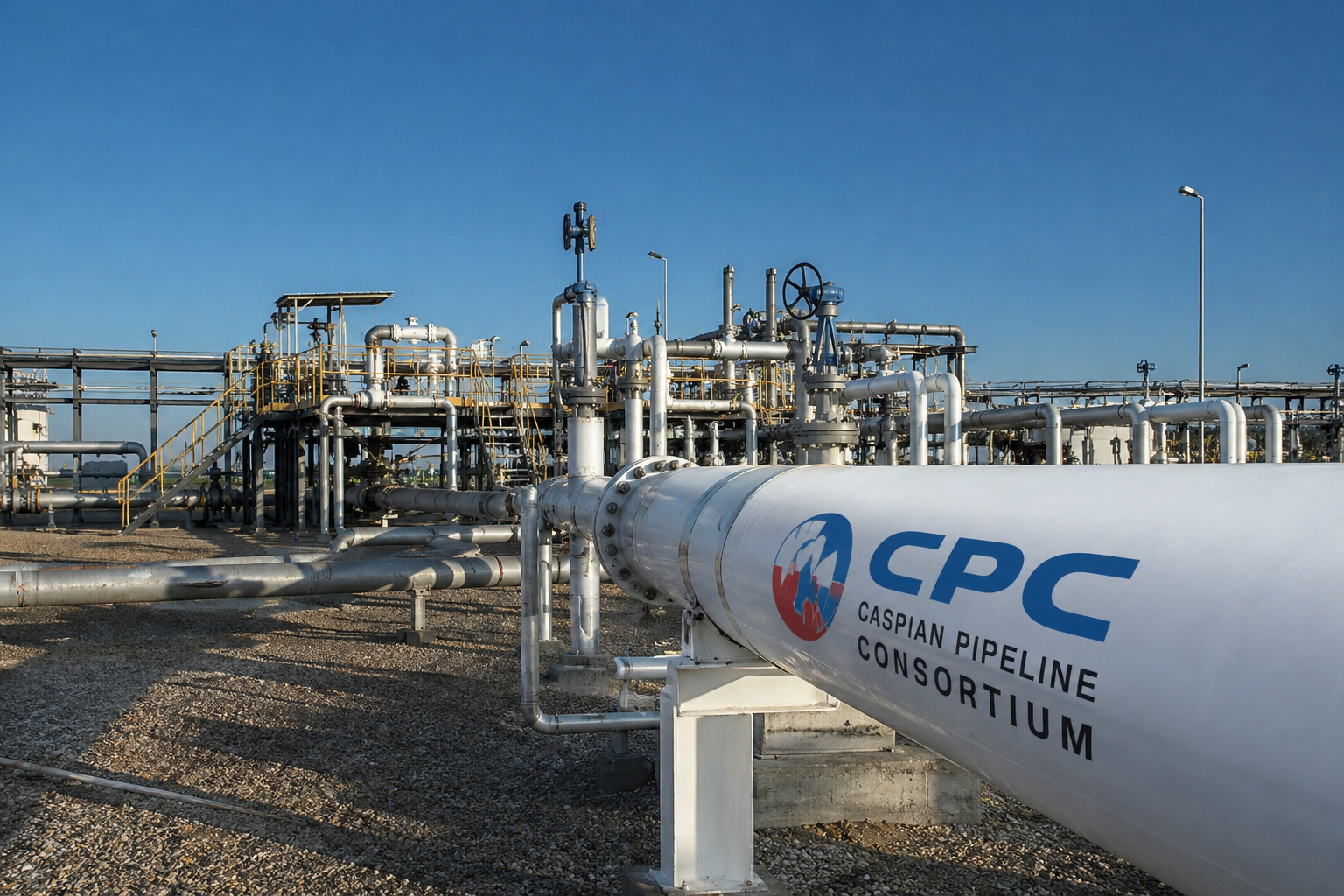
Its roughly 1,511-kilometre pipeline connects Kazakhstan’s largest oil fields with a marine terminal near Novorossiysk. About 80% of Kazakhstan’s crude exports move through the system.
Reuters estimates that the route carries around 1.8% of global oil supply.
The system transports crude from Tengiz, Kashagan and Karachaganak, projects involving Chevron, ExxonMobil, Eni, Shell, KazMunayGas and other international producers.
Attacks around the terminal therefore disrupt Kazakhstan’s exports as well as the operations of major U.S. and European oil companies.
July Attacks Cut CPC Loadings by as Much as 20%
The impact of July’s escalation was substantial.
Four sources cited by Reuters said Black Sea drone attacks removed as much as 20% of CPC loading capacity during July. Kazakhstan’s oil production fell about 14% from June as export disruptions intensified.
The effect reflects the physical structure of oil logistics.
If tankers stop lifting crude from the marine terminal, oil continues arriving through the pipeline from Kazakhstan. Storage capacity gradually fills, forcing pipeline throughput lower and eventually requiring production cuts at upstream fields.
That mechanism became visible during July, when Kazakhstan’s crude and condensate output on some days fell to around 1 million barrels per day compared with an average of roughly 2.16 million barrels per day in June.
Tanker Attacks Repeatedly Shut Loading Operations
The most serious disruption began in the second half of July.
On July 19, CPC reported attacks on the tankers ASIA and NISSOS IOS during loading. A fire broke out and operations were temporarily suspended.
The following day, tanker NELSA was hit while loading at a single-point mooring. A fire broke out and most of the crew was evacuated, forcing another shutdown.
Further incidents followed on July 30. NISSOS SIFNOS was damaged while loading Tengizchevroil crude, while MARATHI was attacked while approaching the terminal. Loading was again suspended.
There is an important distinction in attribution. Ukraine initially did not publicly claim responsibility for several specific CPC tanker incidents. Subsequent Bloomberg and FT reporting, however, describes a Ukrainian strike campaign and an agreement with Washington to halt attacks against CPC and qualifying vessels.
Shipowners Began Avoiding Novorossiysk
Physical damage to vessels was only part of the problem.
Some tanker owners became reluctant to accept CPC voyages. Reuters reported that traders sometimes needed several attempts to secure a vessel willing to load crude, while Russian transport group FESCO suspended new operations in the region.
LSEG shipping data reviewed by Reuters on July 30 showed at least five tankers that had previously signalled CPC as their destination changing course toward Türkiye, Spain or switching to a waiting-for-orders status.
For Kazakhstan, this was critical. A technically functioning terminal cannot export crude if shipowners are unwilling to send expensive Suezmax tankers into the area.
Tanker Rates Reached About $400,000 a Day
The security risk rapidly translated into freight costs.
Seatrade Maritime reported that tanker rates on the route from CPC to Augusta in the Mediterranean had more than doubled since mid-June.
The Baltic Exchange TD6 benchmark rose from around WS230 to roughly WS530, equivalent to earnings of about $400,000 per day.
Reuters had already estimated average Black Sea crude-tanker costs at more than $300,000 a day on August 5, compared with just over $200,000 a week earlier.
War-risk insurance also surged. Cover for Black Sea port calls rose from around 1% to as much as 2% of a vessel’s value, potentially adding hundreds of thousands or even millions of dollars to a single voyage.
The U.S. Agreement Will Not Immediately Normalize Freight Costs
The political agreement therefore solves only part of the problem.
A halt in attacks reduces the immediate military risk, but shipowners and insurers will want evidence that the new rules hold over time.
There are several reasons for continued caution.
The arrangement contains exceptions: Russian-owned, sanctioned and Russian-cargo vessels remain potential targets. In the busy Novorossiysk area, owners will still assess the risk of misidentification or collateral damage.
Attacks on other Russian energy and port facilities are also continuing, meaning the wider Black Sea security environment remains dangerous.
Insurance prices typically respond to a sustained reduction in risk rather than a single diplomatic understanding.
The return to pre-crisis freight and insurance conditions could therefore take weeks or longer even if the CPC terminal itself is no longer attacked.
CPC Has Become More Important Because of Middle East Disruption
The timing of Washington’s intervention is also significant.
Black Sea disruption has coincided with severe constraints on oil flows through the Strait of Hormuz and increased risks in the Red Sea. With the global market already losing part of its normal Middle Eastern supply, instability affecting a route responsible for around 1.8% of world oil supply became much harder to tolerate.
Kazakh crude is particularly important in this context because it is a major non-Russian source of oil that happens to depend geographically on a Russian Black Sea export terminal.
Washington therefore faced an unusual balance.
The U.S. supports Ukraine and pressure on Russia’s energy sector, but it also has a strong interest in preventing that campaign from disrupting Kazakh exports or damaging Chevron, ExxonMobil and other Western companies.
The new understanding effectively draws a line between Russian oil flows and internationally owned Kazakh exports through CPC.
The Arrangement Separates Vessels by Ownership and Cargo
In practical terms, the mechanism creates a new risk classification for ships operating around the same Russian port complex.
A tanker heading to CPC for Kazakh crude, with no Russian ownership and no Ukrainian sanctions designation, should fall outside the target set.
A vessel carrying Russian cargo, owned by Russian interests or already sanctioned by Ukraine does not receive the same protection.
Shipping companies must therefore verify more than the vessel’s flag. Beneficial ownership, charter arrangements, cargo origin and sanctions status all become relevant.
That is why direct information channels between Ukraine and commercial shipping operators are an important component of the reported arrangement.
Kazakhstan Will Continue Searching for Alternative Routes
Even if the CPC agreement holds, July’s crisis has exposed the scale of Kazakhstan’s dependence on one export corridor.
Tengizchevroil planned to send around 100,000 tonnes of crude by rail to Georgia’s Batumi port in August, while Kazakhstan continues developing routes across the Caspian Sea, Azerbaijan and the Baku-Tbilisi-Ceyhan system.
None of those alternatives can replace CPC in the short term.
With around four-fifths of Kazakhstan’s crude exports moving through Novorossiysk, even a brief shutdown quickly affects oil production, CPC Blend pricing and export revenues.
The July disruption therefore gives Kazakhstan another reason to accelerate diversification even if U.S. intervention now stabilizes its main outlet.
The Main Test Is Whether Tankers Return
Washington appears to have achieved its immediate political objective: Ukraine has agreed to remove CPC infrastructure and a defined category of international tankers from its target set.
For the oil market, however, that is only the first step.
Before the crisis, CPC was a predictable shipping route. After repeated attacks, tanker owners must now consider vessel value, crew safety, war-risk insurance, possible delays and the chance of renewed suspensions.
Within weeks, those risks pushed freight costs to around $400,000 per day and drove some owners away from the trade.
If the absence of attacks since July 31 continues, insurance premiums and tanker rates could gradually retreat and vessel availability may improve.
But confidence in maritime logistics usually returns more slowly than the attacks themselves disappear.
The real test of the U.S.-Ukraine understanding will therefore be not only whether strikes remain suspended, but whether CPC can restore a stable loading schedule without tanker shortages and extraordinary war-risk premiums.
Read also: CPC Operations Disrupted as Drone Threats Hit Kazakhstan’s Oil Exports