

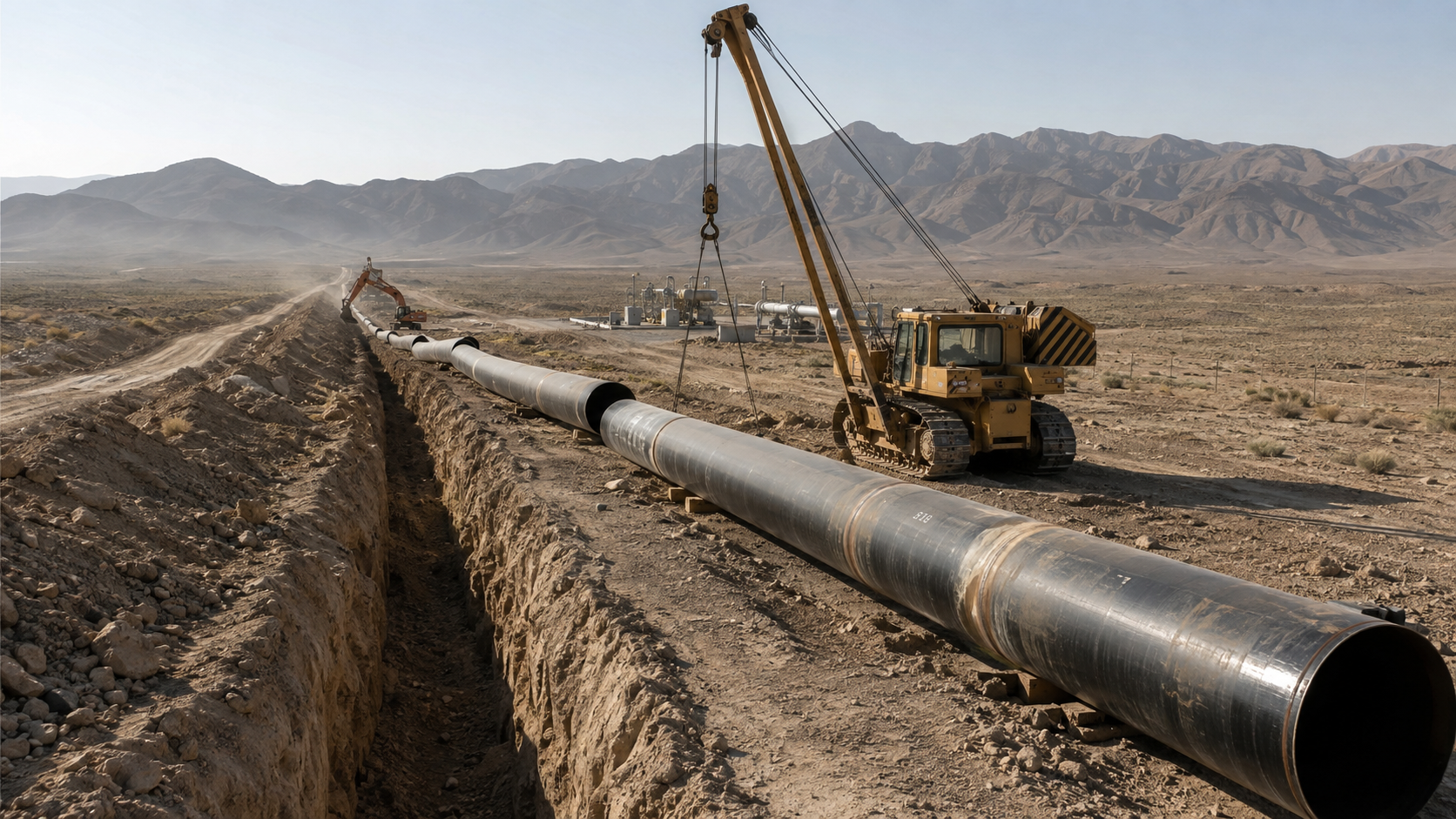
Pipeline Designed to Carry 33 Billion Cubic Metres Annually
The TAPI project involves constructing a natural gas pipeline from Turkmenistan’s Galkynysh field through Afghanistan and Pakistan to the Indian border. It is designed to carry up to 33 billion cubic metres of gas annually over an expected operating period of 30 years.
The complete route is planned to extend for 1,814 kilometres. This includes 214 kilometres in Turkmenistan, 774 kilometres across Afghanistan and 826 kilometres through Pakistan to Fazilka on the Indian border.
Afghanistan is expected to purchase part of the transported gas for its domestic market. The largest volumes are intended for Pakistan and India, where demand for additional energy supplies remains substantial.
Turkmenistan Seeks Export Diversification
For Ashgabat, TAPI remains one of its highest-priority energy projects. The pipeline is intended to create a southern export corridor and provide Turkmenistan with direct access to major South Asian markets.
The route could complement existing Turkmen gas exports and reduce the country’s dependence on a limited number of buyers. However, meaningful diversification will occur only after the entire pipeline is completed and commercial deliveries begin.
The project is being developed through TAPI Pipeline Company Limited. Turkmenistan’s state-owned Turkmengaz holds the controlling stake, while entities representing Afghanistan, Pakistan and India are also shareholders.
Afghan Revenue Estimates Differ
In October 2025, Gurbanguly Berdimuhamedov, Chairman of Turkmenistan’s Halk Maslahaty, said Afghanistan could receive an average of more than $1 billion annually after the project is fully implemented. The Turkmen statement linked this figure not only to transit but also to Afghan participation and the pipeline’s broader economic effect.
The claim that Afghanistan will receive $1 billion exclusively in direct transit payments is not supported by publicly available commercial agreements. The Regional Economic Cooperation Conference on Afghanistan has published an earlier estimate of approximately $400 million in annual revenue for the Afghan treasury.
It is therefore more accurate to distinguish between the two figures. The amount exceeding $1 billion is Turkmenistan’s estimate of the project’s overall annual benefit, while actual transit income will depend on tariffs, transported volumes and the final commercial arrangements between the participants.
Construction Focuses on the Route to Herat
Current construction is concentrated on the 153-kilometre Serhetabat–Herat section, known as Arkadagyň ak ýoly. Work on this part of the route inside Afghanistan resumed in September 2024.
Business Turkmenistan reported on August 11, 2026, citing the Watan news program, that pipes covering 120 kilometres of the route had been delivered. Approximately 140 kilometres had been graded, a 123-kilometre inspection road had been built, and welding and installation had been completed along 117 kilometres. Around 300 pieces of specialized equipment were reportedly operating at the site.
An official Turkmen statement published on August 12 confirmed that work on the Serhetabat–Herat section was continuing but did not provide a completion date for the entire pipeline. No independent comprehensive verification of the reported construction figures has been published.
Afghanistan Expects Jobs and New Infrastructure
In addition to future government revenue, TAPI is expected to create employment during pipeline construction, operation and maintenance. Afghanistan would also be able to use part of the gas to improve domestic energy supplies.
Related infrastructure projects along the corridor include electricity transmission and fibre-optic lines. These facilities could improve energy access in western Afghanistan and increase the economic potential of areas located along the pipeline route.
TAPI nevertheless remains one of the most difficult infrastructure projects in Central and South Asia. Its full launch requires hundreds of kilometres of additional construction in Afghanistan and Pakistan, route security, major financing and final agreement on the commercial terms of gas deliveries.
Read also: Trans-Afghan Railway Project Estimated at $7 Billion