

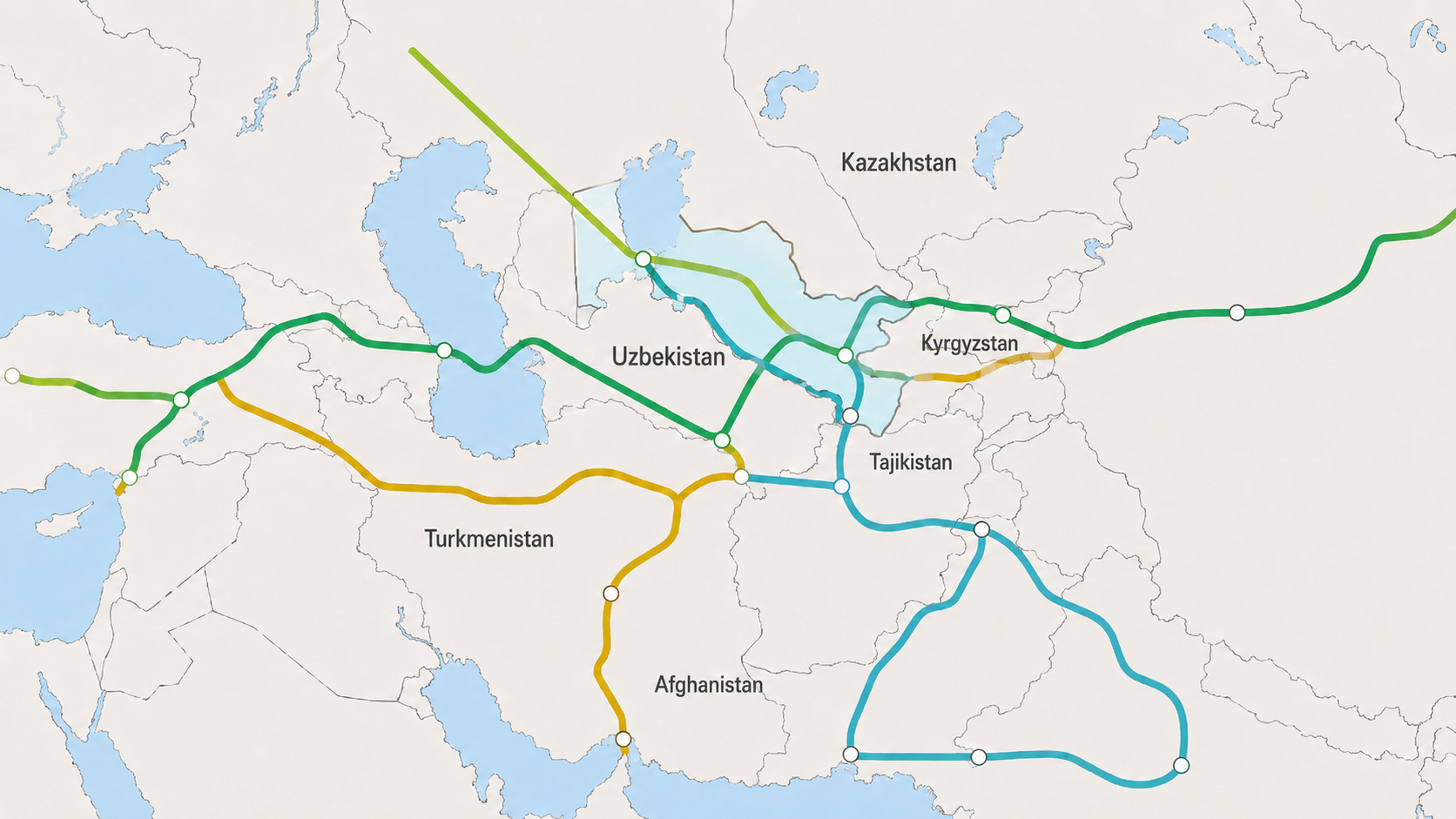
Uzbekistan is rapidly increasing its use of the Middle Corridor as the country looks for more diversified routes to global markets. According to Deputy Prime Minister and Minister of Economy and Finance Jamshid Kuchkarov, the share of the route in Uzbekistan’s total cargo transportation reached 28% in 2025.
This marks a sharp increase compared with 2021, when the corridor accounted for 12% of the country’s cargo transportation. In practical terms, the share has grown by 16 percentage points, or 2.3 times over four years.
The expansion reflects Uzbekistan’s broader strategy to reduce dependence on limited transit directions and develop a more flexible logistics system. For a landlocked country located at the center of Central Asia, access to reliable international corridors is not only a transport issue, but also a key condition for export growth, industrial development and trade diversification.
As K2Cargo News previously noted in Can the Middle Corridor Become Eurasia’s Main Alternative?, the Trans-Caspian route is becoming increasingly important for countries that want additional access to Europe, the South Caucasus, Türkiye and global markets without relying on a single traditional corridor.
Uzbekistan’s Cargo Flows Are Shifting
The latest figures show that Uzbekistan is no longer treating the Middle Corridor as a secondary route.
According to LogiStan, Uzbek cargo flows along the corridor more than doubled between 2020 and 2025, rising from about 500,000 tonnes to more than 1 million tonnes. Although these volumes remain modest compared with the largest Eurasian trade routes, the direction of travel is clear.
The Middle Corridor is becoming a more important part of Uzbekistan’s logistics portfolio.
For exporters and importers, this matters because route diversification can reduce exposure to congestion, geopolitical risk and operational disruption. In recent years, companies across Eurasia have increasingly sought alternatives to traditional northbound and maritime routes, especially for cargo that requires more predictable delivery options.
Uzbekistan’s increased use of the Middle Corridor reflects the same trend. The country is trying to build access to several directions at once: northward, westward, southward and through the Caspian region.
Investment Is Driving the Growth
Jamshid Kuchkarov linked the growth of the Middle Corridor’s share to increased investment in infrastructure.
Three areas are especially important: railway electrification, road development and multimodal logistics.
Railway electrification can reduce operating costs, improve efficiency and support higher freight capacity on key routes. Road infrastructure helps connect industrial zones, border crossings, logistics centers and production regions. Multimodal logistics allows cargo to move more smoothly between rail, road, ports and container terminals.
For Uzbekistan, this combination is essential. The country does not have direct access to the sea, which means every international route depends on coordination with neighboring states and efficient transfers between transport modes.
Better infrastructure inside Uzbekistan can reduce the cost and time required to reach international corridors. But the full benefit appears only when domestic infrastructure is connected with cross-border routes, customs systems and regional logistics platforms.
Container Volumes Remain Small but Important
The container segment remains one of the most important indicators to watch.
At present, around 5,000 containers per year move through Uzbekistan along the Trans-Caspian International Transport Route. In 2026, the figure is expected to rise to 6,500–7,000 containers.
In absolute terms, this is still a limited volume. However, containerized cargo is strategically important because it often includes higher-value goods, industrial products, consumer items, machinery, chemicals, electronics and time-sensitive shipments.
For logistics companies, container growth is also a sign that the corridor is becoming more structured. Bulk cargo can move through many channels, but container flows require regular schedules, predictable handling, standardized documentation and reliable terminal operations.
If Uzbekistan can continue increasing container volumes, it may strengthen its position not only as a source of cargo, but also as a regional consolidation point for freight moving between Central Asia, the Caspian region and Europe.
The Middle Corridor Needs Multimodal Coordination
The Middle Corridor is not a simple route.
Cargo moving from Central Asia toward Europe may involve rail transport, road links, Caspian Sea crossings, ports in Azerbaijan or Georgia, rail connections through the South Caucasus and onward movement toward Türkiye or the Black Sea.
This complexity creates opportunities and risks at the same time.
On the one hand, the route gives Uzbekistan access to multiple markets and reduces dependence on any single transit direction. On the other hand, every additional border, terminal and mode change can create delays if procedures are not synchronized.
This is why investment in multimodal logistics is critical. Without efficient transfer points, digital documentation and coordinated schedules, the corridor can lose competitiveness despite its strategic advantages.
The development of ports along the western part of the route is also important. K2Cargo News recently reported that Georgia is expanding the Port of Poti to strengthen the Middle Corridor, showing how infrastructure upgrades in one country can affect the efficiency of the entire route.
Uzbekistan Is Looking Beyond One Direction
Uzbekistan’s growing use of the Middle Corridor does not mean the country will rely on only one route.
Instead, the trend shows that Tashkent is building a more balanced transport strategy. The Middle Corridor gives access to the Caspian region, the South Caucasus, Türkiye and Europe. Other routes connect Uzbekistan with Afghanistan, Pakistan, Iran, China, Russia and neighboring Central Asian markets.
This multi-directional approach is logical for a landlocked economy. The more corridors Uzbekistan can use, the more resilient its trade system becomes.
The country is also developing projects that could open access to South Asian markets. K2Cargo News previously reported that the Trans-Afghan Railway project is estimated at $7 billion, underlining Uzbekistan’s effort to create new transport links beyond the traditional Eurasian routes.
Together, these projects suggest that Uzbekistan wants to move from geographic limitation to geographic advantage.
What This Means for the Logistics Market
The growth of the Middle Corridor’s share in Uzbekistan’s cargo transportation is an important signal for the regional logistics market.
First, it confirms that demand for alternative Eurasian routes continues to rise. Second, it shows that Central Asian countries are not only discussing new corridors, but are gradually moving cargo through them. Third, it highlights the growing importance of infrastructure investment inside landlocked economies.
For freight forwarders, railway operators, terminal developers and logistics companies, Uzbekistan’s rising Middle Corridor volumes may create new commercial opportunities. These could include container consolidation, customs brokerage, warehousing, cross-border trucking, rail forwarding and multimodal transport services.
However, the corridor’s future will depend on reliability. Increasing volumes from 500,000 tonnes to more than 1 million tonnes is an important achievement, but further growth will require stable schedules, competitive tariffs, digital coordination and sufficient capacity at border crossings and transfer points.
If Uzbekistan reaches its 2026 container target of 6,500–7,000 units, it will show that the route is continuing to mature. The next challenge will be turning growth from a short-term trend into a stable part of the country’s long-term logistics system.
For Uzbekistan, the Middle Corridor is becoming not just an alternative route, but one of the pillars of a more diversified trade strategy.
Read also: Can the Middle Corridor Become Eurasia’s Main Alternative?